Categories
Board Games Comics Reviews

Riddler Puzzle Box Review

Match wits with the Riddler as Edward Nygma presents his personal puzzle box for you to solve.

The Riddler: Puzzle Box by Edward Nygma is made by McFarlane Toys, and as such expectedly looks fantastic. The 5-6 inches a side box has great detailing and largely looks like worn/distressed metal rather than the plastic it’s made of. It’s just plain cool to look at and play around with.

Solving puzzle boxes is often made more enticing by including a prize locked within, and the encased prize here is awesome. Solving each of the three sections is rewarded with a piece of a hefty metal “1:1” batarang replica. They went all out with this aspect of the box.

The website description claims the Riddler Box “features 4 challenging Batman themed puzzles.” To be perfectly blunt, this is not even remotely true. These are some of the easiest puzzles imaginable, made more difficult only by so-so implementation. One puzzle is solvable completely by accident. One I solved without the required tool, leaving me confused as to what that tool was for throughout the experience. One puzzle is a tad misleading on when the player should be trying to solve it, which led me to have the right solution but thinking it was wrong because I had to do something else first.

All that said I had a fun time with the box despite its imperfections. The puzzles are conceptually and thematically good even if easy, and I found it all interesting and engaging despite its flaws.

Which brings us to the puzzling aspect of this puzzle box as a purchase. The detail, inherent nature of making a puzzle box with hidden mechanisms, and high quality prize all add to the cost. But with a msrp of $100, which admittedly is entirely reasonable for what it is in total, people are likely to expect more from the actual puzzle box itself.

Now this has been out a while and at it’s currently available price (under $40) it’s *easily* worth it for Batman and/or puzzle box collectors. But to be completely fair with the review I’m not sure I’d have been as happy with it at full retail price.

Overall this is a great collectible containing an equally great collectible as a bonus prize, with an ok puzzle experience attached. Score one for Edward Nigma.


Thanks to everyone who’s given this a read. 2024 was a sporadic return for this blog and I hope to have more regular updates going forward in 2025. Derailments of Thought currently updates on Wednesday and Saturday.

If you enjoy the blog any support is appreciated, including shares on social media and simply continuing to read. If you happened to be inclined and able to help out monetarily please see my  Ko-fi page. Every little bit helps.

Categories
Board Games Reviews

Guilty: Houston 2015 Review

A senator’s daughter has died mysteriously in prison, and you’re the lucky one in charge of figuring out what happened before giving a press conference to a gaggle of reporters after a long night of investigation.

The Guilty series is a new entry into the ever expanding genre of games that try to capture full fledged mystery investigations in board game form. The short, short version is it’s got the weight of a Detective case in a box closer to the size of the Exit series.

The setting is perfect for this type of game: it’s within a contained area of investigation with believable constraints and reasons for time pressure. The atmosphere is well developed, and the economical descriptions befitting a game confined to cards are on point. The box advertises the game as “immersive,” and I agree wholeheartedly. More than any other mystery game I’ve played that doesn’t use external elements this really felt like conducting an investigation the players are in control of.

The time deck mechanic is really well done. Cards are flipped from a separate deck representing the passage of time as the player chooses which leads to investigate. At different points in the deck game affecting events happen. It presents ongoing pressure and twists without making the game feel too short and is really well implemented.

Guilty thrives via its design and setup. The board that grounds the display and organizes the numerous investigative choices available really helps present the overwhelming options in an accessible manner. The progression of the investigation is completely open. The player is in control, and most uncovered cards/information feel interesting if not always vital.

This game consists of one case, but it’s a DENSE, meaty one. This takes 3-4 hours and as mentioned feels more equivalent to a round of Detective than other stand alone mystery games or even a round of Suspects (which I found weighty and challenging itself, but this is on a different level). That they accomplished this with a system that’s completely contained in the box (ie no internet component like Detective, etc has) is impressive.

There’s an overload of information to sift through throughout, but it’s by no means a negative. The case is compelling and it was extremely engrossing. There are important minute details, so players should be ready to read and observe carefully. However there really wasn’t one key piece of information that derails everything if missed. This has a mix of several visual and textual clues and figuring out how it all comes together is the goal.

Two players is probably the sweet spot for this series. Even for veteran gamers be at peak concentration level when soloing. I overlooked a couple vital points and was a bit off in my solution. That said in was still a blast as a solo experience.

The scoring system is a little odd, but good enough. It’s forgiving in a way I didn’t expect. I didn’t really solve the case (I got twisted around in my own head and picked the wrong killer), but figured out enough of everything else to get best evaluation. I have mixed feelings on that, as on one hand it seems like getting the criminal wrong should be disqualifying but on the other being recognized for solving a majority of the questions and piecing together all the other details is nice. Like I said: a bit odd but still fine.

There were a couple of red herrings I found mildly frustrating, but most of them connect to ancillary things to figure out if you dig enough so it’s not the issue it could be.

Nothing gets destroyed so the game is resettable and can be passed on to other players (the box insert isn’t great for storing the cards once they’ve been unwrapped, but that’s a minor quibble).

Overall this was excellent, and one of the best of this type of game I’ve played. Looking forward to future entries in the series.


Thanks to everyone who’s given this a read. 2024 was a sporadic return for this blog and I hope to have more regular updates going forward in 2025. Derailments of Thought currently updates on Wednesday and Saturday.

If you enjoy the blog any support is appreciated, including shares on social media and simply continuing to read. If you happened to be inclined and able to help out monetarily please see my  Ko-fi page. Every little bit helps.

Categories
Board Games Reviews

Suspects:Claire Harper, Eternal Investigator Board Game Review

Second verse, reasonably similar to the first.

Suspects is a card based mystery game that involves visiting locations, speaking to suspects, and examining items to try to unravel the secrets behind a crime. Claire Harper, Eternal Investigator is the second collection in this series and includes three separate cases.

I enjoyed the first Suspects game, Claire Harper Takes the Stage, despite not doing particularly great solving its cases. They required catching little details, and were generally harder than other games of this type I’ve played. But it was still a well crafted game and quite fun and I was looking forward to the sequels.

Eternal Investigator provides a deeper look at the protagonist introduced in the previous collection. She’s the thread tying the cases together and this group features different times in her life.

The game plays extremely similar to the first with a deck of cards driving the gameplay with information to uncover as the cases proceed. Each case has a couple extra things to go with the deck that help frame the investigation and present initial leads to follow. Things that can be investigated are numbered and drawing the corresponding cards is how the game proceeds. It’s extremely open in letting the players decide what order to poke at things at, although at times certain mechanics hold parts of the investigation back a bit until certain progress has been made.

With the mechanics out of the way the main question is how good the cases are. In the end it’s rather hard to compare this to the first set. I again played solo, did a little better, and for the most part enjoyed these. But while one of my favorite cases in the series was here, my absolute least favorite case in any of the Suspects series was here too (including the third collection, review to come). I won’t get into spoilers but I felt it just didn’t come together and unlike all the other cases relied a bit on educated guesses (which mysteries never should).

Playing the cases in order makes sense as it progresses through Claire’s life, but they most definitely ARE NOT in progressing difficulty. The game’s fully resettable and can be passed along to others after playing.

Overall I enjoy and recommend the series and with one really good case and one solid one out of three the good still outweighs the less so in this collection. Far from perfect but still well worth checking out if you enjoyed the first batch.


Thanks to everyone who’s given this a read. 2024 was a sporadic return for this blog and I hope to have more regular updates going forward in 2025. Derailments of Thought currently updates on Wednesday and Saturday.

If you enjoy the blog any support is appreciated, including shares on social media and simply continuing to read. If you happened to be inclined and able to help out monetarily please see my  Ko-fi page. Every little bit helps.

Categories
Board Games Reviews

Suspects:Claire Harper Takes the Stage Board Game Review

Time for everyone to don their thinking caps. Suspects follows early 20th century adventurer Claire Harper in playable classic style mysteries.

Suspects is a card based mystery game that involves visiting locations, speaking to suspects, and examining items to try to unravel the secrets behind a crime. Claire Harper Takes the Stage includes three separate cases.

Each case has a couple extra things to go with the deck of cards to help direct and unravel the mystery. There’s usually some type of list of suspects as well as a a map to show the locations you can look at which gives a nice mental image of the crime scene. Anyone and anything that can be investigated has a number next to it, and you can take the card of any visible number (unless a restriction tells you otherwise).

I really like the system. It’s a great way to handle a somewhat free investigation with a deck of cards. The production quality is excellent and the oversized cards are great for this type of game. Specific mechanics range from evidence links where lines on the various cards will line up if related to certain cards only being available if a set number of identical symbols has already been revealed. The former is great, the latter not so much. The idea’s interesting but which cards would reveal the symbols seemed arbitrary at times and as such was more of a stumbling block than something to puzzle out.

The goals are stated up front in the form of questions the players are trying to answer. The rules explain that there is some meta information in the questions, (for example: if it asks who the murder, singular, is there will be no accomplice) but for me this was a plus not drawback. It prevented things from being too ambiguous to solve. Which is good, because these were quite challenging.

Some of the questions were open ended with room for interpretation on whether answers are right “enough,” but it didn’t detract much from the experience.

The main hurdle in this cases is the overabundance of information. For a game based on what can be fit into a deck of cards, the stories are fully formed and well fleshed out. Numerous suspects have compelling motives, and it’s easy to be led astray by what feels like the strongest. There’s a need to focus on small contradictions and/or method conjecture in order to catch on to what actually happened.

I adore mysteries and am fairly good at these types of games, but didn’t completely solve any of these. I don’t feel cheated at all though. The game is difficult and requires reading things extremely carefully, but the cases are solvable. I left each wanting to do better in the next one, determined to be a little more thorough. Some of the clues and deductions to be made are extremely subtle, but the information is all there to be found.

Which leads to an aspect where I made things more challenging unknowingly: I played all three of these cases solo. While I usually enjoy this type of game equally on my own or with a few friends, this is one of the rare examples where I think it’d play much better with 2 or 3 people. A second set of eyes on cards and someone thinking differently to bounce ideas off of is almost necessary to fully solve the cases. That said, personally I still really enjoyed trying to puzzle these out and will probably attempt the second set solo as well.

There’s a solid, interesting scoring system based on the number of cards seen before answering each question correctly (although there’s a bit of thematic disconnect with the descriptions of the end game tiers – they’re a little more negative in outcome at times than seems appropriate). There’s luck involved in what the player chooses to investigate first, but there are often little hints that point at the most important stuff.

Claire is a decent point of view character for these cases. She has just enough backstory to drive things, but at the same time is enough of a cipher to feel like the player is the one doing the investigating.

The instructions recommend playing the cases in order. While one character does repeat in a later case it wouldn’t spoil much to play these in any order you choose. There really isn’t increasing difficulty across the cases or anything like that. They’re different but roughly equivalent in challenge. But while it’s not really necessary here to play the cases in order, there’s no reason not to either.

As is expected with “solve a mystery” type games there’s no real replayability here, but three cases is a good amount and the game’s fully resettable and can be passed on to others.

Overall I had a great time with Suspects and am looking forward to the subsequent games.

Categories
Board Games Reviews

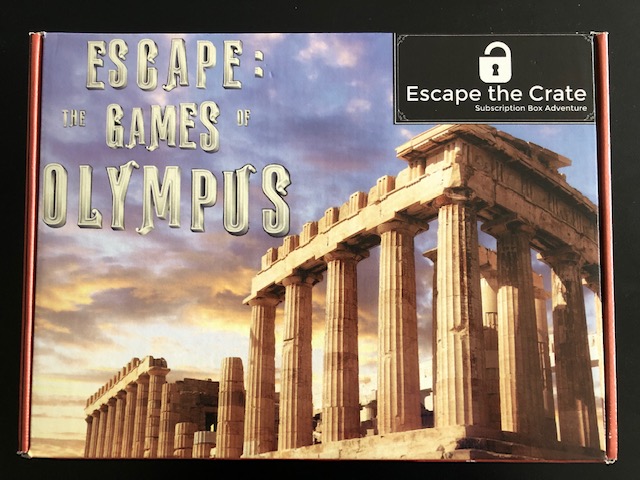
Escape the Crate: The Games of Olympus Game Review

Escape the Crate is a subscription box in the vein of the escape game phenomenon and home game variations such as the Exit series. This is my second crate from them after Escape the Circus Heist, which I enjoyed quite a bit.

** SPOILER FREE **

The subscription service delivers a new “crate” every other month. Some of their “retired” (past) boxes are available for individual purchase (at a higher price than getting them blind as they come out through the subscription). It’s nice to have the option to pick up old ones, and makes sense to offer them as possible given the effort that goes in putting this type of experience together.

Similarly to Circus Heist, Escape the Games of Olympus contained an introductory letter directing the player to a required website, a few props, several cards, envelopes, and sheets for the puzzles. There was no dedicated sheet to be cut up and written on that can be reprinted this time, but this box didn’t really need it.

The structure was a bit different this time where the bulk of the game is actually a batch of four smaller sub-adventures that can be played in any order (with their own time goals so if you are playing with that optional aspect it’s easy to stop between parts). I’m a bit of a mythology buff, so this theme was right up my alley and they did a good job incorporating the subject matter into the puzzles.

I liked some of the puzzles much more than others, but overall this was another really solid and fun experience. Even the part that was a touch less enjoyable than the rest for me was fairly and logically built and wasn’t bad to finish once I made slight use of the extensive and well done hint system. And when this box shined, it really shined. I found a couple of the puzzles to be particularly clever.

The way in which the website is used to support the story elements for a bit of immersion while also providing progression framework continues to be impressive. Again extra touches like optional recordings of the text from the websites make this a well developed, engaging product, and the password system does a nice job of both allowing the story elements to have progression and to let players attempt to answer a puzzle without spoiling the actual solution if they are incorrect.

The props are well integrated with the puzzles, and the fact that the inside of the boxes themselves are used as well continues to be one of my favorite things about these. Games of Olympus also has an optional side element, which was interesting enough and the way it was implemented was a very nice thematic touch.

Finally the connecting narrative between the boxes provides a nice (if a little out there) link between each installment while still allowing each to stand alone. So far there’s absolutely nothing preventing someone starting with any given box from what I’ve seen, although playing the two back to back hinted at some larger story points and had a couple of really nice callbacks.

Another good game box overall. I do feel I’m getting my money’s worth from these thus far (particularly considering they are resettable) and while they won’t necessarily challenge experienced puzzlers too deeply they are quite enjoyable and I do recommend them.

Categories
Board Games Reviews

Escape the Crate: Circus Heist Game Review

I adore the escape game phenomenon, and the home game variations it inspired including the excellent Exit series.

A subscription box service version called Escape the Crate came to my attention, and here’s a SPOILER FREE look at my first experience with them.

The subscription service delivers a new “crate” every other month. Some of their “retired” (past) boxes are available for individual purchase (at a higher price than getting them blind as they come out through the subscription). It’s nice to have the option to pick up old ones, and makes sense to offer them as possible given the effort that goes in putting this type of experience together.

The box for Escape the Circus Heist contained an introductory letter directing the player to a required website, a few props, several cards, envelopes, and sheets for the puzzles, and a dedicated sheet to be cut up and written on that can be reprinted (so the other elements remain undamaged and the box can be reset/replayed). There are also a number of puzzle and theme related elements printed on the inside of the box itself, which is a wonderful, immersive touch.

I was a little trepidatious about the required internet aspect but it really adds to the experience. Most of the actual puzzle elements are in the box, with the website providing setup, story, and hints (if wanted). It allows the game to be deeper and more fully formed and makes it very clear at any point which items are in play. There are also extra touches like recordings of the framing elements to play if preferred to reading them.

Every visited page is password protected, with general pages for the box being played requiring a password given in the introductory letter and puzzle solutions (generally a series of numbers or letters) used as the passwords for subsequent pages as the player advances. It’s a clever way to do things, as it means means players can check their solutions without spoiling the right answer if they are incorrect.

Of course the most important part of something like this is the puzzles themselves. They were solid, logical, and fun. I thought the difficulty was reasonable, neither so difficult to be frustrating nor so easy to be boring. Experienced puzzlers won’t struggle with this, but it was quite satisfying progressing through. The target time is an hour to an hour and a half depending on the player’s experience, which is standard for games of this type.

The nature of this type of production model makes it more expensive than some of the other options available, but I found this worth it so far (and unlike examples like the Exit games these are resettable).

Overall I really like how this all came together, and am looking forward to playing another. 

Categories
Board Games Reviews

Son of Doctor Esker’s Notebook Review

Doctor Esker’s Notebook was an interesting and overall enjoyable batch of puzzles in a fairly unique format. There was obviously a lot of potential to expand on the idea, and here I’ll take a look at the sequel Son of Doctor Esker’s Notebook.

Like the original, Son of Doctor Esker’s Notebook is a series of puzzles presented via a deck of cards. There are 74 cards total, made up of 59 puzzle cards, 10 solution cards, and 5 instruction cards. It stands alone and does not require Doctor Esker’s Notebook or any knowledge of it to play.

The solution to each of the 10 puzzles in the deck is a 2-4 digit numeric code. The solution cards are numbered 0-9 on their backs, and when arranged in the correct order for each solution they will identify the next puzzle to be played (via seemingly random elements on the answer cards coming together to form words, pictures, etc). It’s a very clever, elegant way to handle solving the puzzles and as with the original game is well implemented here.

Like with the original, I played this solo but felt it would also work well with a small group (I’d probably cap it at 4 players rather than the “1-6, or more” the box suggests).

There was a wider variety of difficulty in these puzzles, although I thought they were a little easier on average. I found several of them really clever and well executed though, and the game built to a nice crescendo with some of the best puzzles coming toward the end.

I particularly loved the fact that the final puzzle parallel that of the first game without really feeling like a repeat. The minor production issues from the first were missing here, making things feel more polished.

However I did feel a couple of the puzzles tried too hard to be accessible. These puzzles aren’t really deep enough to have multiple paths to solve, so when one puzzle was actually two completely separate, simplistic puzzles that lead to the same answer it completely felt like unnecessary padding.

Even more annoying was that one puzzle had essentially included instructions on how to solve it. It was weird and unwanted. It would have been a great puzzle otherwise, but was instead reduced to a rote exercise.

Outside of those issues though I found the remaining puzzles engaging and fun.

The online only hint system is exactly the same here, with several hints for each puzzle allowing players to choose how much help they want. I like the approach a lot, but it’s worth mentioning that the hints and solutions are strictly available online so if players get stuck on a puzzle visiting the website is required to continue on.

Despite some minor criticisms the Doctor Esker series is continuing to be quite good for what it is, which is a fun little collection of decent puzzles presented in a cost friendly, portable, and reusable way. Son of Doctor Esker’s Notebook doesn’t really break the established mold at all, but there’s nothing wrong with more of a good thing.

Categories
Board Games Reviews

Doctor Esker’s Notebook Review

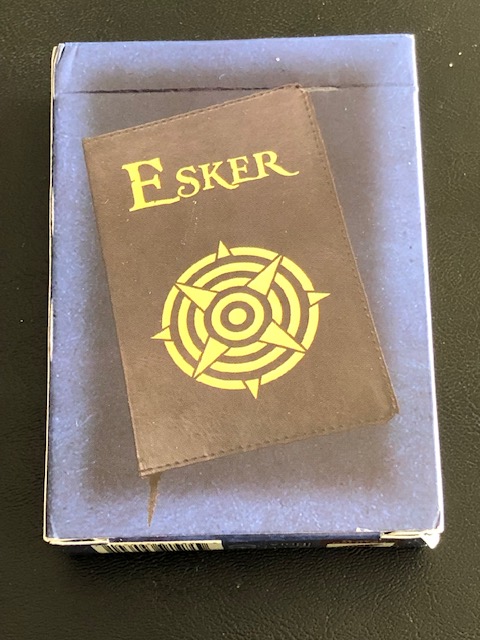
I’m a big fan of puzzles and puzzle type games so was very interested to check out the curious little box of cards called Dr. Esker’s Notebook.

As implied above, Dr. Esker’s Notebook is a series of puzzles presented via a deck of cards. There are 73 cards total, made up of 58 puzzle cards, 10 solution cards, and 5 instruction cards.

The solution to each of the 9 puzzles in the deck is a 2-4 digit numeric code. The solution cards are numbered 0-9 on their backs, and when arranged in the correct order for each solution they will identify the next puzzle to be played (via seemingly random elements on the answer cards coming together to form words, pictures, etc). It’s a very clever, elegant way to handle solving the puzzles and is well implemented.

The puzzles themselves were quite good, with decent variety to them and some really inventive elements. There were a couple I thought were exceptional, and only one I didn’t really care for. I played this solo, but it feels like it would also work well with a small group (I’d probably cap it at 4 players rather than the “1-6, or more” the box suggests).

There were some minor execution issues that hindered my enjoyment just a little here and there, but nothing that was impossible to work around. For example, when several puzzles depend on lining things up properly having white borders on the cards is a particularly poor choice. There were other small things that I’ll avoid discussing in detail due to spoilers, but again largely things that in my opinion kept some good puzzles from being great puzzles rather than anything really problematic.

There is a decent hint system available with several hints for each puzzle, allowing players to choose how much help they want. I like the approach a lot, but it’s worth mentioning that the hints and solutions are strictly available online so if players get stuck on a puzzle visiting the website is required to continue on.

Dr. Esker’s Notebook felt somewhere in between board game versions of escape rooms like the Exit series and puzzle books like  Journal 29 to me, and that’s a pretty favorable place to be. The deck of cards approach is creative in the way it was done and keeps this cost friendly, portable, and reusable. Overall I had fun with this and would welcome more puzzle games in this vein.

Categories
Board Games Reviews

Tapestry Board Game Review (First Impressions)

Tapestry is the newest offering from Stonemaier Games, makers of several board games I adore including Viticulture, Euphoria, and Scythe.

I’m going to state up front that I enjoyed the game quite a bit overall, as there are some criticisms to explain and I don’t want the tone of the review to seem overly negative as I go through them. Bottom line is I’ve definitely had fun in the games of this I’ve played thus far (once 2-player and once 4-player).

Tapestry is advertised as a civilization game, which it is in theme only. The various trappings seem well researched and appropriate and it’s a fine theme, but nothing about playing feels like the mechanics really marry with the theme. There are no gameplay effects to changing ages, no real resonance between actions and consequences, etc. This is an engine building cube pusher, nothing more or less. WHICH IS PERFECTLY FINE, and it does it well. But it bears mentioning for those looking for a deeper thematic experience.

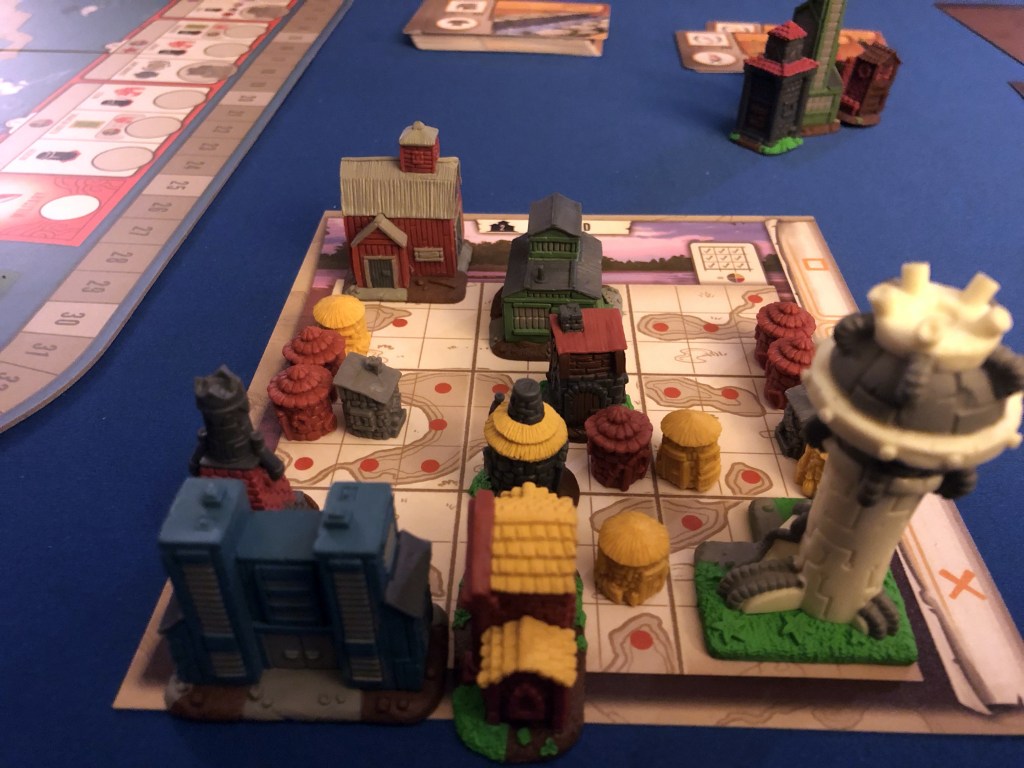
Also, Stonemaier’s usual high production quality admittedly and unfortunately feels like a case of style over substance here. The attractive, individually sculpted landmark tokens end up only having one function from a gameplay standpoint: to cover squares on a player’s capital city mat. And for that they are rather poorly designed.

The smallish bases with rounded corners make them cover a smaller area than they should, and in addition to not fully covering the intended areas they sometimes “fit” into spaces they shouldn’t (areas smaller than the number of squares they are supposed to cover). Yes, there are established, correct areas for them and it’s playable keeping this in mind and “centering” the tokens in the proper areas. But again, this is literally the ONLY thing these intricate tokens are for, so placing aesthetic preferences over functionality is a puzzling and disappointing production choice.

Lastly, some members of my gaming group’s initial impression is that Tapestry’s somewhat unbalanced and a bit too influenced by luck. The person who concentrated on the navigation track was disappointed in the space tiles compared to the rewards players received for completing other tracks, civilization bonuses have a potentially huge impact on the game, tapestry cards vary wildly in usefulness depending on when they are drawn with no real way to minimize the effect, etc.

They are all interested enough to try it again though, and I personally found the luck of the draw aspects fine. Also, luck of course tends to balance out over several plays. But the effect is large and for the type of gamer that prefers careful progress to adapting to circumstance changes this probably won’t be their cup of tea.

All that said, as indicated up top there is a lot to like about in Tapestry.

Each player continues taking turns to move their tokens along the various advancement tracks until they need to or want to take an income turn (during which points and resources are generated, among other things). The big innovation here is that the game lasts five income turns for each player, so since it’s their choice when those turns are taken the game can and likely will end at different times for different players. It’s a really cool and creative idea leading to interesting choices and is well implemented.

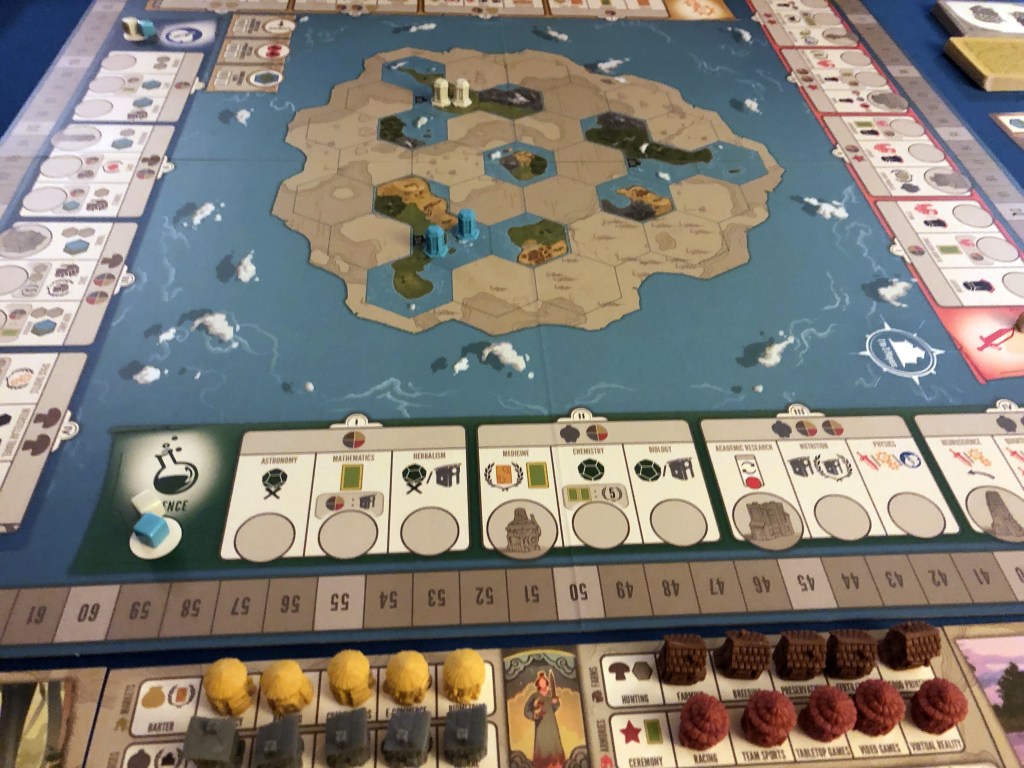
Moving along the four different advancement tracks is a strong central mechanic, particularly in how the tracks interact with each other and with the player boards. Removing buildings from the income mat increases resources and points collected as well as filling in the capital mat for bonuses as they’re then placed, discovering and advancing technology cards give other bonuses and special abilities, choosing which tracks to advance on and which resources to spend effects when income turns have to be taken, exploring and moving about the central map creates other opportunities for scoring, etc. I have minor quibbles with how a few aspects interact (and combat outcomes really should have more involved than pure luck of the draw), but overall the general frame is nicely done and it all gels well.

I’m curious to see how this feels after more plays with varying player counts, but so far despite perhaps not being quite as polished as Stonemaier’s previous offerings in some respects I found Tapestry a fun, creative game that I’m happy to have added to the collection.

Categories
Board Games Reviews

Walking in Burano, Chronicles of Crime, and Planet Game Reviews (Quick Thoughts)

A brief look at some games I got to try out (somewhat) recently.


Walking in Burano

burano

Walking in Burano is a spacial card game in which players choose building sections to add to their area under ascetic and other point related restrictions. There’s an interesting balance created by the different sections needed for building, elements on cards that lead to scoring, placement restrictions, and the cost of taking actions. It all gives a nice layer of depth here. Subtle aspects of needed strategy might not be immediately obvious, but the gameplay itself is easy enough to jump into.

I’ve only played this 2 player thus far, and there’s a mechanic specific to that version that really makes long term strategy difficult in how quickly cards disappear. I imagine it will be a VERY different game with more players because of this. Still enjoyed it quite a bit though and look forward to playing again. 


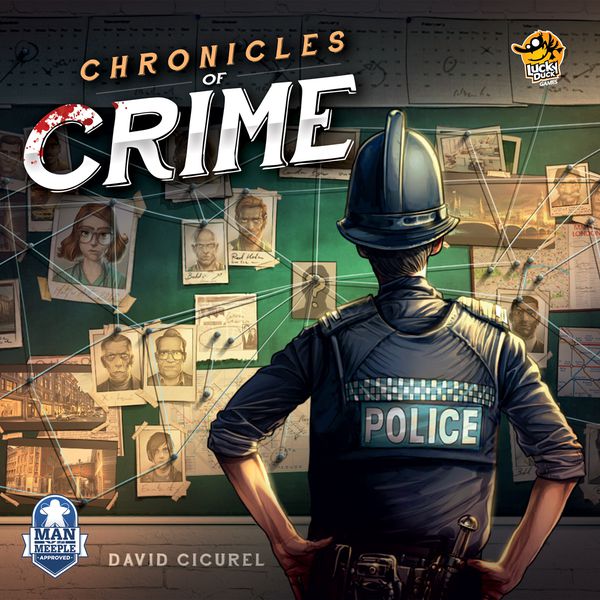
Chronicles of Crime

chronicles

Here’s another game to join things like Watson & Holmes and Detective  right in my sweet spot of providing decent mystery complexity in a way that’s still accessible and fun. This is incredibly application heavy, needing use of a phone to analyze clues, check answers, and even look around crime scenes. But it’s extremely well done and integrated. Excited to continue to progress with this one.


Planet

IMG_5877

Planet provides an interesting variation on tile placement games as players fill in the twelve sides of their planet trying to maximize sections of their secret land type collected while satisfying certain conditions to claim animal cards (both of which provide victory points at game end).

The gimmick is a fine one, although the all important magnets that secure tiles in place should be stronger. It’s much too easy to knock off a piece accidentally when turning the planets around or otherwise handling them, which is pretty much what the whole game is based on doing. 

The variation of goals and rules surrounding them is reasonable, as is the drafting aspect that governs who gets what tile. It feels like there could have been a little more to this, although I’ll admit I’m not sure in what respect. Decent, quick playing, reasonably unique game none-the-less.