Categories
Board Games Reviews

Suburbia Board Game First Impressions

I recently picked up Suburbia based on strong reviews and good word of mouth, but didn’t know a lot of details about it going into my first game. We tried it with three players, and all found it as accessible yet satisfying as advertised.

IMG_3175

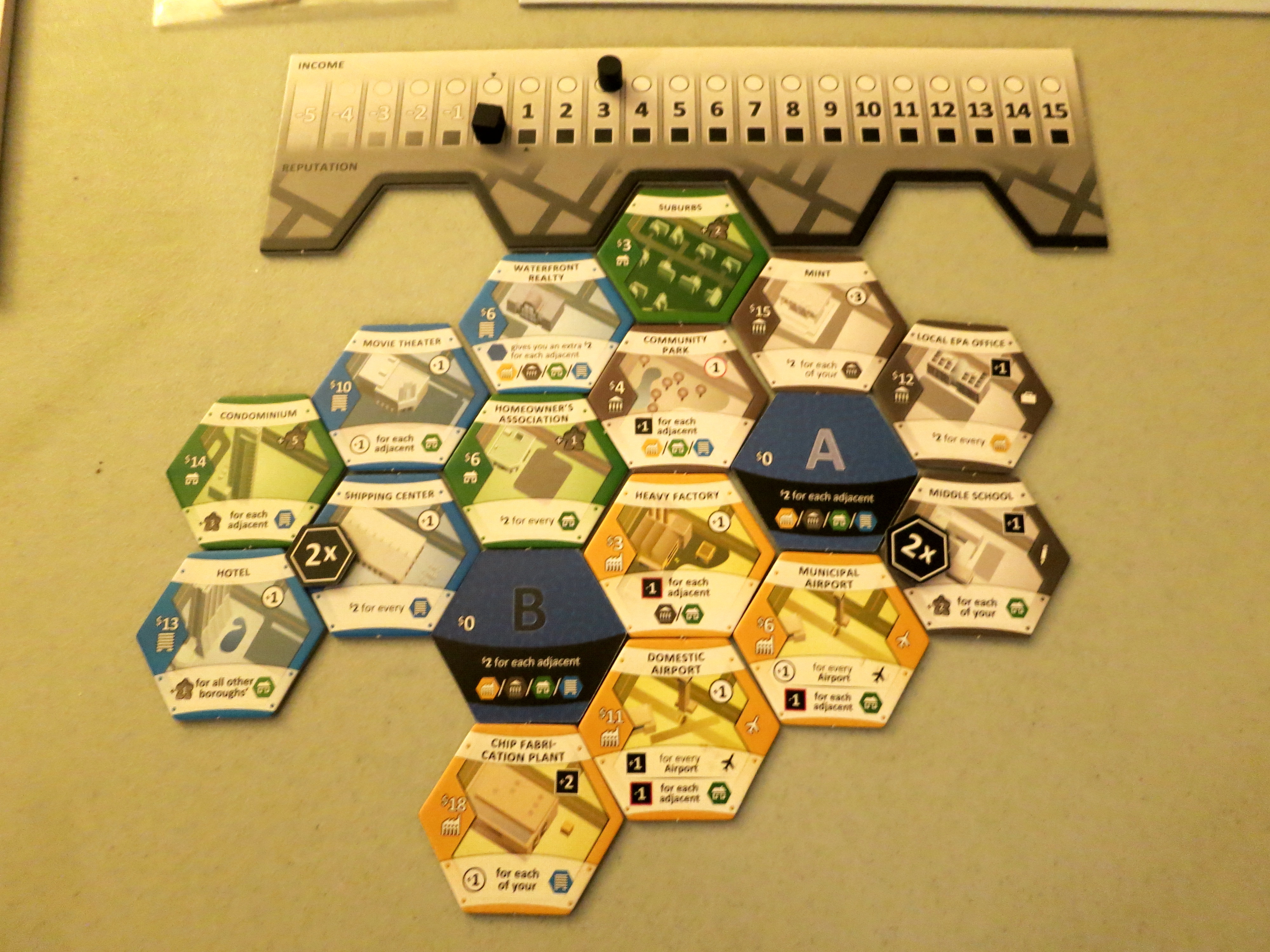
Suburbia is one of those games that might look daunting at first given the numerous components but is quite straightforward at its core and easy to pick up once you start playing. Nearly every turn consists of picking a tile from the current real estate market (or taking one of three always available basic tiles) and placing it in your play area. That simple. The depth and appeal of the game  come from balancing the benefits and drawbacks of each tile, along with the changing cost as they move along the real estate market track. Wait a bit and you could get a great deal on a powerful tile, but you’ll miss out on it if an opponent decides it’s worth the extra cost.
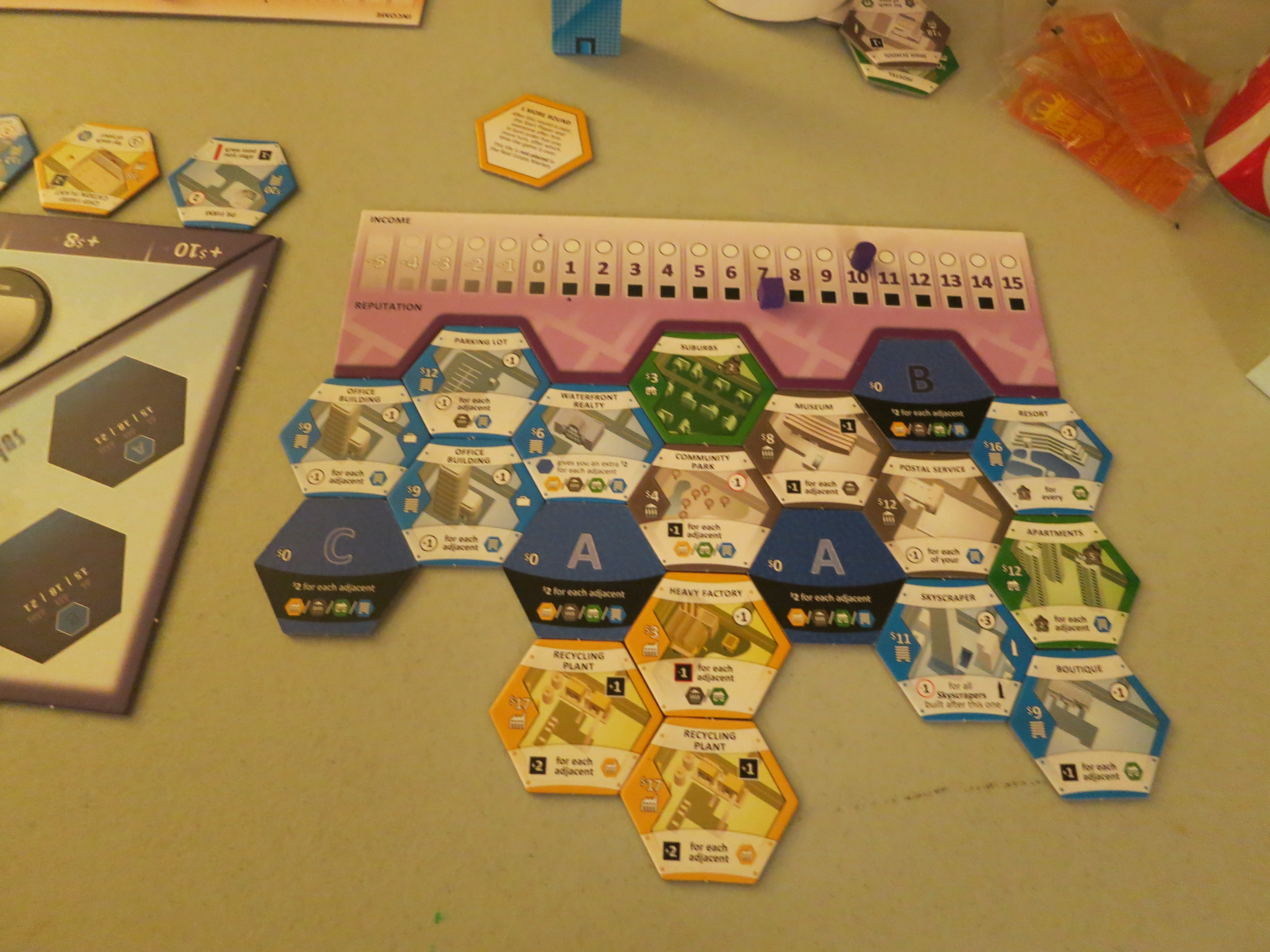
IMG_3018

Different buildings affect your “income” and “reputation,” which both affect your ability to grow your suburb. All of this combines to draw people in, and “population” is the victory point system for the game. The theme is extremely well integrated and fairly intuitive. For example, airports provide greater income the more airport there are in play, but will “upset residents” and damage your reputation if you place them next to living areas. It’s a nice touch that makes it easier to really get sucked into the game.
IMG_3019

In addition to using the buildings as is, there a couple more options. For just the cost on the real estate track (not paying the base cost of the building) you can take a tile to use as a lake. All tiles have lakes on their backs and all lakes are identical – it gives $2 per adjacent building (other lakes don’t count). Not only is this an interesting strategic income choice, it allows players to “pass” in a way if they need to or potentially block an opponent from getting a valuable building. Each player also has three investment markers to use during the game, which can double the effects of one of their buildings.

The game plays until a certain tile, always placed towards the middle of the final stack, is flipped. When that happens the current round finishes and then everyone gets one more turn. So everyone gets a chance to make a play once they know the game is ending, and all players end up with the same numbers of turns. The number of tiles used varies depending on the number of players. There are also both public and secret bonuses for achieving certain things at the end of the game, like lowest income, most blue buildings, etc. Highest population wins.

IMG_3017

I’m glossing over some details in the mechanics, but I’ve hit the gist. I loved the balance and the strategic choices present while still having some chance involved that forces adaptability. Having some buildings depend on the total number of similar buildings in play, including in your opponents areas, makes you focus on what they’re doing as much as what you’re building. The combination of tile laying and resource management really worked for me, and I can’t wait to play this one again.

Categories
Board Games Reviews

Ghost Stories: Black Secret First Impressions

Ghost Stories is one of my favorite cooperative board games, and I’ve played numerous times with a varying number of players, and with and without the White Moon expansion. While I wasn’t quite sure how things would work out having someone play the villain, the idea was intriguing and adding a fifth player had appeal so I recently picked up the Black Secret expansion.

IMG_3095

Gameplay:

As I alluded to above, the gist of the Black Secret expansion is that one player actively takes the role of Wu Feng and works against all of the other players. There are three main aspects to this:

  1. The Wu Feng player now controls the ghost phase, including where each new ghost is placed. Instead of placing the ghost, there are options to cast curses or summon demons.
  2. Curses are tokens played on a special board that harm the taoists. They are color coded and must match the color of the ghost the Wu Feng player is discarding to play the curse. They are played in a pyramid structure, with stronger curses available as you near the top.
  3. Demons are agents of Wu Feng represented by three plastic figures that roam an underground board that directly correlates to the main game board. The demons “dig” in the dungeon, searching for three relics that will unleash Wu Feng’s avatar on the village. As the demons dig they may find nothing, bonuses for their master, bonuses for the players or the artifacts they seek. If the demons are successful, Wu Feng’s figure is placed in the village, can not be attacked/beaten/removed, and can attack players every turn.

In return, there are a couple things meant to aid the players as well:

  1. Each time any player loses a life point, they place it on a card. When a certain number of points get placed on a card the players get that card’s bonus. There is a new villager tile that allows players to swap out the cards to get bonuses of their liking,
  2. When any player is down to one life, they get the power of the player opposite them as well as their own.

IMG_3096

Thoughts:

Black Secret is an interesting expansion, but one that tries a bit too hard. There are an almost overwhelming amount of new components and rules, and in the end a lot of them were a bit perplexing.

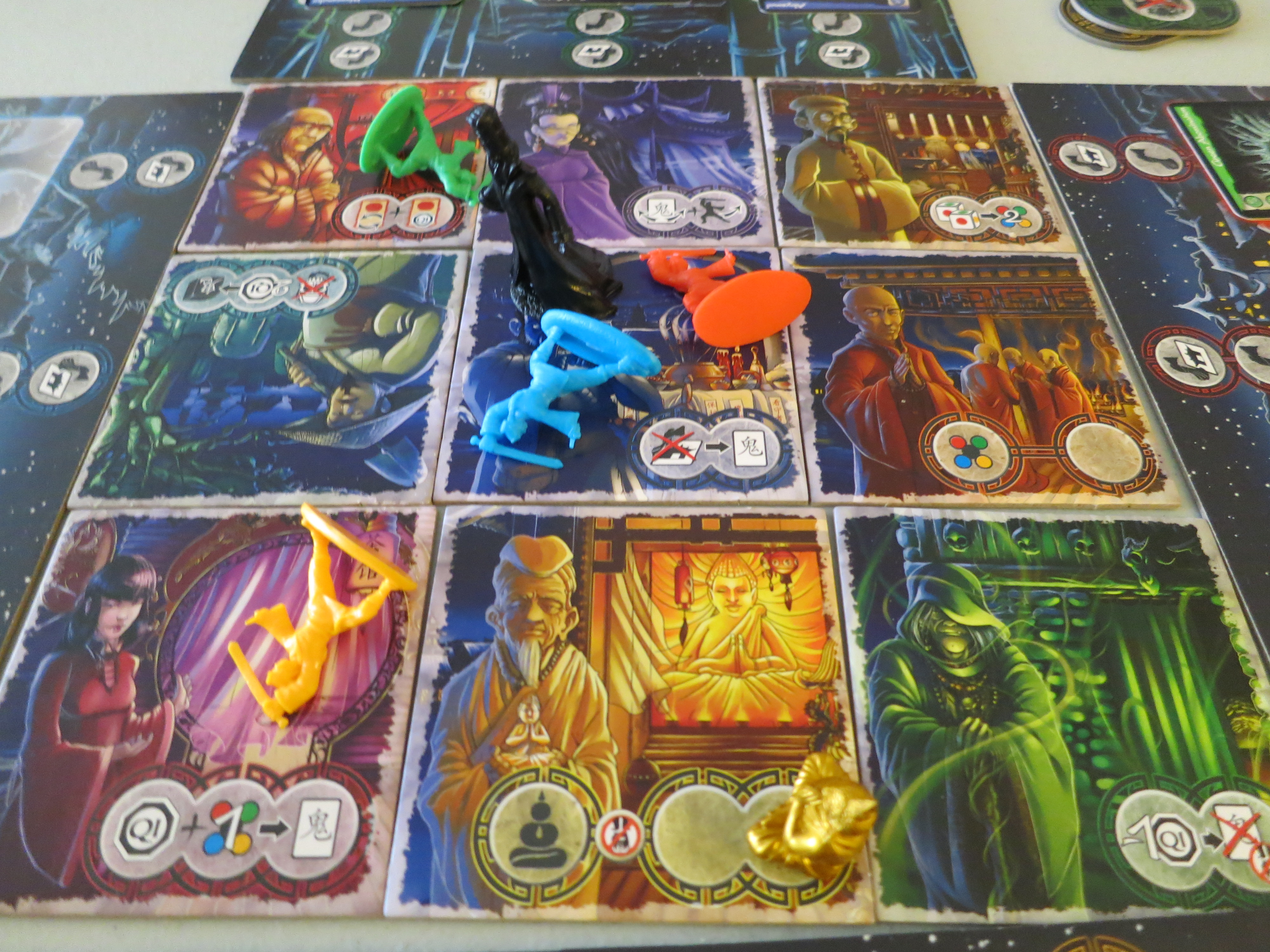
The Demons: The demons have a summoning mechanic, a whole new board devoted to them, unique plastic figures, a system connecting it to the main board using ladders that can be destroyed, a special phase of each turn for them, etc. And their entire purpose is to search stacks of tiles. That’s it. They can’t fight/hurt/hinder the taoists in any other way, and all a taoist has to do is be on the same spot to keep the demon from digging.

Now this is a problem for the taoists since there are often much more important things to be doing, and there can be several demons out at once. And if the demons succeed in getting to the bottom of the right piles Wu Feng’s avatar appears, which is major trouble because now it’s the taoists who can’t do anything about it. This is kind of the point of our issues – the Wu Feng player spent most of the game wishing his cool looking demons could do something besides dig, and the rest of us realized if the avatar came out what very little chance of success we had was pretty much immediately eliminated. This aspect would have been a lot more interesting if there was more give and take in each stage of progression.

Balance:

While the demon part could have been better, it wasn’t a deal breaker. The bigger issue was that in trying to justify the expansion and make sure the Wu Feng player had enough to do, things were moved too far from the rest of the players. Having the Wu Feng player in control of the ghost phase and adding the demon phase meant that on every players turn he had two phases, then the player whose turn it actually was got to move and take an action. With the full four taoists we were essentially waiting for 11 phases to pass before we got to do anything again, with 8 of those phases belonging to the Wu Feng player. Making things even worse was the fact that with things tilted in the favor of Wu Feng, there was usually an obvious best move to make, so our turn didn’t even feel like a turn when it did come around.  Our Wu Feng player wasn’t thrilled either, as after the game he remarked it was interesting but he got to the point where he wanted a break, as he was basically constantly playing for the full time.

Beyond play time the other balance issue with giving the Wu Feng player the ghost phases was difficulty. Ghost Stories is a notoriously hard game in the first place, and not being able to place ghosts in advantageous positions for fighting ramps that up even more. Obviously we probably weren’t playing optimally, but we didn’t find the benefits given to the taoists even remotely countered the added advantages given to Wu Feng.

IMG_3010

Overall

Black Secret expansion for Ghost Stories seemed to tilt things WAY too far to towards the player playing the bad guy, in both game advantages and gaming time. I really wish they had handled certain elements differently, as the core ideas are really good. Not the best first experience, but the game was still fun overall and I’d be up for giving the expansion another shot sometime.

Categories
Board Games Reviews

Turning Classic Game Elements On Their Head

In June 2012 I backed a Kickstarter for an interesting two player game called The Duke. It employs a unique mechanic that has pieces flipping over after each time they move, with their available next move dependent on which side is currently face up.

It took about a year and a half for the game to be produced and delivered, and it sat on my shelf for nearly that long again as my gaming was long limited to three plus player games. I finally got an opportunity to play recently, and my only disappointment is that I waited this long to try it.

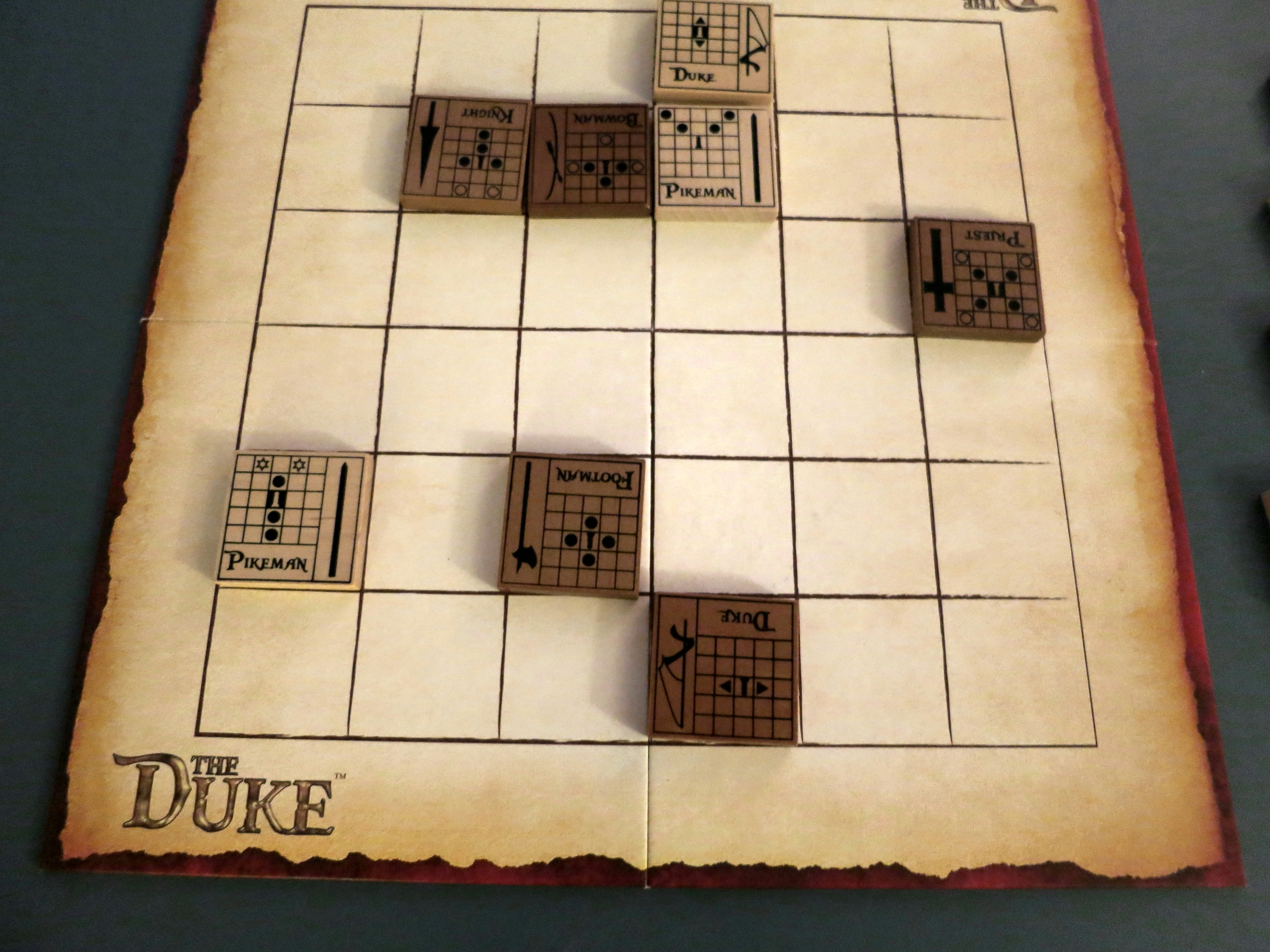
Game in progress.
Game in progress.

While it will undoubtedly take a long time to learn the intricacies of using each piece to its full potential and the numerous possible strategies the game provides, learning enough to play took minutes. Both players start with their Duke and two Footman. On each turn two actions are available: move one of your pieces on the board or bring a random piece from your reserves into play in any free space adjacent to your Duke.

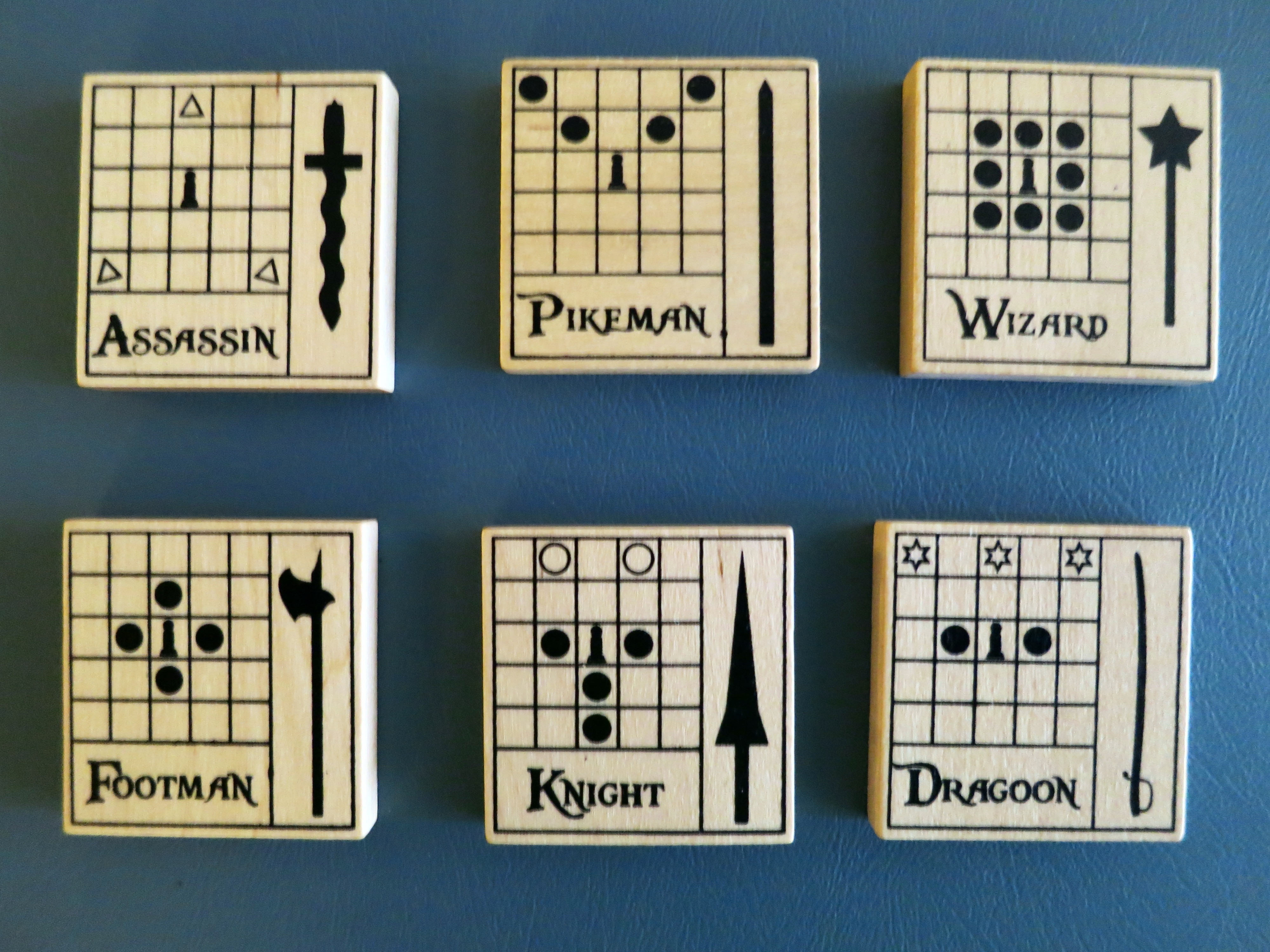
The starting side of some of the pieces in the base game...
The starting side of some of the pieces in the base game…

As mentioned above the key innovation of the game is that every piece has two distinct movement patterns indicated on its two sides. They can vary wildly and it’s extremely interesting and fun to try to plan your moves taking into account what the piece you’re using will be able to do next turn. Possible moves include basic orthogonal or diagonal movement, jumping adjacent pieces, capturing pieces at a distance without moving, etc.

... and the flip side movement patterns for the same pieces.
… and the flip side movement patterns for the same pieces.

There have been a fair number of comparisons to chess, and the influence is obvious, but I found this much more accessible and enjoyable. The vast number of movement patterns allows for deep gameplay, yet the smaller board and limited starting pieces keeps things manageable. The biggest chess parallel is the game’s goal: capture your opponent’s Duke. There is even a “check” equivalent (called “guard”). But despite this commonality The Duke is solidly its own game, feeling unlike anything else I’ve played.

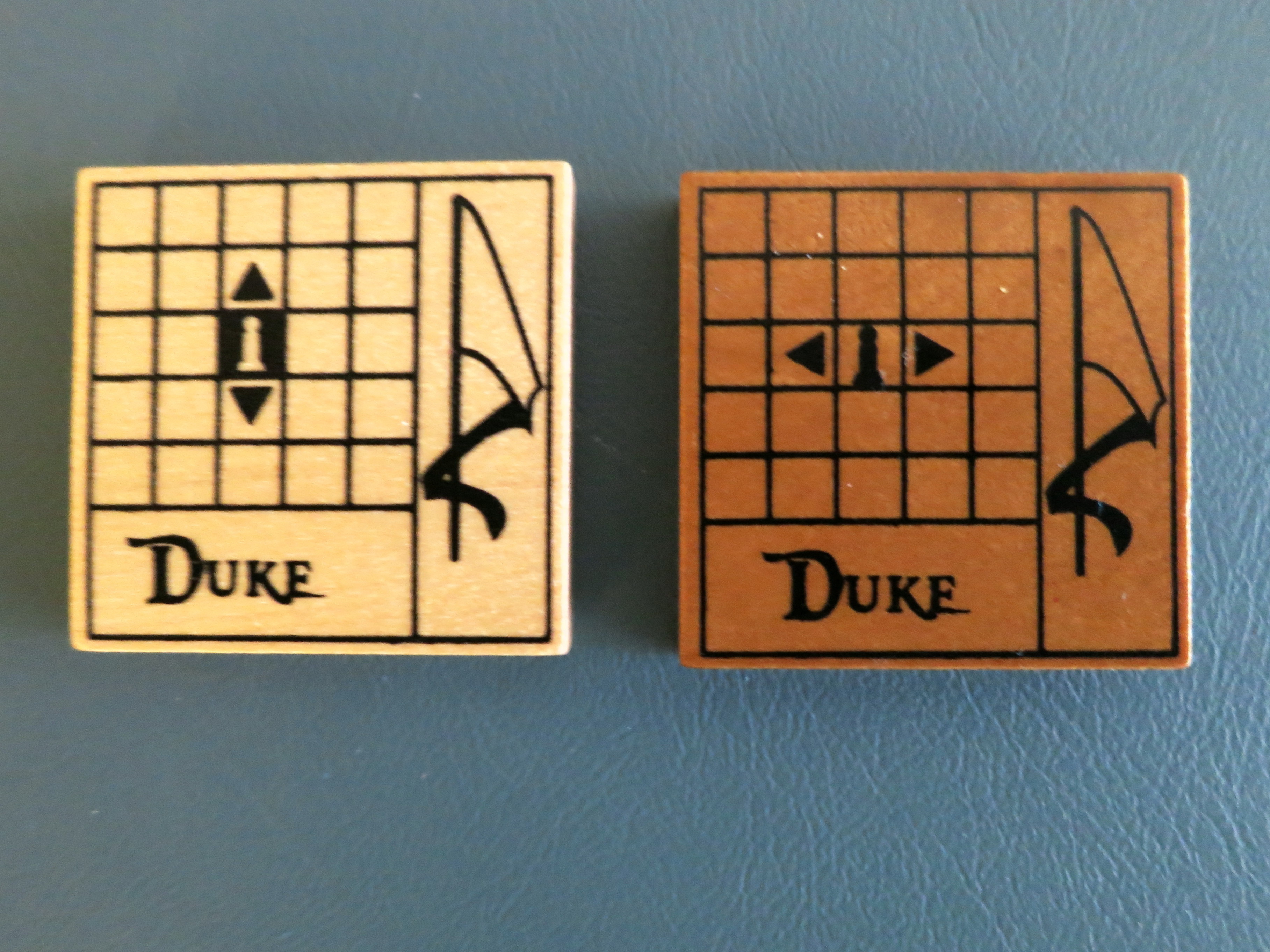
And I adore the fact that the Duke, while limited, is still quite powerful. He is basically a one directional rook, with his sides alternating between vertical and horizontal movement. This is fantastic because he can defend himself somewhat and get out of tight situations, but can still be cornered and trapped if you’re not careful.

Your mission: protect your Duke at all costs.

The game plays quick. We were able to get three games in around an hour, although I expect that will change once we get better at it. Throughout those three games we didn’t even see all of the fifteen different troop types in the base game, so it will be a VERY long time before it starts to feel the same from game to game (if it ever does). But there’s even more variety to be had regardless.

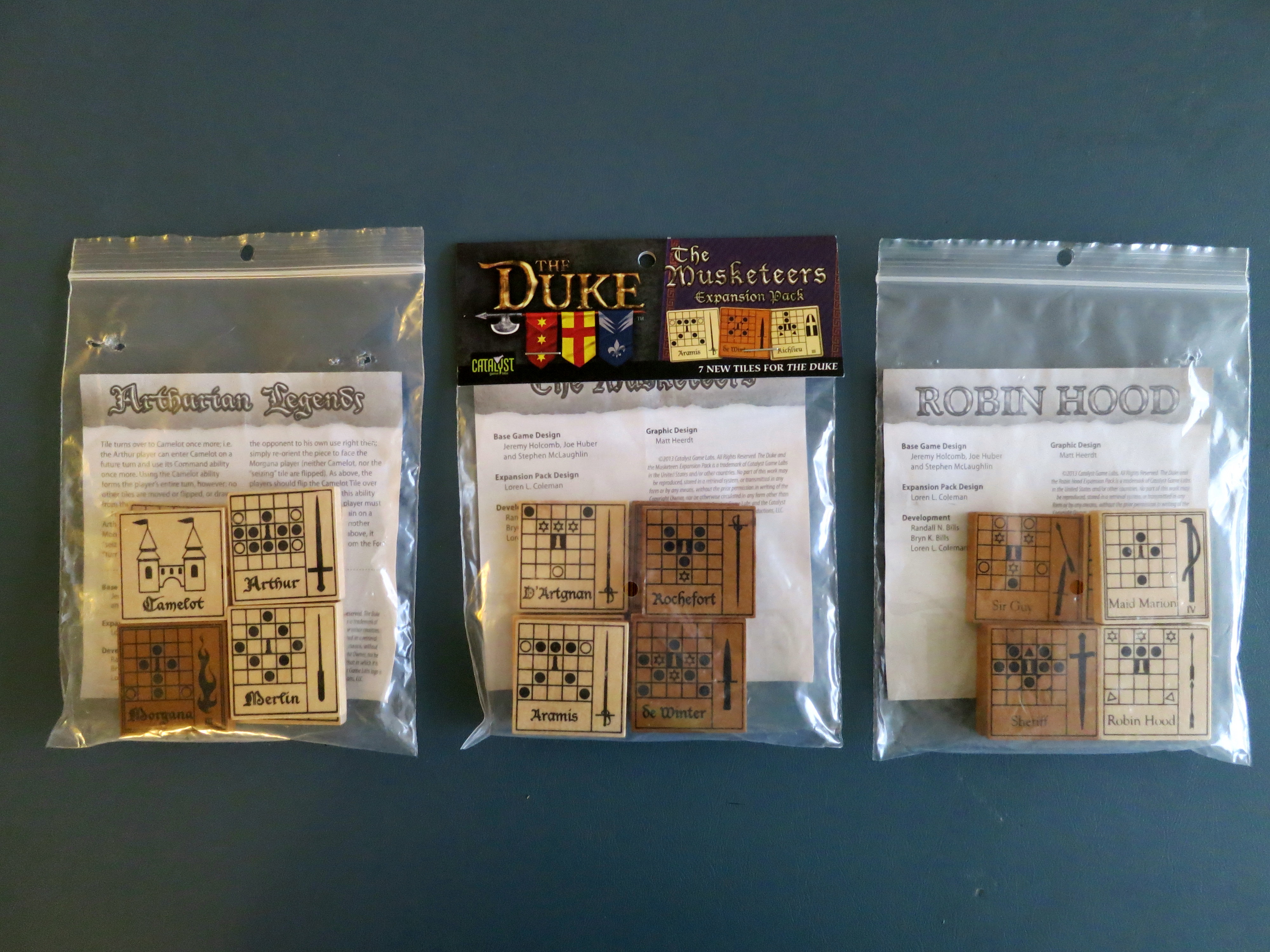
Expansions based on Arthurian Legend, Robin Hood, and The Three Musketeers.

Several expansions based on classic literature and legends have been released. While in the base game each player has identical forces, these sets are asymmetric and contain pieces molded after certain characters which are swapped with particular pieces from the base game. I have not tried any yet but I love the idea and the sets I have look great. If that somehow isn’t enough, there’s also a pack of blank pieces with movement stickers available to design your own units.

Do-it-yourself reinforcements!

Overall the Duke is easy to learn, quick to play, has great production value, and is a blast. Suffice to say I’m incredibly impressed and will be playing it for a long time to come.

Categories
Board Games Reviews

Castles of Burgundy Review

The Castles of Burgundy is a “Eurogame” played in five phases for 2-4 players. It blends tile placement and die rolling as its major mechanics into a fairly unique strategy game of optimization and capitalizing on presented opportunities.

Although it’s more of a backdrop than something critically tied to gameplay, the theme of creating the best “estate” during the 15th century provides a nice backbone for separating the types of tiles and (due to stunning thematic art) gives the game a great aesthetic.

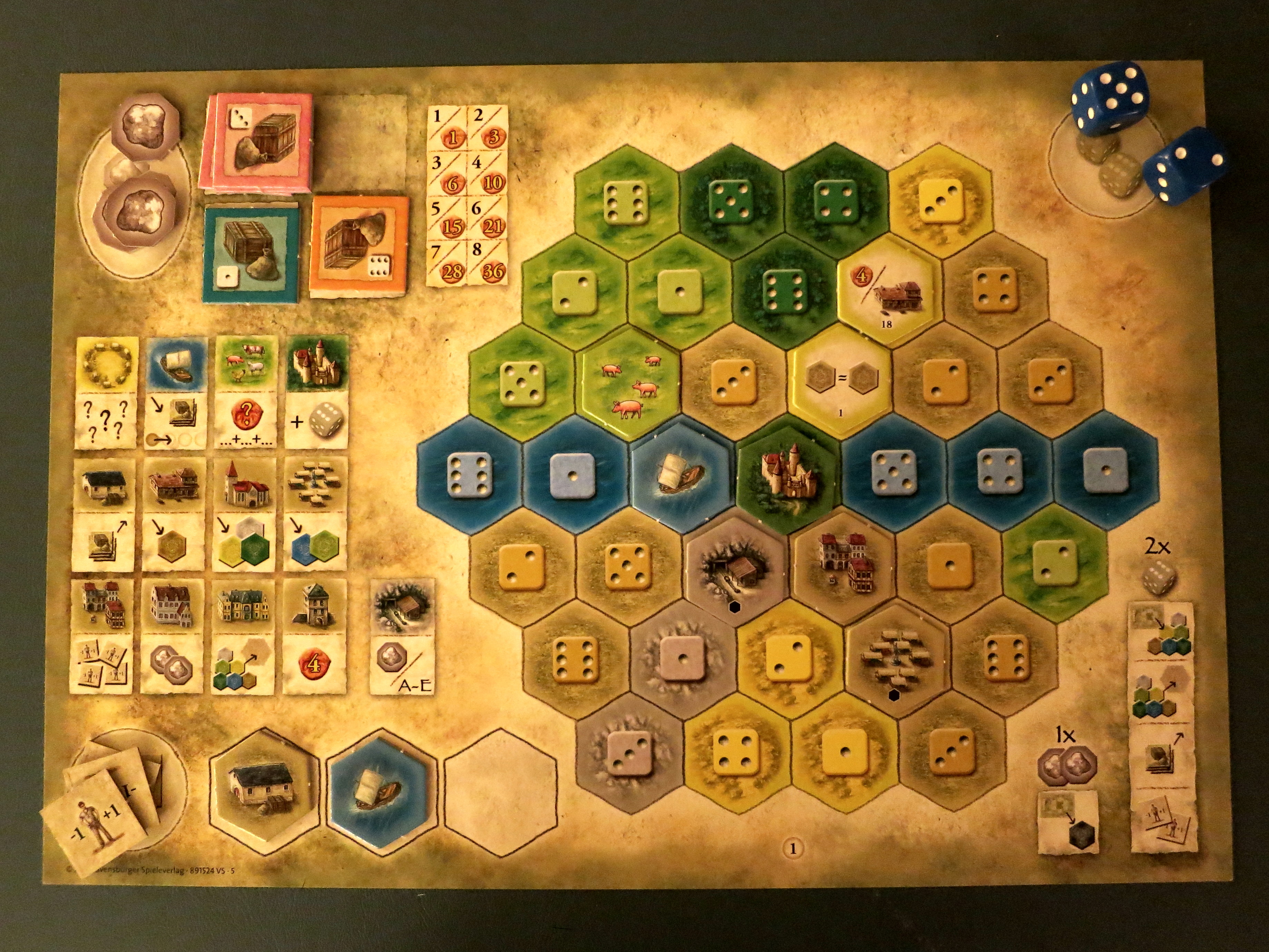
IMG_2505

Gameplay: The core gameplay is elegant and relatively straightforward, but the large variety of options and different powers available based on what tiles you play makes the game very deep and strategic. Luck determines a fair bit about the choices you’ll have, but the game is more determined by the choices than the luck.

The goal is to have the most victory points by the end of the game. Earning points is always related to placing hex shaped tiles on your game board, but there are a lot of variations. I’ll give examples below.

1) The game board has a lot of information, reminders and spaces for setup, as well as score and turn order tracks. As such it is a bit busy even though it is well laid out. The most important parts to get an idea of gameplay are the six numbered areas (corresponding to the faces on a normal die) from which tiles can be claimed and the central area from which hex tiles can be bought .

2) Player boards, along with likewise containing a wealth of information and symbols, have a map of their estate of 37 hex shaped spaces that have varying colors and die numbers on them, as well as three hex shaped storage spaces and three square shaped storage spaces.

3) There are six different colors/types of hex tiles, all representing things that can be added to improve your estate: buildings, animals, “knowledge” (we generally call them “technologies” or “enhancements”), mines, castles and ships. Each have their own effects and powers.

4) During each round all players will roll two dice and use them one at a time to either – take a tile from the matching numbered area on the board into storage – place a tile from storage onto an appropriately colored space with matching number on their map – claim two worker tokens (die number doesn’t matter). Once per turn a player can also buy from the central area. Player use the effects of the hex tiles when they are placed on the map. The workers are key to the genius of the game balance and strategy – each token can be redeemed to change a die roll one value higher or lower, and they can be redeemed several at once. This gives players control to mitigate the effect of luck if needed.

5) Highest score after five phases of five rounds wins. Points come from a large number of possible methods, including placing special buildings, completely filling in sections of your player board, being the first to fill all spaces of a color, collecting animals of the same type, selling “goods” (square tiles that can be claimed from the gameboard), etc.

I’m obviously skipping a lot of details, but that should give an idea of what the game is like. It’s harder to explain than it is to learn, but note that I’m speaking from the point of view of a regular, veteran gamer. This is NOT an entry level game.

IMG_2507

Overall: The Castles of Burgundy has a ton of pieces and somewhat complicated set up, but the setup is to keep the game balanced (certain spaces aren’t used depending on how many players you have) and it’s not too bad if you keep the different types of hexes separate during storage (I use small ziplock bags).

The game scales perfectly with the number of players and the mechanics are a lot of fun. The player boards are double sided, with a standard identical board on one side and unique boards on the other. So beyond the variation each game will have just from the tiles, the unique boards can be used to increase the dynamic and replayability.

One other thing to mention is there isn’t really direct player interaction – someone might take tiles you had your eyes on, or get a fulfillment reward first, but that’s about it. It didn’t bother us at all, but if you’re more into confrontation style games this won’t fit the bill.

As is probably clear by now I loved The Castles of Burgundy. It’s an innovative take on tile placement games that I can see myself playing for a long time to come.

Categories
Board Games Reviews

A work of art in its own right.

Princes of Florence is a “Eurogame” played in seven round for 3-5 players that centers around the theme of supporting artisans during the Renaissance. It combines bidding, resource management and other common elements into a unique, wonderful strategic game. It has long been my favorite and I find it holds up beautifully years after I first played.

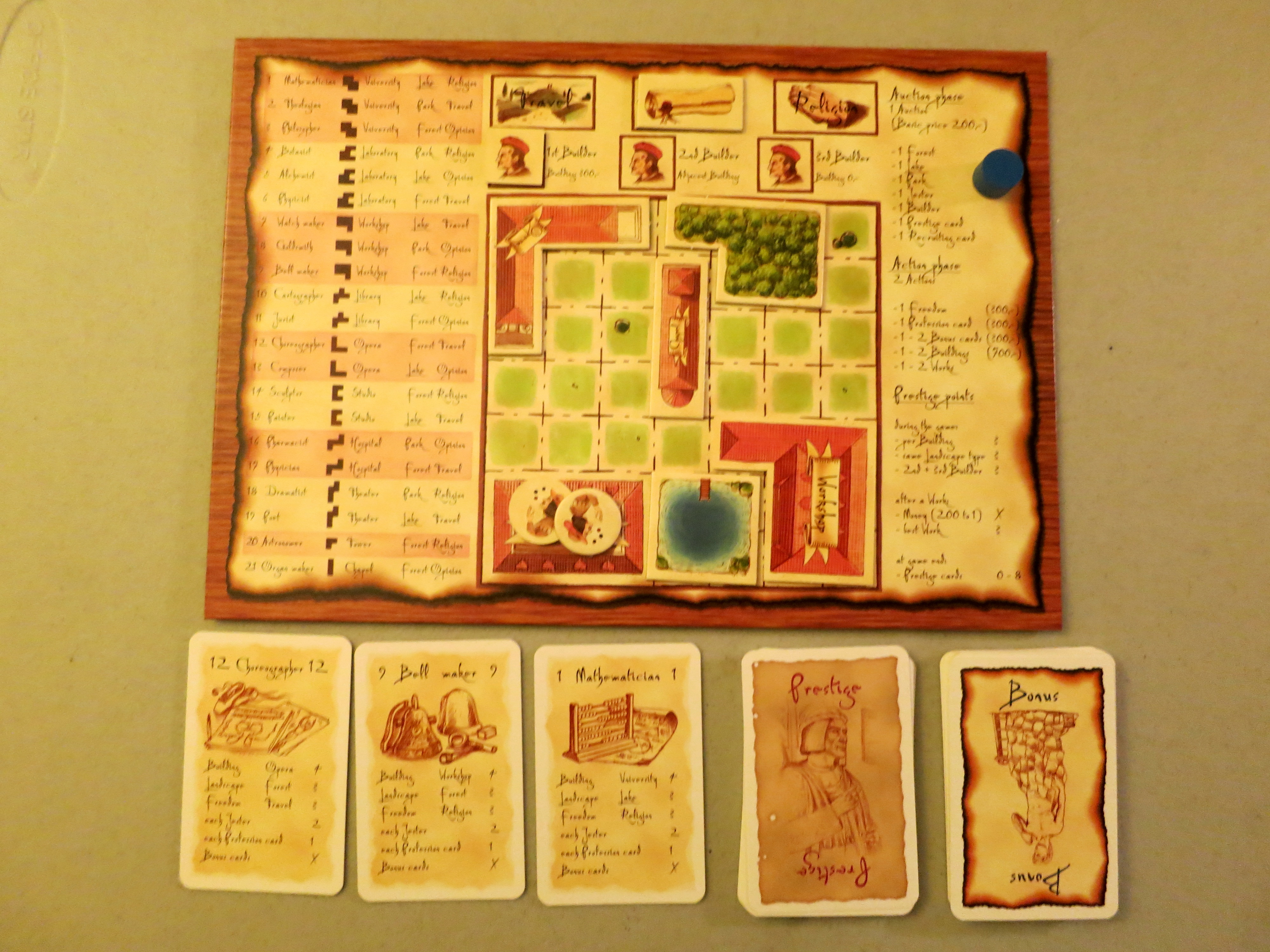
IMG_2470

It can seem a bit overwhelming at first. There are a lot of components and rules and it is necessary to give new players some instruction before beginning. Once that’s done and the game begins, however, most find it easy to pick up. Getting a feel for strategy and planning will likely take a few games.

Gameplay
The goal is to have the most prestige points (victory points) by the end of the game. The primary method of scoring prestige points is by playing one of the 23 artisan cards to complete a “work.” The value of the work will depend on whether or not you have things in your principality (play area) that inspire the artisan. For example, playing a Mathematician is worth more if you have a University.

Each artisan prefers 1 of 10 available buildings, 1 of 3 available landscapes and 1 of 3 available freedoms. Balancing which of these, and of other benefits and modifiers, you acquire is the key to victory. There are also placement and monetary restrictions to consider.

I won’t get into to too much more detail, but the structure of each round is another key to the game and warrants discussion.

Each round has two phases:
1) Auction phase: Seven things (the three landscapes, jesters, builders, cards worth extra prestige at the end of the game and cards that let you use previously used artisans) are ONLY available via auction. Bidding always starts at 200 florin and increases in increments of exactly 100 until all players pass. The last bidder now gets their choice of anything that hasn’t been already claimed that round. This continues until every player has obtain exactly one auctionable item. The bidding element combined with only being able to obtain one of these things per round adds great layers of balance and strategy to the game.

2) Action phase: Each player takes up to two actions. You can buy a freedom, buy a new artisan, buy a card to add bonus value when you complete a work, buy a building, or complete a work. Careful use of your two actions, management of available cash and exploiting what you acquired during the auction will pay off greatly.

The game comes with two player rule modifications and a packed in expansion of six special character cards. These give special abilities (such as getting a free auction item) and are auctioned off in a special phase at different points in the game. I enjoy the base game so much (and never have just two people for gaming) that we have never tried either of these modifications, so I can’t comment on it’s execution or balance.

The individual player game boards and other game components are all of good quality and hold up well over time.
IMG_2471
Overall
Princes of Florence has a lot going on but it is all wonderfully constructed and well balanced. I adore the way everything comes together. Even the auction element, which I generally dislike in games, is incorporated perfectly and adds strategy without slowing things down. There are several viable ways to enhance your chances of completing works and scoring points, and the availability of things based on your opponent’s action makes every game different.

While I wouldn’t use it to introduce people to Eurogames, Princes of Florence is easily my personal favorite and I’d highly recommend it for any Eurogamer’s closet.