Tenri Cultural Institute, in addition to its language school, concerts, and various other cultural events, hosts an art gallery that is always home to a variety of incredible exhibitions ranging from demonstrations of traditional Japanese techniques to innovative displays of multinational modern art. I’ve spotlighted severalpastshowings, including Chika MacDonald’s Mugen exhibit and Nobuko Tsuruta’s 12 Years.
Here I’ll be talking about last month’s Pseudoastronomy by Kiichiro Adachi and the currently ongoing The Art of Japan: NOW, with the Past by the
Alumni Association of Tokyo University of the Arts.
Kiichiro Adachi sees his art as a way to explore the “distortion” of using made man things to “control or simulate nature.” His Pseudoastronomy exhibition (which ran from November 9th to the 22nd) sought to capture a small piece of the grandeur of the universe via light reflections of off intricate, carefully constructed mirrored apparatuses.
The exhibit was tailored to the space available at TCI and the effect of the moving reflections through the darkened space and added light smoke effects was captivating. In comments about the exhibit Adachi mentions he likes “the absurdity of using mirror balls to simulate the sacred universe.” This perspective and his creativity created a striking piece of art with a thought provoking theme beneath it.
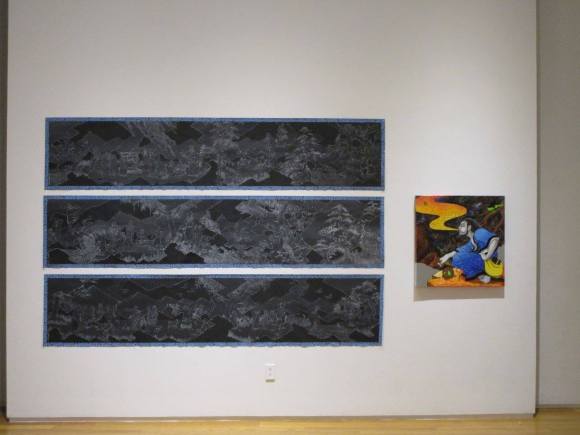
Tokyo University of the Arts Alumni Association of New York’s “2nd Art and Music Collaboration Exhibition,” entitled The Art of Japan: NOW, with the Past, features an art collection by several artists, along with musical performances and workshops all focused on highlighting a combination of modern and traditional Japanese influences.
The opening reception featured shamisen music by Yoko Reikano Kimura and tango/jazz by Machiko Ozawa (violin) & Ayako Shirasaki (piano). Both performances were excellent.
There are also workshops related to this event, including the still to come “NOH WORKSHOP: VOYAGE TO NOH” with sessions for both children and adults on December 10.
The varied and distinctive pieces that comprise The Art of Japan: NOW, with the Past exhibit can be viewed at TCI until Monday, December 11.
For me this was perhaps the most highly anticipated set they’ve done yet. The concept of fantasy cards dedicated to people and creatures embodying the four classic elements is fantastic, and lends itself to endless variation and interpretations. The 20 card base set is a wonderful example of this, with a multitude of artists providing numerous unique, captivating visions.
Base cards 1-5 and SF1.
Base cards 6-10 and SF2.
Base cards 11-15 and SF3.
Base cards 16-20 and SF4.
Also included were four striking spot foil cards by Soni Alcorn-Hender, as well as gorgeous metal and lenticular chase inserts.
Fire metal chase card by Alcione Silva.
Lenticular chase card by Meghan Hetrick.
As always Perna’s sets shine shine with their one of a kind sketch cards and Artist Proof’s. Each artist’s individual style, choice of subject, composition, etc all make every card distinct and all of them together result in the extremely high quality these sets consistently achieve.
My favorite elements are wind and water, so those were the main focus of my collecting. I got wonderfully diverse sketch cards featuring each including a gloriously semi-abstract piece by Mick & Matt Glebe (my first of theirs), Danielle Gransaull’s vivid mermaid, Arwenn Necker’s air elemental with a classic fantasy feel, and a hauntingly etherial work by Sean Pence.
Water by Mick & Matt Glebe.
Water sketch card by Danielle Gransaull.
Wind sketch card by Arwenn Necker.
Wind and water AP by Stacey Kardash.
Wind sketch card by Sean Pence.
Artist Proofs (APs) are generally directly commissioned from the artists and thus provide an opportunity to request something specific (within the guidelines and theme of the set). In a couple of cases, such as the incredible half formed female elemental made entirely of water by Peejay Catacutan at the top of this entry, I gave just a general subject then chose between more specific ideas provided by the artist.
For the rest, instead of a common base idea for my APs as I’ve done in the past this time I tailored most of them a bit more individually based on other cards the artists had done. Stacey Kardash’s sketch cards featured recurring elementals of each type, and I requested an AP with those wind and water elementals. She gave me a number of great compositional options, and I ended up with a fantastic metal AP of the two face to face.
Wind sketch card by Achilleas Kokkinakis from Perna Studios’ Elementals set.
Water AP by Achilleas Kokkinakis.
Wind AP by Achilleas Kokkinakis from Perna Studios’ Elementals set.
I was lucky enough to pull two of my absolute favorite sketch cards from the pre-release previews (and pick up more later). One of the pulls was Achilleas Kokkinakis’ geisha themed air elemental making tea. I adored the idea and execution so much I got two APs inspired by it. One with a water elemental against a gloriously colored sky (prompted by another beautiful sketch card he did) and a wind elemental forming a dragon made of air. I can’t say enough about all the exquisite details, including the intricate borders, small thematic scrolls showing the kaiji for the element, etc.
Earth sketch card by Alexis Hill.
Wind sketch card by Alexis Hill.
Fire and water AP by Alexis Hill.
Water sketch card by Alexis Hill.
My other pull of a sketch I’d been eyeing in previews was Alexis Hill’s striking wind elemental gathering lightening. After I’d added her mermaid and earth elemental sketches to my ever growing collection of her cards, I decided to request a fire elemental AP to complete representation of all four elements. Doing a pairing with water was an idea I’d been batting around, and the resulting metal AP from Alexis is great.
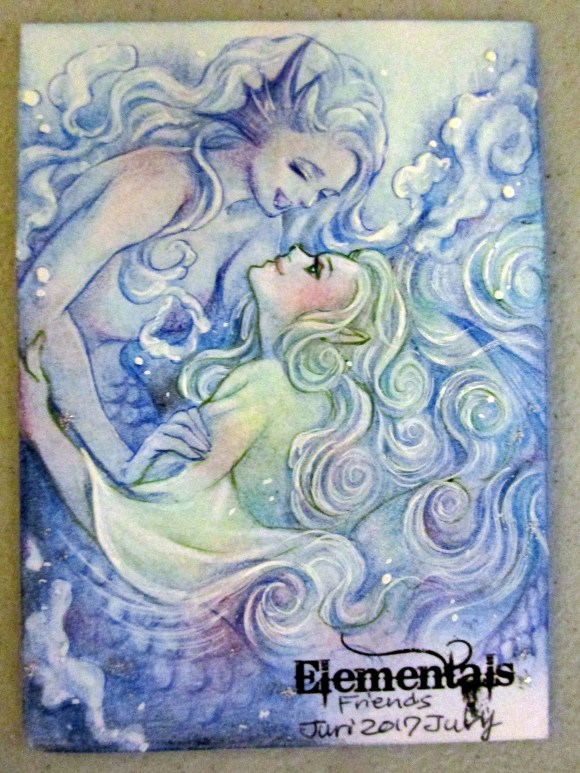
Wind and water AP by Juri Chinchilla.
And of course I was thrilled to add another AP from Juri Chinchilla, this time a playful meeting between a mermaid and her friend made of air. As always Juri’s work is gorgeous, brought to life with her vibrant shades of soft colors. What I really adore about this one in particular is the sense of motion she’s achieved on a small 2D card with the mermaid’s bubbling hair and the (pardon the pun) windswept curls in her counterpart’s.
——-
Hope everyone enjoyed my look at the Elementals set. Of course there are MANY more phenomenal artists featured in it and other excellent sets from Perna Studios to check out..
The signing of Stardom’s Kairi Hojo in early 2017 by the WWE created immediate buzz and excitement. It was wonderful to see that feeling build in anticipation as the Mae Young Classic and her debut as Kairi Sane approached.
Kairi is a masterful ring technician, measuring everything she does carefully and exerting expert body control for maximum visual impact. Her trademark diving elbow from the tope rope looks as beautiful as it does devastating. Her excellent selling draws the audience in and invests them emotionally in her matches, yet she always believably feels like a threat to her opponent no matter how much punishment she’s taken or how much bigger her opponent is. She brings something special and unique to WWE, and the hype surrounding her debut as it approached showed they realized it.
My own perspective on Kairi’s pre-WWE career was bit different from when I wrote about Kana (NXT Step for a Legend) and Johnny Gargano (NXT Step for an Icon) heading to NXT, as I’d only seen her live on two occasions (though she essentially wrestled twice on each show). Even from that small sample it was easy to see the command she has of her craft.
My first time seeing Kairi live was under unique circumstances, as she was involved in Act Yasukawa’s retirement match at Climax 2015.
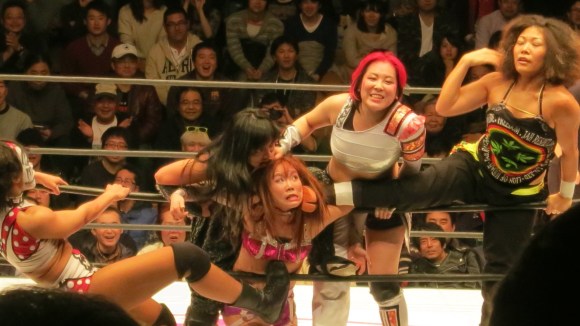
Act’s retirement match and ceremony had an incredible atmosphere around it, and the entire spectacle was awesome to be at live. Kairi teamed with Act & Haruka Kato vs. Holidead, Kris Wolf & Kyoko Kimura in a match that went on for about 10 minutes, with back and forth action that saw Act and her teammates, particularly Kairi, more and more at odds. Both Act and Kairi did a phenomenal job at portraying two people who thought they had reconciled but were just never meant to get along. Things eventually exploded and the two fought into the crowd with everyone else along for the ride, resulting in a double countout.
Then the “real” match began, as Act rejoined her former Oedo Tai stablemates leading to Act Yasukawa & Kyoko Kimura vs Haruka Kato & Kairi Hojo. This was a fitting send off, with Act and her teammates clearly enjoying themselves against long time rivals. Kairi was clearly genuinely emotional as she helped bid farewell to her fellow wrestler’s career.
The following year I was back for Climax 2016 and saw Kairi in a pair of equally impressive matches at opposite ends of the spectrum. In a special contest model Nana Suzuki made her debut in a singles match against Hojo, one of Stardom’s aces. Nana actually played her role as an overmatched but determined underdog well and the match was quite good, due in no small part to Kairi playing her own role of dominant veteran absolutely perfectly. She knew exactly how to rightly control most of the offense and avoid reducing her own standing yet still make her rookie opponent look strong. That takes an incredible amount of skill and a deft touch, and the two told a great story here.
Later that night Kairi told a completely different story as she and partner Yoko Bito looked to regain their Goddesses of Stardom Titles from Oedo Tai (Kyoko Kimura & Kagetsu). This time Kairi was in some sense the underdog, as there was a lot of interference from the Oedo Tai entourage outside the ring. The stacked odds and again excellent awareness of the story being told combined to generate quite the conquering hero reception for Hojo & Bito when they finally overcame it all and took their belts back. It was a treat not only seeing Kairi perform twice, but in such different (but complimentary and consistent) circumstances.
Fast forward back to a few months ago and Kairi entered a WWE ring for the first time as part of the Mae Young Classic. It was certainly no surprise when she provided several of the best matches of the whole thing, including a show-stealing first round encounter with Tessa Blanchard, great bouts with Bianca Belair, Dakota Kai, and Toni Storm, and a fitting finale to the whole thing against Shayna Baszler. Seeing her joy at becoming the well deserved first ever MYC winner was wonderful. Since then she has become an integral part of NXT’s women’s division, and is likely to feud with Shayna Baszler and eventually progress to a one on one challenge to champion Ember Moon.
Incredible art print depicting (and signed by) Kairi by Rob Schamberger.
Kairi Sane is the epitome of the cliche “a joy to watch,” and I wish her all the best as this exciting new phase of her career continues.
I adore Hanamikoji, and its designers have released another excellent 2 player game with a tied in theme / aesthetic.
Gameplay
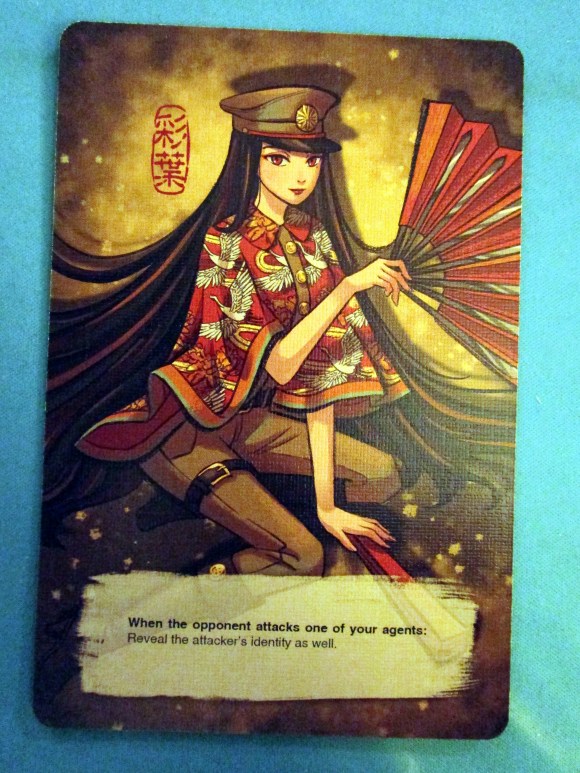
Like Hanamikoji, Shadows in Kyoto has a classic Japanese theme to it, but this time players take on opposite sides of the Meiji Government and Oniwaban in a battle to uncover the other side’s spies and capture key intelligence without being misled.
Each player controls six pieces with values ranging from 0 to 3. There are Stratego-like elements of piece values being hidden from the opposing player and the “weakest” piece being able to capture the opponent’s best when attacking. From there on though Shadows in Kyoto is entirely its own game.
The core of the game revolves around the concept of “key intelligence.” Two of each players’ pieces are marked as carrying their key intelligence. Thematically this means they have “real” information the enemy wants and the rest of the pieces are carrying “fake” information to confuse them.
A player wins if either of their two agents carrying real intelligence reach the opponent’s back row, or if they capture both their opponent’s such agents. However if a player captures too many (three) of their opponent’s agents with fake intelligence they LOSE.
There are also clever card based mechanics related to moving player pieces. Basic colored cards relate to spaces on the board and can move any friendly piece forward (straight or diagonally) into a space of that color. Limited tactics cards add options like moving/attacking sideways or backwards, swapping pieces, or forcing an opposing piece back. The two types of cards are drawn from separate decks giving players interesting hand management options.
Finally, the base game can be modified by the addition of included asymmetric character and equipment cards with special abilities that increase variability and strategic choices.
General Thoughts
First off, there’s nothing tying Shadows in Kyoto to Hanamikoji beyond the art style and setting. But that’s fine, as both games shine as their own unique creations and the common aesthetic is a nice enough touch.
I’ve always enjoyed the hidden information aspect of Stratego, and this pulls the best elements of it and improves them several fold with the concept of real and fake information and multiple victory conditions. The added dimension of often needing to attack yet having to be careful about capturing too many of the “wrong” pieces gives a fantastic extra layer of strategy and a strong “cat and mouse” feel to the game.
The asymmetric elements seem well varied and balanced, and again add an intriguing extra layer to the solid basic gameplay that extends replayability. There are some nice thematic ties running through the powers available to each side as well, particularly given the Oniwaban player always goes first.
Overall
The imaginative new take Shadows in Kyoto brings to classic gameplay elements and the depth arising from the hand management and asymmetric power aspects combine to something really fun and engaging. I loved this accessible, intriguing game immediately.
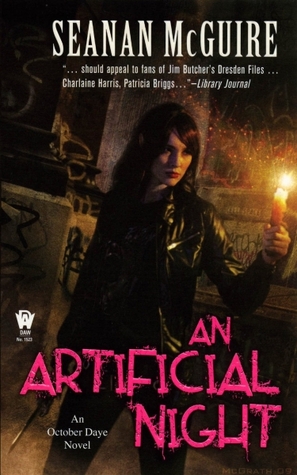
Children, both human and fae, are disappearing, and October Daye is about to find out not all boogeymen are myths.
This is the third book in the October Daye series. There is probably enough context to follow without having read the previous books, but significant depth and nuance would be lost. Best to start with Rosemary and Rue (book 1).
An Artifical Night is fantastic. It revs up quick and hardly ever slows, keeping a constant sense of dread forefront. The skill with which the theme of children’s tales and the nebulous rules of farie are interwoven is masterful. McGuire drops new concepts on reader’s head constantly and abruptly, but she keeps it manageable somehow and does such wonderful things with them all is forgiven. Toby continues to be an excellent protagonist, being smart and largely self aware yet still susceptible to emotional responses and bad decisions.
In addition to compelling characters, interesting world, and strong plot, it’s the writing that shines and draws the reader in. The style is excellent, particularly in distinct, natural sounded dialogue and speech patterns rising from characters’ personalities and individual situations. I enjoyed the continued focus on a couple of my favorite supporting cast members, plus a PHENOMENAL new addition, and how they all interact with Toby.
The last third of the story loses just a touch of what made the first two-thirds so compelling somewhere, but it’s a minor criticism. There are getting to be a few too many building questions and ongoing story threads though, and while they’re all interesting at least a couple need to start being addressed next book.
Easily my favorite book in the series thus far. Highly recommended.
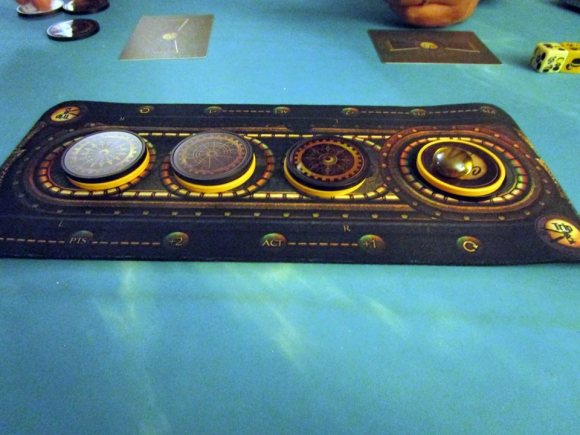
Triplock is a memory based game where four stacks of chips represent the cylinders of a lock to be solved. On a player’s turn die rolls will determine the actions available as they try to manipulate the stacks to match various diagram cards in front of them.
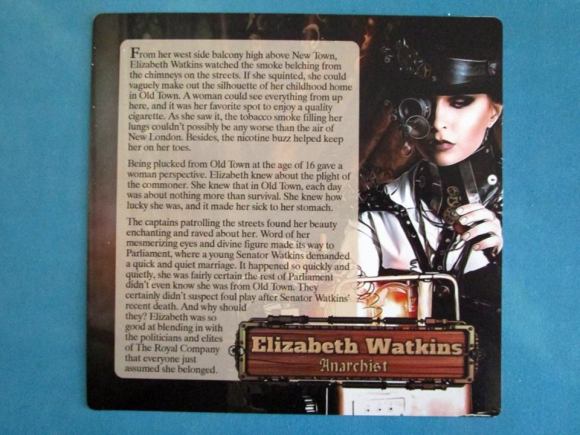
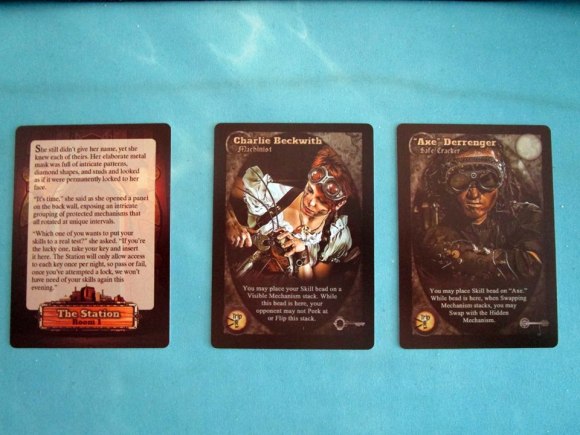
This has a unique feel to it as it combines memory and positioning aspects. There are lots of little nuances that provide good depth, from choosing which of the four options on a diagram card to pursue to being able to discard both die options to pick any action to manipulating the options available to your opponent. There are also several characters to play with different player powers for added variability.
The production values Triplock this are excellent. The stacks of chips that are central to gameplay are of nice weight and design. The plastic coated cards have good thickness and play well, and the oversized character cards provide additional story and more of the game’s wonderful art. The flexible gamemat lays flat when needed for play and rolls up nicely to conserve space for storage. Really impressed overall with the quality of the components here.
I was interested in the look of the solo game for this, but while it’s fine the two player game is better. The solo mode is a series of challenges based on a “room” (scenario) being played. Only one’s included, with others planned as expansions. The story elements are clearly meant to be ongoing, as they were really just a prologue here. I wonder if there’s a set number of expansions planned that will complete this story, or if it’s going to be an indeterminate number of subsequent cliffhangers. Without knowing that I’m unlikely to keep spending additional money on an open ended narrative framework, but the “rooms” will be available in a print and play format that I will likely keep an eye on.
Triplock is an extremely well put together package featuring a fun an different type of game with a fair amount of replay value. Definitely one of the better memory based games I’ve come across.
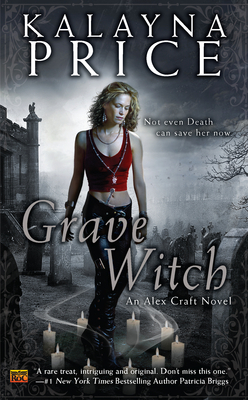
“Grave witch Alex Craft can speak to the dead, but that doesn’t mean she likes what they have to say.“
The most interesting thing about Grave Witch is its underlying world, with an imaginative system of magic giving rise to interesting powers. Equally important (and perhaps more intriguing) are the limitations on those powers, and it’s Alex’s struggle balancing her strengths and weaknesses that provide the book’s highlights.
The plot is solid, with enough mystery, intrigue, and action to keep things moving at a nice clip and engage the reader. Some developments did feel a little forced, while others grew naturally out of the narrative. This seemed a touch more “paranormal romance” than “urban fantasy” to me, and honestly the romance elements were the weakest parts of the book. Although a particular love interest of Alex’s was far and away the novel’s most compelling character.
Overall this was a fine introduction to the adventures of Alex Craft. Nothing particularly spectacular but nothing bad either, and there’s potential. I’m in no rush to continue but not opposed to it if/when the opportunity arises.
“Giants and witches, fairy-tale monsters… those are for heroes. For everything else, they have people like me.”
Changeling October Daye has been reluctantly pulled back into dealing with the fae world and all the headaches and dangers that go with it. When the Duke who granted her knighthood sends her to investigate an odd lack of communication with his niece with tense political implications Toby will have significantly more immediate concerns to worry beyond potential diplomatic incidents.
Rosemary and Rue was a great start to a fantasy series I definitely felt inclined to continue along with. A Local Habitation sees Toby dealing with different, more external threats in a book that’s honestly a step down from the first, but still a solid installment overall. The pace is just a little off and the central mystery, while decent enough, has a couple of weakness that are hard to overlook. In parts I felt Toby and others were just a little too slow on the uptake, which is a rough flaw to get by in a mystery. When the reader feels too far ahead of the protagonist, particularly one like Toby who’s usually sharp, some frustration starts to set in.
But Toby’s second adventure does shine in several of the ways her first one did. The mythology continues to be revealed in a natural, engrossing manner and McGuire’s recurring characters are a delight to observe and attempt to decipher. I also liked this more the second read through, even though I’d forgotten enough about the plot in the intervening years that there shouldn’t have been much difference in the experience. The implications of how everything turns out should have interesting ripple effects going forward.
All in all A Local Habitation was a good read, although I expected just a little more from it based on Rosemary and Rue. Regardless the series is compelling and I’m excited to move on to book three, which will be new to me.
“I know you want to save the world. But… you’re not ready yet.”
I enjoyed bits and pieces of Sam Raimi’s original three Spider-man movies, but overall they weren’t as good as they should have been. I never had enough interest to bother watching the “Amazing Spider-Man” films. But I read a fair number of comics featuring him when I was younger and have always been interested in seeing a proper representation of the character on-screen.
Given the success and quality of Marvel’s ever expanding cinematic universe, news that they reached a deal to reacquire Spidey for use in their own films brought a lot of excitement. The new version of the character was introduced in Civil War, and Tom Holland impressed immediately as the perfect person to channel the balance of earnestness and awkwardness Peter needed.
Still, the high school setting that needs to be incorporated in a solo Spider-Man movie is tricky, and there were points of concern going into this new vision of the wallcrawler. As contradictory as it sounds, I thought things were executed both really well and with somewhat lackluster execution.
Make no mistake, the movie is great overall. When things start to come together the level of tension and emotional pitch are perfect, the action scenes are striking and fun, and the acting throughout is excellent. The catch is getting to the point where the movie becomes fantastic and all of the groundwork pays off is so boring. It shouldn’t be, as there’s nothing wrong with the plotting, acting, nor approach in the first half of the movie as the specifics of Peter’s life and all the important characters around him are introduced. Yet somehow despite being necessary and competently done the film lacks something to fully engage the viewer and shake the feeling of waiting for “the good stuff” to happen. Again, it’s not bad, but the early sections feel slow and pedestrian despite touches of humor and a solid underlying story.
And then a switch flips, and all the buildup, potential, and patience pay off in a big way. The climax of the movie is fantastic, anchored by incredible performances by Michael Keaton as a smart, dangerous antagonist just a few degrees of center and by Holland as a wannabe hero coming of age. Homecoming became everything I wanted from a Spider-Man movie by the end, it just took it a while to get there. Hang in for the full ride, and you’ll be rewarded with some of the MCU’s best scenes and performances. I just hope next time they’ll skip right to that feeling from the get go.
“It’s just that sometimes my cases were more Brothers Grimm than Magnum PI.”
Former knight October Daye, who prefers Toby, is half human / half fae changeling who has extremely good reasons for no longer wanting anything to due with the Faerie world. However it has no intention of giving her a choice…
I’m getting back into urban fantasy in earnest and decided to refresh my memory on the first couple of October Daye novels so I could continue with the series. I remember Rosemary and Rue being a great start, and reached the same conclusion with this reread. It establishes a deep intersecting world combining Fae kingdoms with the modern world as well as giving weighty, completely understandable reasons for protagonist Toby Daye’s role as a reluctant heroine. We feel the tragedy of her past, and thus are fully invested in the troubles she unwillingly has to deal with.
McGuire does a phenomenal job here providing enough context and answers to fully engage the reader while simultaneously really only scratching the surface of her world’s potential and mysteries she has in store. Particularly compelling are the variety of diverse and genuine feeling characters Toby has to deal with, each with a well formed personality and their own goals and agendas. I’ll hold off naming favorites to avoid spoilers, but the cast really shines overall and is one of the series’ greatest assets.
The plot and underlying mystery is appropriately tense, builds nicely, and unfolds logically. I’ve enjoyed revisiting Rosemary and Rue and am really looking forward to getting farther along in Toby’s adventures.