Categories
Japan Wrestling

Farewell Gatoh Move, Long Live ChocoPro

On August 31, 2024 Emi Sakura’s promotion Gatoh Move held a show at historic Korakuen Hall for the first time in eight years (full show available on YouTube). It was a great show and a huge milestone for the small company that fought tooth and nail to survive and evolve during difficult and turbulent times.

One of their evolutions was the creation of a second promotion/brand, named ChocoPro, during the pandemic. Once performing in front of crowds became possible again Gatoh Move and ChocoPro existed side by side.

After the Korakuen show, Sakura announced that her two brands would officially be merging, to be known only as ChocoPro going forward. As such I wanted to take a quick look back on the significance of the merge, and what separated the brands in the first place.
In 2012 Emi Sakura left a company that she founded called Ice Ribbon (that to this day still running and highly enjoyable), and founded a new joshi (girl/woman) promotion named Gatoh Move.

Likewise built around the idea that wrestling should be fun for both the wrestlers and fans, Gatoh’s general approach to wrestling wowed me when I initially saw them during my first trip to Japan both in ring and in the unique environment of Ichigaya Chocolate Square.

A deep dive into the promotion is beyond the purpose of this post, but check out this retrospective I wrote for their 10 year anniversary highlighting a lot of what I adore about both Gatoh Move and ChocoPro.

As mentioned above ChocoPro was created as a direct response to the difficulties of operating during the pandemic. Sakura didn’t want to just proceed as if they were doing Gatoh Move shows without fans. She approached the idea of streaming empty venue shows as something completely new that should be tailored and targeted as such.

When ChocoPro started there were three key differences to Gatoh Move. First was the absence of an audience in attendance.

Second, all the shows would stream live, where Gatoh shows had been primarily for the attending audience with big shows released on dvd and nothin aired live. This also led to Sakura’s new No Pay Wall strategy of having all their shows and other content airing free on YouTube with a variety of optional support methods.

The third key difference was that while Gatoh Move had always incorporated a lot of guest male wrestlers into their shows and were known for great intergender wrestling, they were still a joshi promotion. The official Gatoh roster was all women, the titles were held by women or intergender teams, and outside of extremely unusual circumstances the main events would always feature a roster member.

While still based largely around the core Gatoh roster, ChocoPro immediately established itself as a fully intergender promotion with a main event of Baliyan Akki vs Minoru Suzuki on the first show. As ChocoPro went on the vacated Super Asia singles title would return as an intergender belt, and likewise the Asia Dream Tag Titles would become open to challenges by male teams.

As pandemic restrictions lifted and live crowds began to be allowed again, the delineation between Gatoh Move and ChocoPro changed.

ChocoPro started running “ChocoPro Peoples” shows, which were still aimed at the streaming audience but had live attendees as well.

When “Gatoh Move” officially returned it was specifically used for the ring shows, and ChocoPro essentially became the name for the Ichigaya shows. All other differences besides the official Gatoh Move roster still being all joshi wrestlers had fallen by the wayside.

So at this point the merge is mostly a symbolic action to make things more straightforward with a single name for the company. While I’m personally quite attached to the Gatoh Move name and sad to see it go ChocoPro is more reflective of what the company has become. The overall impact on the fans is minimal, as the same great people will be presenting the same great wrestling they have been for years.

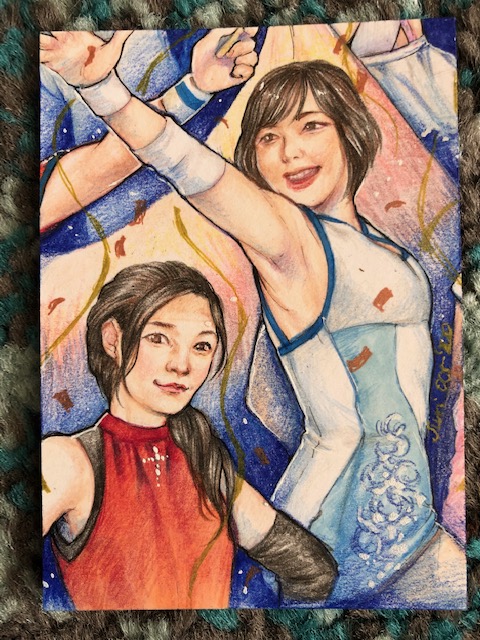
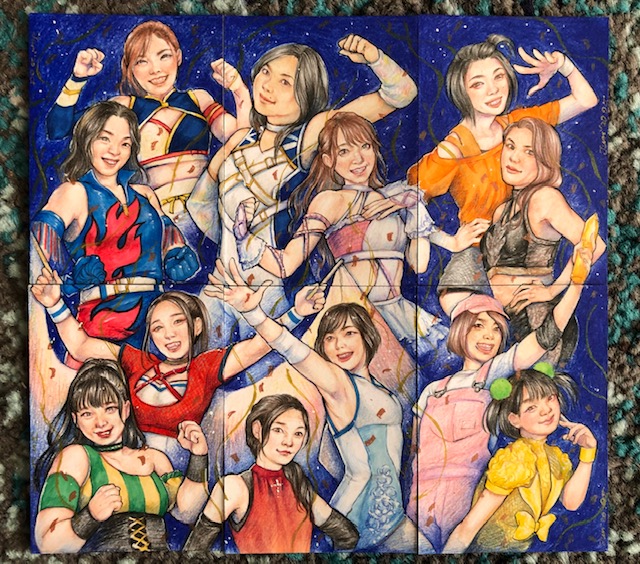
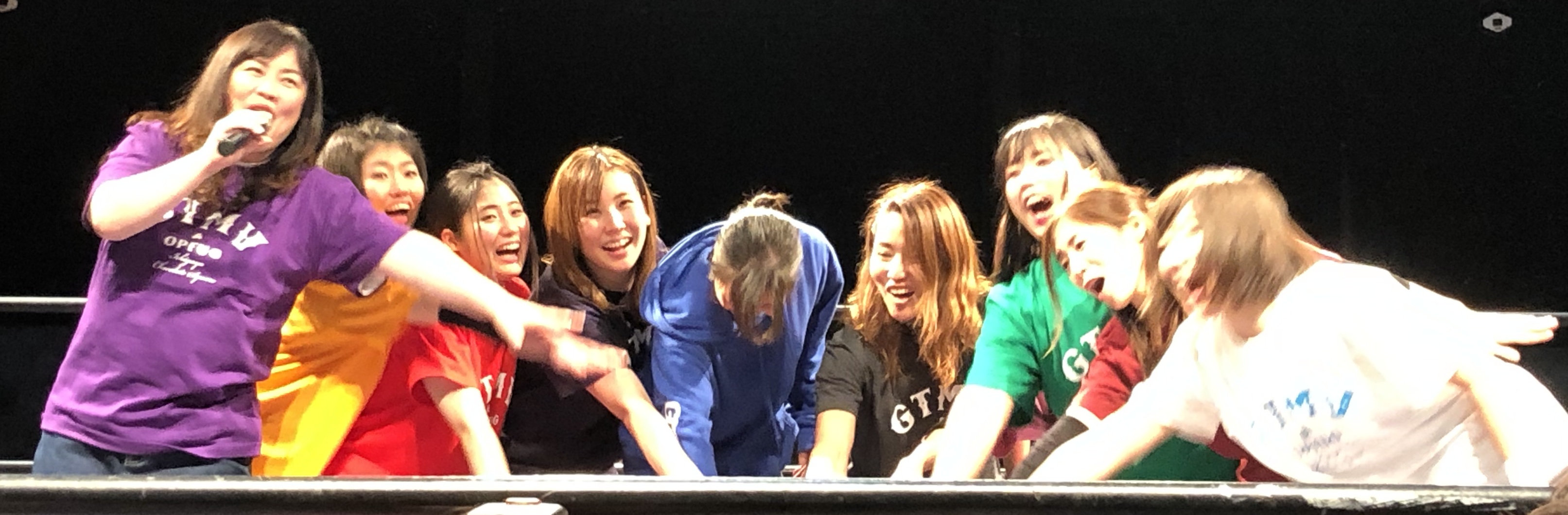
2019 Gatoh Move roster PSC puzzle by Juri Chinchilla.

So that’s why Gatoh Move/ChocoPro had two names, what the differences originally were, and what they became. Wishing all the best going forward for the newly “combined” ChocoPro.
Categories
Japan Wrestling

Pure Violence: Arisa Nakajima’s Retirement

August 4, 2024

Among near uncountable incredibly talented favorites of mine, there’s perhaps no wrestler who better encapsulates my time as a joshi wrestling fan in Japan than Arisa Nakajima.

Arisa was already a huge star who’d been wrestling for nearly a decade when I traveled to Japan for the first time in late 2015. Though I hadn’t seen any of her matches I was well aware of her reputation. She was already a two-time JWP Openweight Champion (of four eventual total reigns), and her battles with the equally tough as nails Kana (now WWE’s Asuka) were legendary.

I was also familiar with, and a big fan of, her tag partner Tsukasa Fujimoto from Tsukka’s appearance in Shimmer in fall of 2014.

So of all the wrestlers I’d be lucky enough to see live for the first time during that trip, I was far and away most excited about Arisa. Needless to say, she certainly didn’t disappoint.

I saw her wrestle for the first time in the main event of my fifth show in Japan, JWP’s 12/23/15 event . She faced Kayoko Haruyama, and made an immediate and lasting impression against her more veteran, larger opponent.

Arisa exudes self confidence and determination every second she’s in the ring. They beat the hell out of each other in a tremendous battle that confirmed everything I’d heard about Arisa and made her an instant favorite of mine.

Speaking of instant favorites, the same show was also my first time seeing Dash Chisako & Sendai Sachiko (the Jumonji Sisters). They were fantastic and my anticipation levels for their tag title match against Arisa & Tsukka (Best Friends) a few days later at JWP’s Climax 12/27/15 shot through the roof. It was amazing, and remains one of my favorite matches of all time to this day.

All in all I saw 84 matches featuring 144 different wrestlers during that first trip. Arisa was in all 3 matches at the top of my list of favorites (more on the third of those matches to come).

The trend of top tier matches would continue, with Arisa’s intensity and skill making her appearances highlights of every trip.

As luck would have it my next opportunity to see Arisa would come relativity quickly. A few months later I attended her first and only Shimmer weekend. It was her US debut, and it was really cool to see her compete in a different atmosphere against a variety of opponents she’d be unlikely to face anywhere else.

She had four matches over the course of the weekend, and made an immediate splash defeating former Shimmer Champion Nicole Matthews in her first match with the company. She also faced solid Shimmer mainstays Shazza McKenzie and Rhea O’Reilly on later volumes.

The true centerpiece of her weekend though was a Shimmer title match against reigning champion Madison Eagles. It can’t be overstated how special it was at the time to see the reigning JWP Openweight Champion coming into a US promotion and facing their top tile holder. It was a dream match for me, and they absolutely tore the house down.

Arisa’s intensity is ever-present. Her hard hitting style evokes a visceral response that draws fans into her struggles and battles.

Whether she’s displaying her deep technical prowess, breaking out the occasional high flying spectacle, or simply wearing her opponent down with a never-ending onslaught of brutal strikes, Arisa’s always captivating to watch.

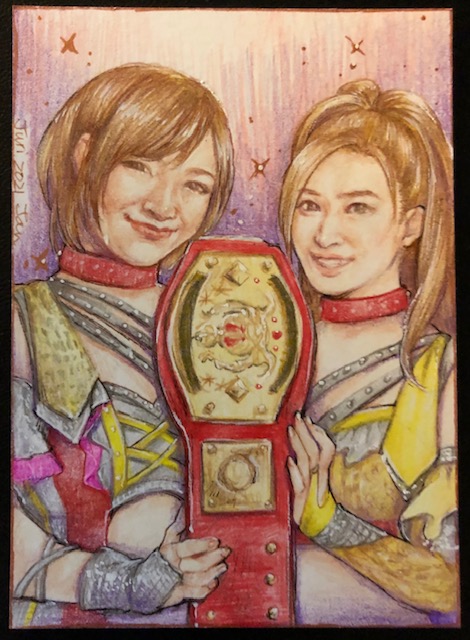
Best Friends (Arisa Nakajima & Tsukasa Fujimoto) PSC by Juri H. Chinchilla.

I alluded to another top match from my first trip above, and it had long lasting influence on me in a number of ways. At Ribbonmania 2015 I saw Best Friends defend Ice Ribbon’s International Tag Ribbon titles against Misaki Ohata & Ryo Mizunami (Avid Rival). Misaki was another favorite of mine from her time in Shimmer, and seeing this particular group of wrestlers face off was such a treat. They’re two of the greatest tag teams of all time, and the chemistry they had was incredible.

The match was so special to me and made such an impression that when the teams were slated to wrestle a special three match series a year and a half after their initial encounter I made a specific trip to Japan planned largely around seeing two of the shows they were fighting on. The Ribbonmania match plus the best of three series were the only four times they faced each other, and they are all excellent contests well worth seeking out.

In addition, Misaki was an extremely similar wrestler to Arisa in terms of tenacity, style, and mastery of the German Suplex as a signature move. The rivalry the two had was enthralling, throughout interactions in both tag and singles matches over numerous years.

It’d be impossible to go through every single match of Arisa’s I adored. Just the small sliver of her career I was lucky enough to witness live is a treasure trove of impactful pro wrestling masterclasses.

A few more that are particularly fond memories for me include a war against cocky upstart Mio Momono (SEAdLINNNG 4/18/18), Best Friends against Kyuri & Maika Ozaki (Gekokujo, Ice Ribbon 12/24/17), and an underrated match of unusual pairings where Arisa teamed with Karen DATE against Misaki & Asahi (Ice Ribbon 10/8/18).

I haven’t been able to return to Japan since prior to the pandemic, so while I didn’t know it at the time Arisa’s main event against Yoshiko of SEAdLINNNG’s 1/24/2020 show would be the last time I saw her wrestle live. As far as an in person memory of her career, a big singles match against another major star of her current company is a good note to finish on.

Arisa’s retirement road has been as intense as the rest of her career. Tsukka made a temporary return from hiatus to properly send her partner off, and has been involved in several of Arisa’s last matches.

Getting to see Arisa cross paths with Mio Momono, Dash Chisako, and others one last time has been a blast. Best Friends also wrestled a number of dream matches on Arisa’s way out, including against Chihiro Hashimoto & Yuu (Team 200kg) and opposite Stardom’s ace Mayu Iwatani.

Arisa Nakajima’s final show will be SEAdLINNNG’s 8/23/24 event. She will wrestle twice and her last match is the main event teaming with Tsukka against Hiroyo Matsumoto & Hanako Nakamori.

While I wish Arisa could continue wrestling forever, she’s maintained an incredibly physical style for a long, wondrous 18 year career and no doubt has a long list of accumulated injuries to deal with. Stopping on her own terms is wise.

I’m grateful for all she’s done to entertain us fans and wish her all the best in life after wrestling.

Categories
Cards Japan Wrestling

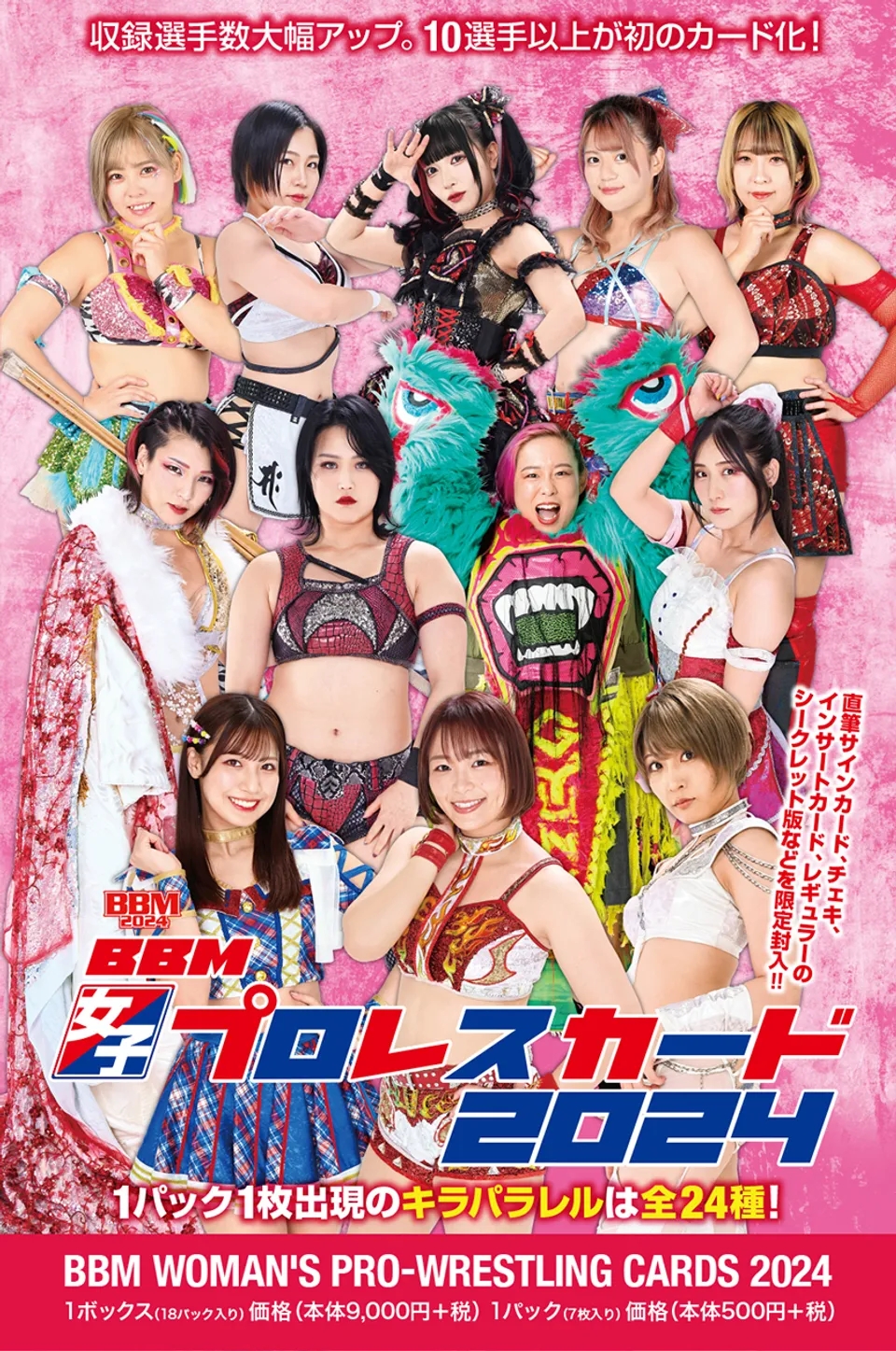
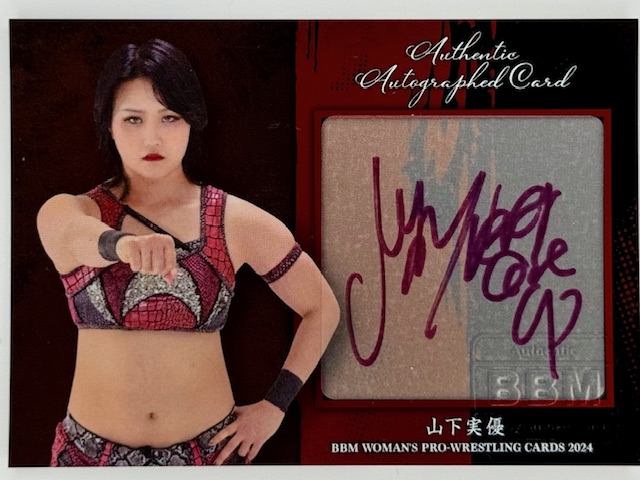
Collecting Spotlight: BBM Women’s Wrestling 2024 Card Set

BBM releases yearly card sets for a variety of sports, and for over a decade I have been collecting their joshi wrestling sets. Here we’ll take a look at the details and differences in their most recent offering.

Known as True Heart until 2020 and simply Women’s Wrestling since then, these yearly sets focus on women wrestlers all across Japan. Most joshi wrestling companies and freelancers participate. The main exception is World Wonder Ring Stardom, whose roster members do not appear in these sets (Stardom has done occasional card based products on their own in the past).

There are also rare special sets released in addition to the yearly sets, such as the recent 2023 Ambitious. As opposed to the general random nature of packs and boxes, Ambitious 2023 was a box only release. Each box contained a complete 47 card base set, one of nine possible acrylic standee cards, and a small number of random chase inserts and signature cards.

The standard packing numbers for the last several years of Women’s Wrestling releases have been 6 cards per pack, 20 packs per box. Each box had some chase cards in random packs, with the chase card replacing one of the base cards (so you’re always getting 6 cards in a pack).

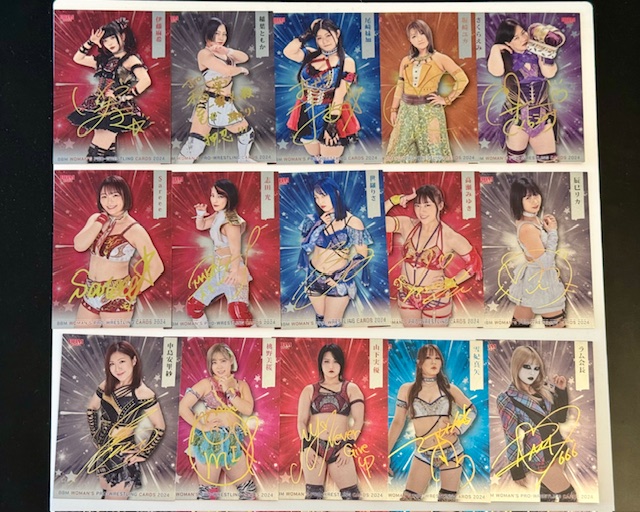
This release dropped from 20 packs per box to 18, but increased the cards per pack to 7. The seventh card in each pack is a one of the 24 “Kira” chase cards, shiny cards which feature a facsimile auto of the depicted wrestler. It’s a solid move for BBM, as now each pack has something a little special in it.

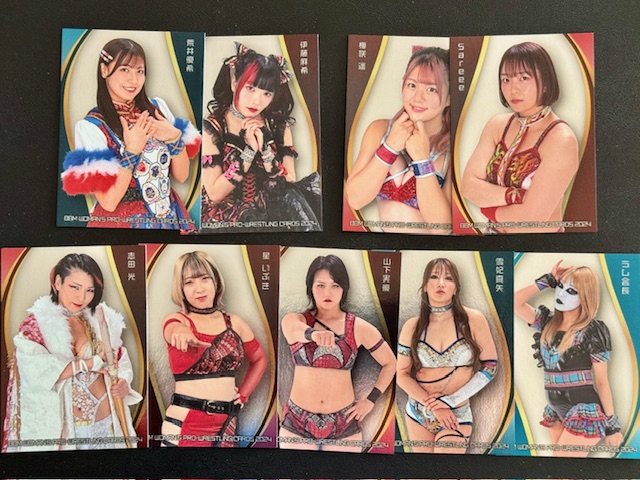
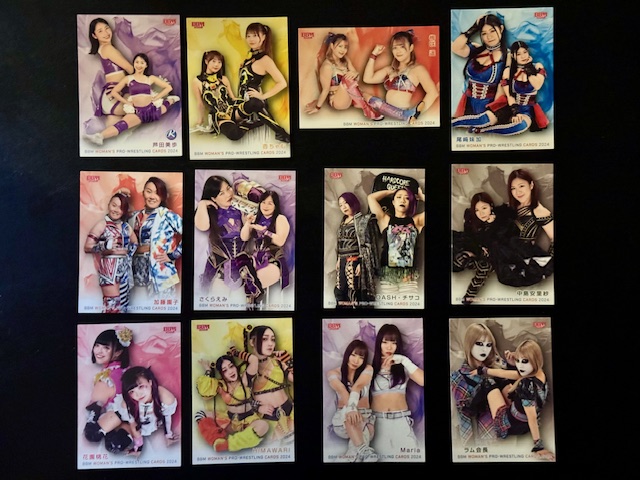
The other chase subsets in the 2024 set are a 9 card foil subset, and 19 “secret” chase cards (18 base card secret variants plus a secret card for Nanashi (“no name”)). The base cards generally feature two images of the featured wrestler while the various inserts highlight a single pose, headshot, etc. There tends to be 3 foil and 3 secret cards per box.

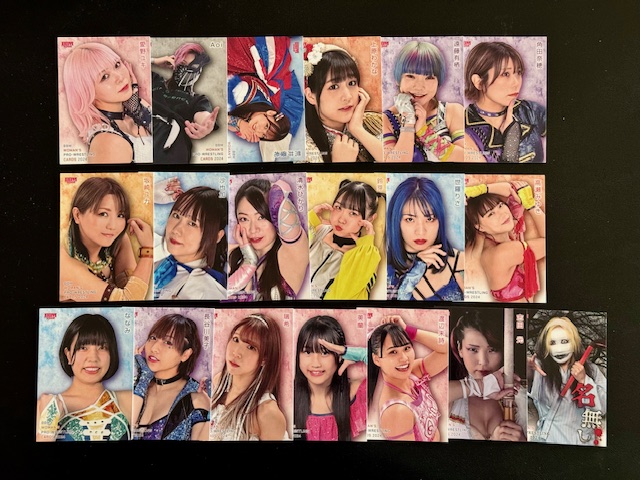
An assortment of base cards from the 2024 set.

The yearly base set varies in size each year to reflect new wrestlers, retirements, occasional special cards for tag teams, and so on. There are a lot of joshi wrestlers active in Japan and these are not small sets. The 2024 base set consists of 156 cards, which is a little over a box and a half of base cards (if no duplicates were drawn).

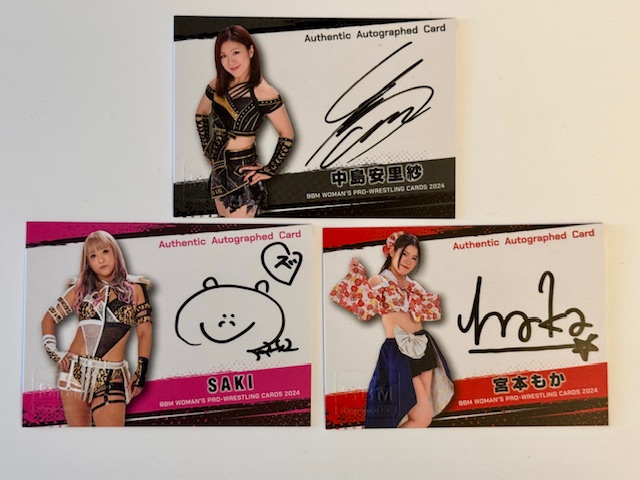
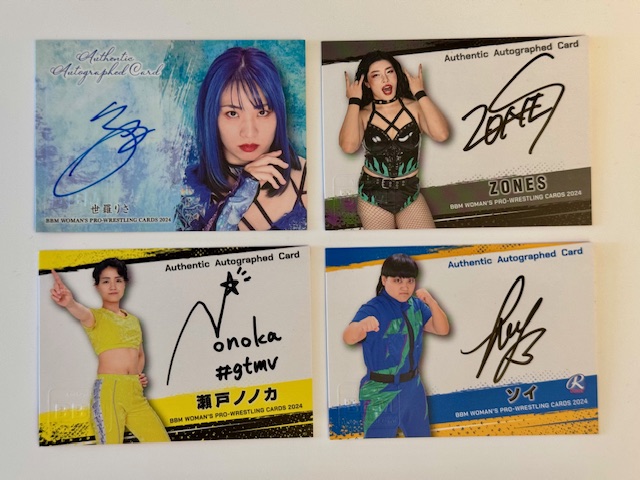
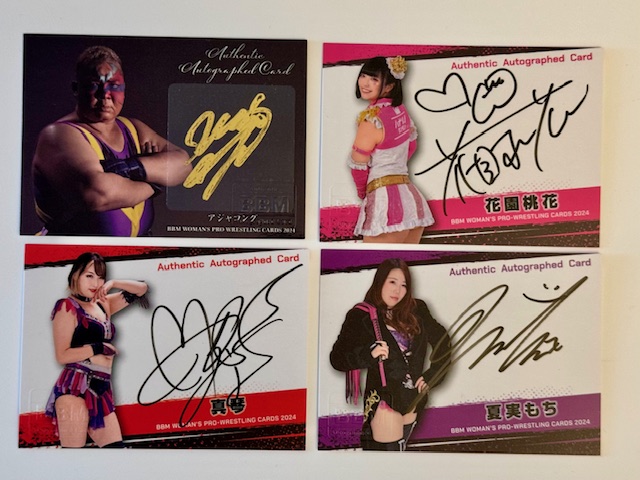
One of the main draws of the sets are the special randomly included cards signed by the wrestlers. This year there are 3-4 sig cards per box.

Anecdotally, for several cases I’m aware of, there were exactly 3 boxes in the 12 box case that had 3 sig cards with the remainder having 4. So it seems like a pretty stable 75% of boxes have 4 sig cards and 25% have 3.

These autographed cards are numbered and there’s generally around 100 of each base version. The vast majority of the base sigs cards this year are on card signatures (with stickers only used for included wrestlers currently based overseas), which is great.

The base signature card design this year is very simple, but I personally like them a lot. The focus is firmly on the wrestler and their signature, and having a fair bit of white background on them makes the insert variants with fully colored backs contrast more.

The 2024 set has signed secret variant cards for the wrestlers who have secret base versions. These are limited/numbered to 90. The foil insert subset has associated signature cards numbered to 60 each.

There are also a small number of “super secret” signature cards. Aja Kong has one limited to 30 copies, while five other wrestlers have versions limited to 10.

Stickers were used for all of the insert autos, which isn’t ideal but is understandable as they’re going for a certain look with these and the stickers limit signatures to a confined area on the card. All of the various insert autos this year look stunning.

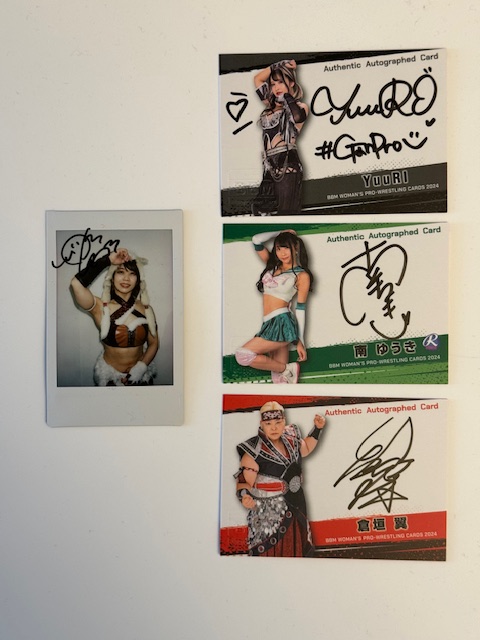
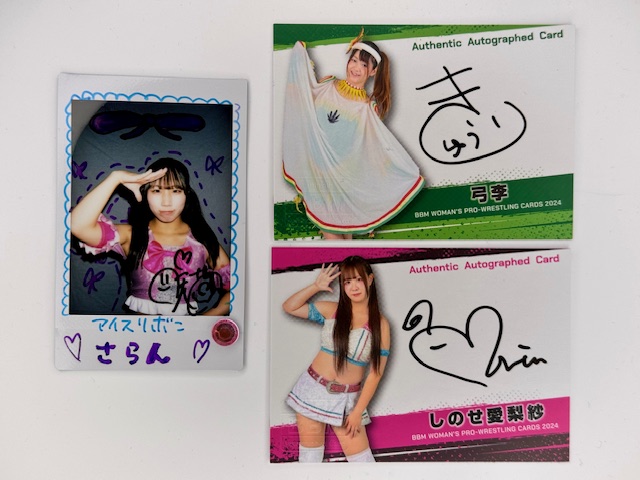
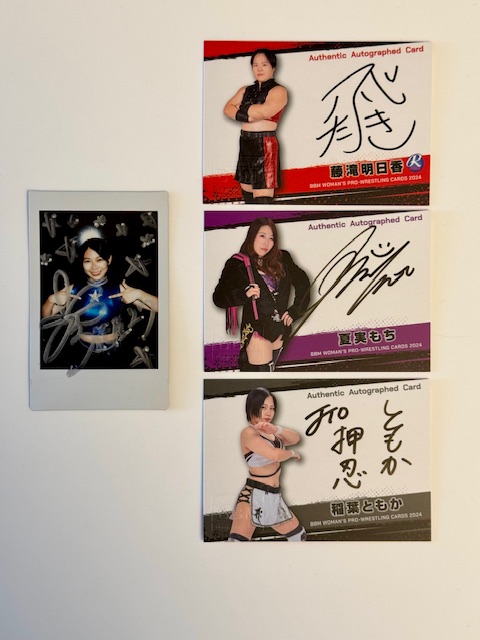
The last chase items to talk about are chekis: mini polaroids of the wrestlers signed and sometimes decorated by them. There are generally 10 for each wrestler who does them (not everyone in the base set does), with a few wrestlers doing different outfits and having a total of 20 this year.

In past years chekis were generally extremely stable pull rate-wise at 3 per case (or 1 per 4 boxes). This year it has dropped to 2 per case (1 in 6 boxes). While they are among the most rare inserts to try to collect, they’re wonderfully unique and a focus of my personal collection.

So that’s it for my breakdown of this year’s BBM Women’s Wrestling release. I wish anyone who decides to collect some of this fun set good luck with their pulls and pickups.

Categories
Japan Wrestling

Deathmatch Daisuki: Hikari Noa’s “Graduation” from TJPW

By the beginning of 2018 I had been to Japan a number of times, and Tokyo Joshi Pro-Wrestling (TJPW) had morphed from a curiosity that wasn’t really aimed at me into one of my favorite promotions.

Their big January 4th show that year opened with the quadruple debut of a wrestling subset of the idol group Up Up Girls, and included someone who would go on to be one of my absolute favorites in the promotion.

The original Up Up Girls lineup, Miu, Hikari, Raku, and Hinano, wrestled in identical gear outside of their signature color versions. They made a solid impression in a basic but fun debut match that hinted at a lot of potential for the group.

A year later the group would transition to new, more individualized gear and tweak their names. This is when Hikari became Hikari Noa, touches of her goth aesthetic were introduced into her outfit, and her unique personality and infectious charisma really started to show.

From the boisterous powerhouse Miu Watanabe, to the sleepy train otaku Raku, to the deathmatch loving Hikari Noa the Up Up Girls became more and more beloved by fans as they let themselves shine. As Pipipipi Pinano (the former Hinano) retired in April 2019, the Up Up Girls would continue as this trio until Shino Suzuki’s debut in 2023.

For me Hikari in particular was a breath of fresh air in wrestling. She took to it well, and evolved quickly in her early career consistently improving and finding her own style within the ring. She was engaging to watch, easy to cheer for, and eventually became one of TJPW’s most popular roster members.

I thoroughly enjoyed her matches, relishing in the opportunities I had to see her compete live against some of TJPW’s top stars. She was the ultimate underdog babyface to me, and I enthusiastically followed along with her progress and celebrated every victory.

In 2021 Hikari became the first Up Up Girl to win singles gold, defeating Yuki “Kamiyu” Kamifuku for the International Princess Championship. She held it from May until January with four successful defenses before losing it to former champion Maki Itoh.

“Deathmatch Daisuki” (“I love deathmatches”) Hikari Noa was true to herself in her wrestling goals, making it well known she intended to someday participate in the type of deathmatches that captured her imagination and attracted her to wrestling in the first place.

She was at the forefront of TJPW beginning to stretch beyond their norms. Her first ever hardcore match main evented TJPW’s first Inspiration show, a spin off concept for unique matches outside of TJPW’s core model. She put up a valiant fight against hardcore veteran Rina Yamashita in a great showing.

Hikari would get her ultimate wish in August 2021, participating in an Electric Current Deathmatch as part of an eight-person inter gender tag contest on a DDT show also featuring TJPW’s Maki Itoh on the other team. In 2023 she’d have a singles Fluorescent Lighttubes Deathmatch against Sawyer Wreck to headline Inspiration #6.

Deathmatches generally aren’t my thing, but I was thrilled that Hikari kept pushing her personal dreams and got to realize the ambitions that brought her into wrestling in the first place.

In September 2023 Hikari and her partner Nao Kakuta, collectively known as Free Wi-Fi, won the Princess Tag Team Championships.

The reign was unusually significant for Hikari, who had three other regular partners (Pinano, Sena Shiori, and Natsumi Maki) who either retired or left TJPW before the team could achieve championship success. For Nao, it was her first championship ever (and only, as she’ll be retiring this July).

Free Wi-Fi was an incredibly fun, skilled team and I was overjoyed to see them ascend to the top of TJPW’s tag division.

In late December 2023, shortly before Free Wi-Fi was set to defend the Princess Tag Team Championships at TJPW’s 1/4/2024 show, a press conference was held announcing they were vacating the titles.

Hikari was not at the press conference (her partner Nao Kakuta and TJPW founder Tetsuya Koda spoke). It was initially reported that she was out due to illness. In mid February TJPW and Up Up Girls management announced she was on indefinite hiatus “due to personal reasons.”

Finally in May it was announced that “after discussions with her about her future” Hikari had left TJPW and Up Up Girls (the general term Japanese companies use for someone leaving, whether retirement or otherwise, is “graduation”).

There would be no farewell appearance or show, and no social media statement from her. The company statement included a general apology from her about not being able to live up to waiting fans wishing for her to return. Hikari has not made any public appearances nor any social media posts since before the original press conference in December.

At this time no one is aware if she’ll ever return to wrestling or public life in general. I will not speculate nor discuss this beyond the above presentation of the public timeline, but of course it is a shame to see one of my favorite wrestlers ever leave the company under such abrupt, clouded circumstances. But whatever the case, I hope things are going well for her.

If this is the end of her wrestling career, it will have spanned over 350 matches across six years. While I’d love for her to return, I am deeply grateful for all the time and effort she spent entertaining fans regardless.

Hikari was always cheerful and appreciative when greeting fans, and I am blessed to have had to the opportunity to meet her a number of times. My thanks again for all the fun she added to wrestling.

I will miss her terribly, but more importantly whatever she does in the future I hope she’s happy and I wish her all the best.

Categories
Art Cards Comics Japan Wrestling

Monochrome Masterpieces: Collecting Printing Plates

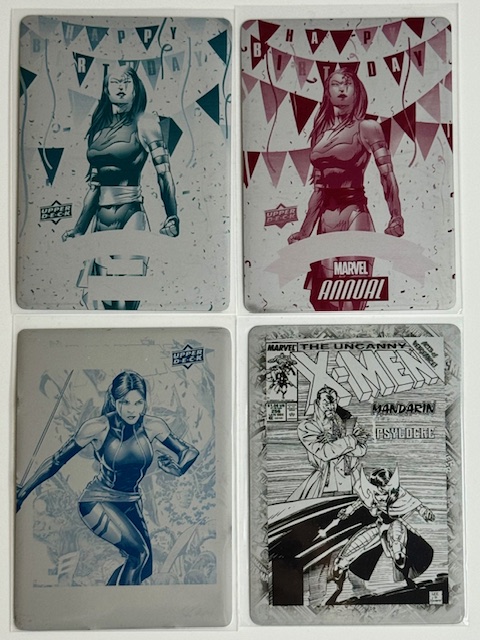
Today I’d like to talk about one of the most unusual and unique trading card related collectibles: the printing plates used to generate the images on the cards.

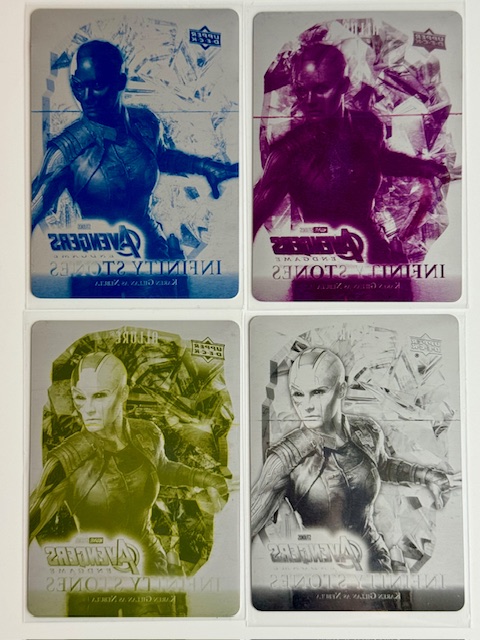
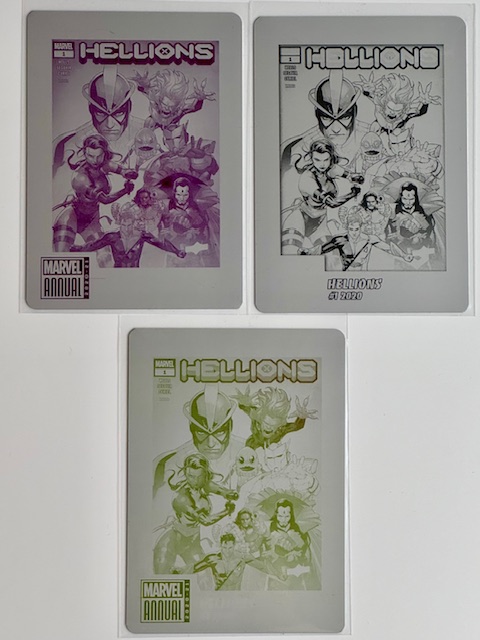
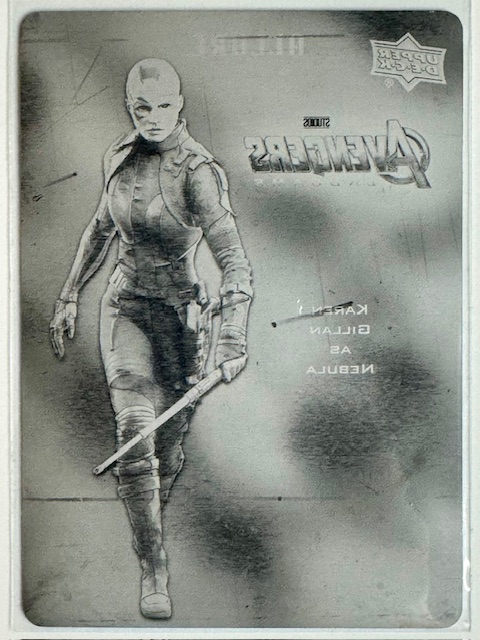
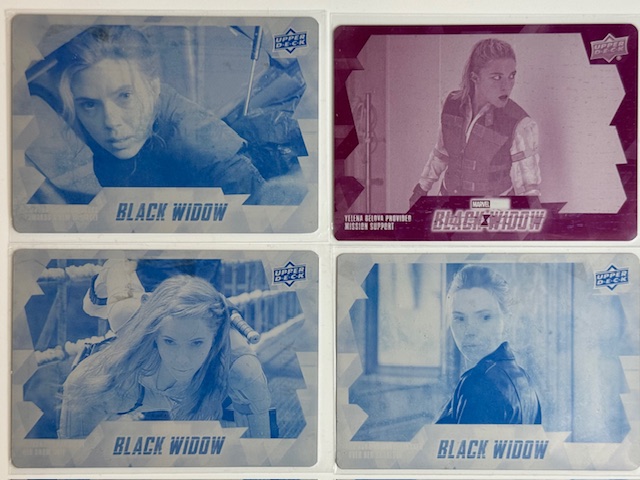
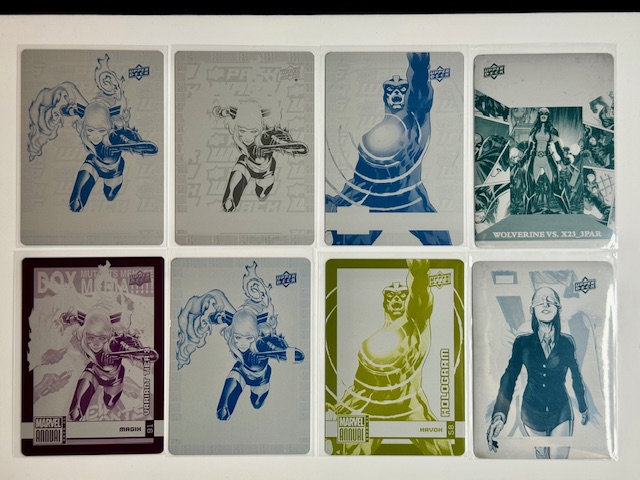
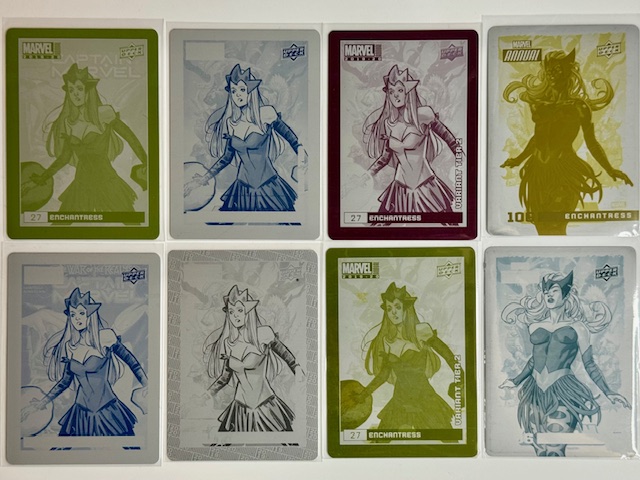
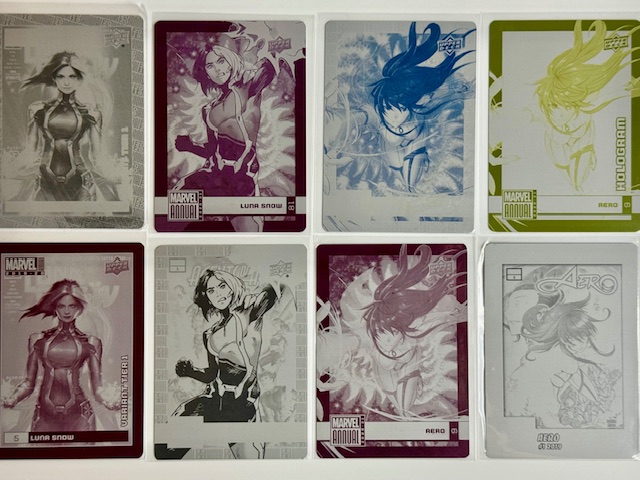
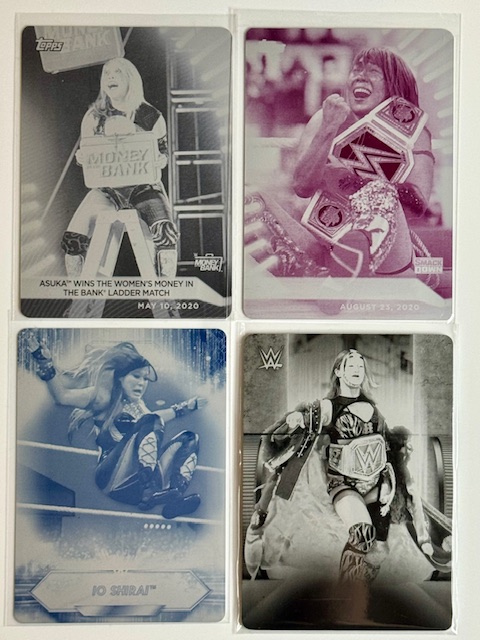
Printing plates are thin metal sheets used in the printing process of the card they represent. Generally there are four plates for a card corresponding to four basic component colors: black, cyan, magenta and yellow. When distributed plates usually have a sticker affixed to the back with publisher, set, card, and copyright information.

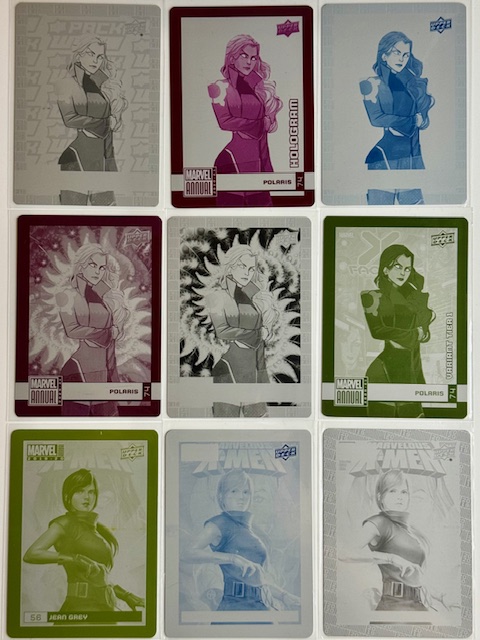
Different colored variants of a card won’t have different plates (changing ink saturation levels produces these versions) but variants with different background patterns, text or logos, etc will. Whether these other versions, or any plates at all, are distributed depends on the manufacturer, set, and distribution method.

Printing plates are extremely unique as a collectible. While many of them are still in great shape, given their nature they are also often imperfect as they may contain smudges, printing lines, blurred images, scratches, or other after effects of the printing process. How much these imperfections affect someone’s desire to collect a particular plate generally depends on the extent and of course personal preferences.

Also certain ink colors may have been practically unused in creating an image and that corresponding plate could be largely blank or an otherwise incomplete image. While rare, this phenomenon is a risk and particularly pops up comic and other art based cards (as opposed to photo based cards, where underlying colors are generally present across the image).

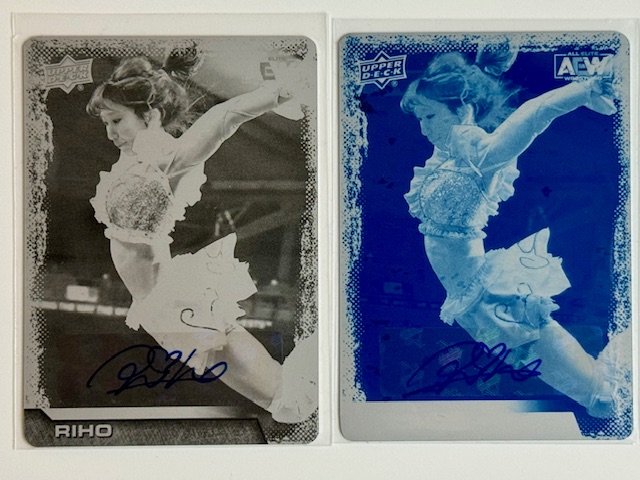
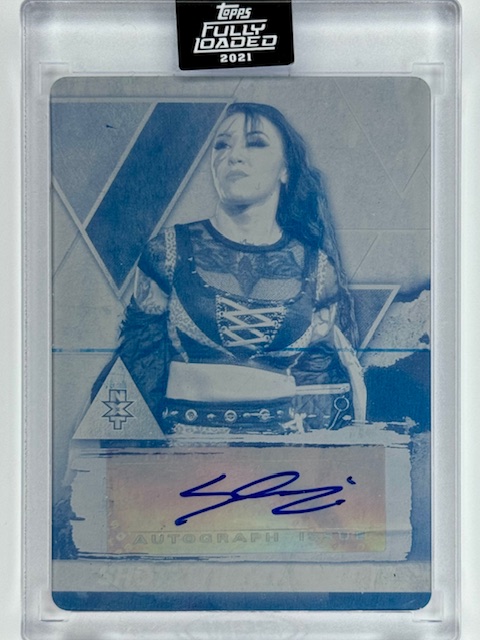
In certain circumstances printing plates may also be distributed with autographs. Actors or athletes depicted, or creators or voice actors of shown characters, sometimes have their autographs on the front of the plates. Usually it’s done via affixing a signed sticker, but direct signatures aren’t unheard of. This is an added layer of collectability and reward for the person who draws the plate.

In addition to printing plates being randomly inserted into packs of their card sets, they are also commonly used as special distribution prizes. Upper Deck often has certain plates set aside to be used as rewards for completing collection goals in their online buying and trading platform ePack.

Sometimes plates used for these purposes are grouped together as sets, occasionally even being collected in connecting booklets. This can be convenient for completionists, as trying to collect all four color plates for a particular card when the plates are separately randomly inserted is a daunting task.

Metal Universe X-men printing plate booklets in custom display cases by Hardball34.

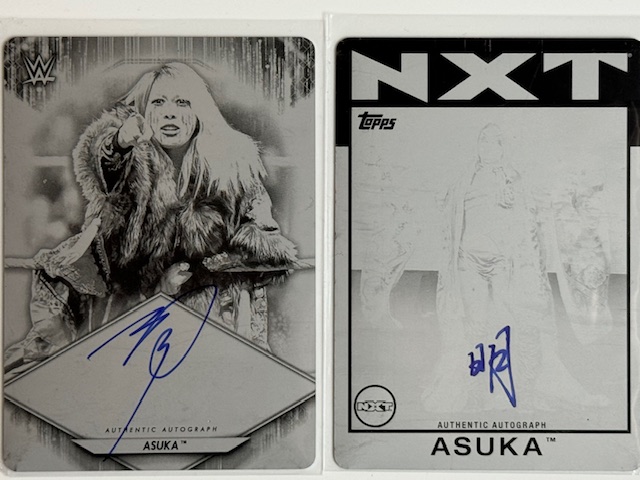
My personal affinity for collecting plates evolved from getting several wonderful booklet collections from the Metal Universe X-men set, as well as drawing some for my favorite characters from Marvel Annual sets and my favorite wrestlers from WWE and AEW sets.

From there I started more proactively chasing/trading for/buying plates and they’ve become a cornerstone of my collections all around. I adore the way the underlying color images look, and there’s just something cool about having a piece of the process.

The lion’s share of my plates are Marvel related from Upper Deck (UD), featuring a dazzling array of comic book characters and MCU actors.

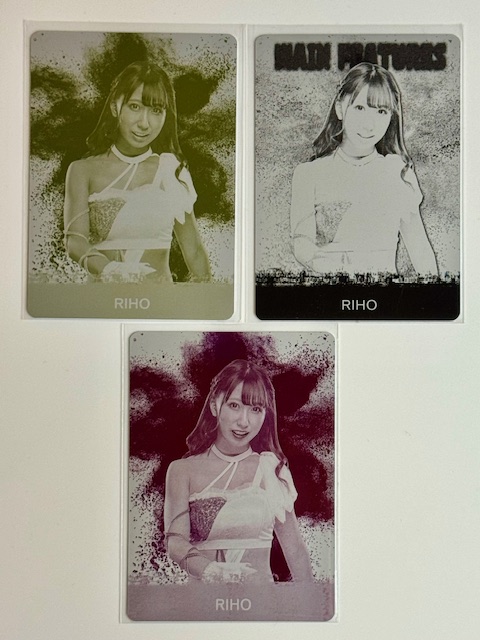
However I also heavily collect joshi wrestling cards, and plates of certain wrestlers from UD’s AEW sets as well as Topps WWE sets form an additional, smaller centerpiece of my collection.

Riho plate displayed with AEW 1/1s in a custom frame by Dion Divens.

Chasing plate “rainbows” (a complete color collection of plates for a given card) is a case by case basis for me. For certain images, characters, and wrestlers I collect everything of theirs I can find. In other cases a particular color plate for a particular card jumps out at me and I’m happy just to have that.

Occasionally a plate I’d otherwise want to keep just doesn’t look great to me in that color and/or with its particular imperfections. And of course as with any card related collectible rarity, availability, popularity with other collectors, and luck all greatly influence what actually ends up in the collection.

These little pieces of metal have become some of my favorite collectibles. I love monochrome art in the first place, and the fact that these are essentially art and photos broken down into that format appeals to me greatly. I’m sure I’ll be expanding their numbers for a long time to come.

I hope everyone’s enjoyed the look at my collection of these unusual inserts. Best of luck with wherever your personal collecting tendencies take you.

Categories
Art Wrestling

Ice Ribbon’s Bridge to Dynamic Illustrations: The Art of Yappy

I’ve written a lot about art I collect of several of my favorite professional wrestlers from a variety of artists. A couple years ago, in Another Wonderful Way Pro-Wrestling is Art 3, I briefly talked about an unusual case: one of those wrestlers is a wonderful artist herself. Yappy has done a number of pieces of her coworkers (as well as self portraits) and today I’ll be spotlighting more of her work.

Yappy has been wrestling for a women’s wrestling company in Japan named Ice Ribbon for nearly five years. She has a naturally upbeat and energetic personality that translates into engaging ring charisma and fun matches. She’s a huge part of Ice Ribbon’s interactions with foreign fans, from explanatory videos to spearheading their international store, and has appropriately nicknamed herself Ice Ribbon’s Bridge to the World. Her soon to return Weekly Ribbon Unravel YouTube show highlights general happenings in Ice Ribbon in English for a foreign audience.

Ice Ribbon’s ace Tsukasa Fujimoto.

Yappy’s larger pieces are wonderfully dynamic, with a strong sense of style and motion to them that beautifully captures the personality of her subjects. The above rendition of Ice Ribbon’s ace Tsukasa Fujimoto is also carefully accentuated by metallic highlights that really bring it to life.

Yappy has also done pieces of (now former) regular guest participants such as former ICE Cross Infinity Champion Saori Anou and former multi-time International Tag Ribbon Champion Maika Ozaki.

I adore playing card style art, and Yappy’s Queen of Foxes illustration of Anou is so creatively done. The regal pose is perfect for the concept, and it’s finished with the same type of great shimmering metallic highlights as the Tsukka piece.

Maika’s piece is adorable and colorful, showing the cute side of one of joshi wrestling’s strongest powerhouses.

One of my favorite illustrations Yappy’s done is Ice Ribbon’s Totoro Satsuki with their mascot Ribbonne in a tribute to the wrestler’s namesake, Studio Ghibli’s animated classic My Neighbor Totoro.
Totoro Satsuki and Ribbonne.

One of the coolest things about Yappy’s art is her willingness to experiment and the resulting variety of styles she can work in. Her joyous black and white illustration of Saran feels quite different from her colored work, but is just as engaging.

Another great example of this is her playful, comic strip style depictions of her interactions with former Ice Ribbon wrestler Nao Ishikawa.

Yappy and Nao Ishikawa.
Tequila Saya illustration by Yappy for Charles Short’s second Ice Ribbon book.

Yappy did a series of illustrations for Charles Short’s second book about Ice Ribbon, titled Wonderland. These portrayals show off her range, as the chibi influenced versions still capture the essence of the wrestlers’ likenesses and charisma.

The last batch of art I’ll spotlight here is Yappy’s art nouveau pieces. Three pieces in total (more on that to come), they are extremely striking and pop with color to make an immediate impression.

Yappy incorporated wonderful detail into these. Ice Ribbon’s Mugendai (“infinite potential”) Girl Kaho Matsushita’s has an infinity motif, and Tsukina Umino’s other job as a murder mystery game GM heavily inspired the theme for her piece.

——-

More information about both Yappy’s art and her wrestling can be found on her social media.

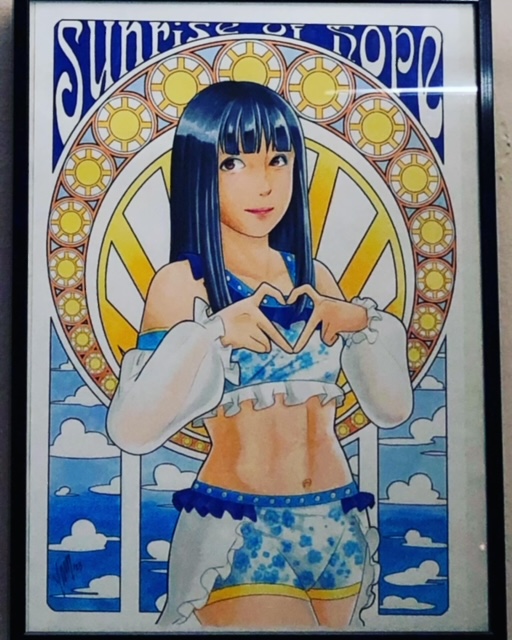
There’s one more wonderful art nouveau piece to discuss, left to last because there’s unfortunately some sad news that now goes along with it. In early February 2024 Actwres girl’Z reported a 21 year old wrestler named Asahi had unexpectedly passed away. Asahi started her career in Ice Ribbon and was a dear coworker and friend to Yappy. She was also a personal favorite of mine, being a joy to watch in the ring and an inspiring presence in general. Yappy’s incredible rendition of the Sunrise of Hope that originally started her art nouveau series is cherished momento of someone gone far too soon.

Rest in Peace Asahi.

Categories
Art Cards Comics Japan Wrestling

Captivating Color: The Art of Miki Okazaki

It’s always exciting for me to discover new artists whose work jumps out and appeals to my personal artistic preferences. Today I’d like to highlight the striking art of Miki Okazaki.

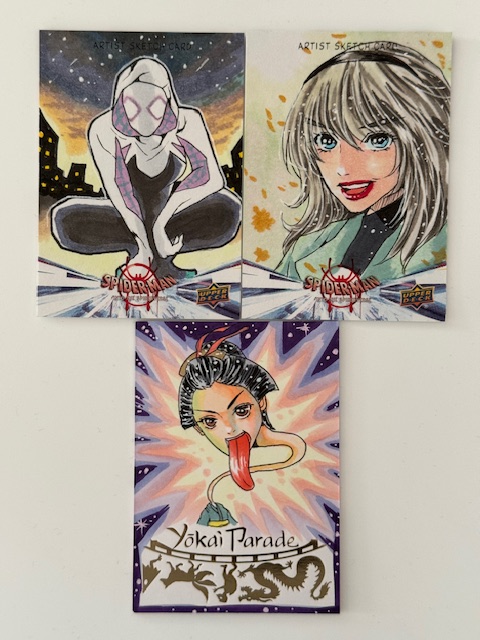
Ghost Spider and Gwen Stacy sketch cards from Upper Deck’s Into the Spider-Verse set, and a recently pulled Rokurokubi sketch card from Iconic Creations’ Yokai Parade set. All by Miki Okazaki.

The first time I saw any of Miki’s art was on sketch cards for Upper Deck’s Into the Spider-Verse card set. It made an immediate impression and had an air of whimsy, and when I followed her on Instagram and found out she was open for commission at the time I jumped at the chance to add more of her work to my collection.

Among the various subjects I collect art of, two of the biggest are joshi pro-wrestlers and Marvel’s Mystique mid-transformation. In my first batch of commissions from Miki I was able to add wonderful pieces to both collections.

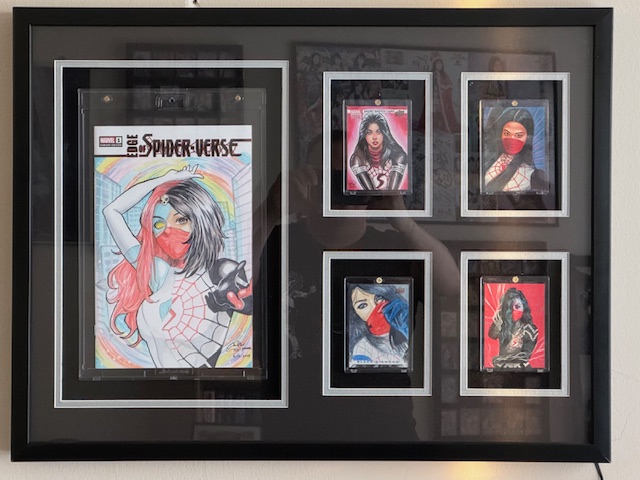
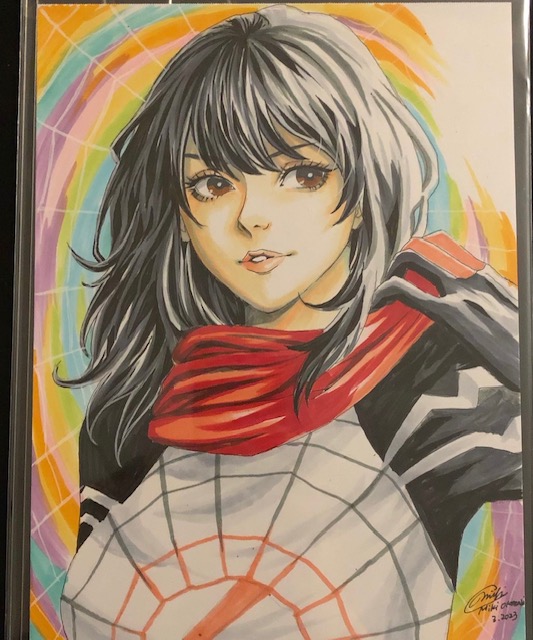
For the incredible Mystique as Silk sketch cover she did for me I specified only the subject. The composition and other specifics were left up to Miki, and she knocked it out of the park with a great dynamic pose and overall awesome general feel.

Miki’s Mystique/Silk cover on display with Silk sketch cards by Effix, Fred Ian, Marcia Dye, and Ash Gonzales in a custom light up frame by Dion Divens.

It’s a great example of her general style with coloring that really pops and a bunch of cool small details, like the exact way things are split between Mystique and Silk around the face and hair, that enhance the overall effect.

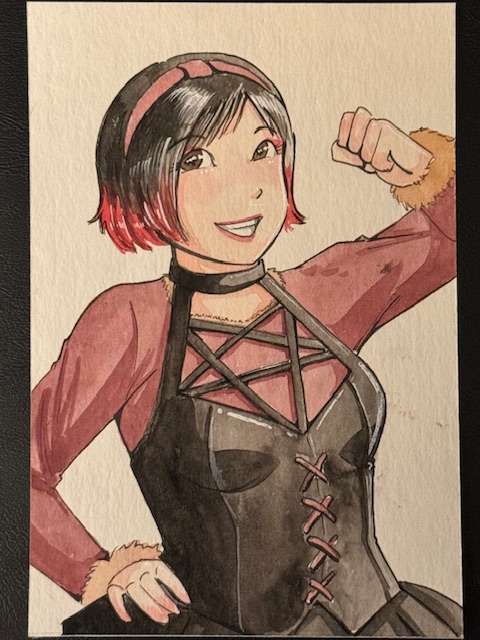
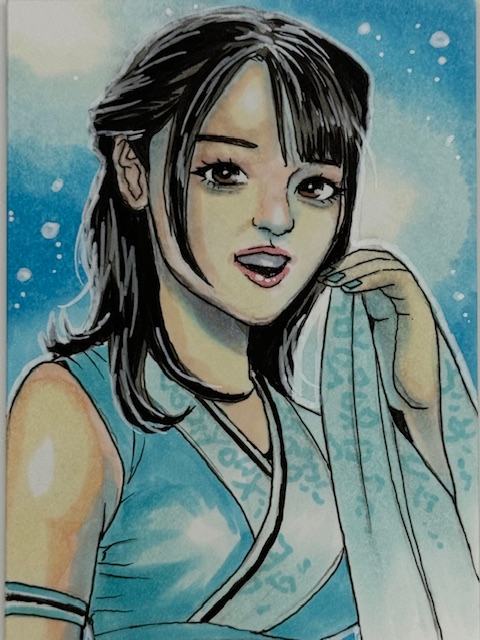
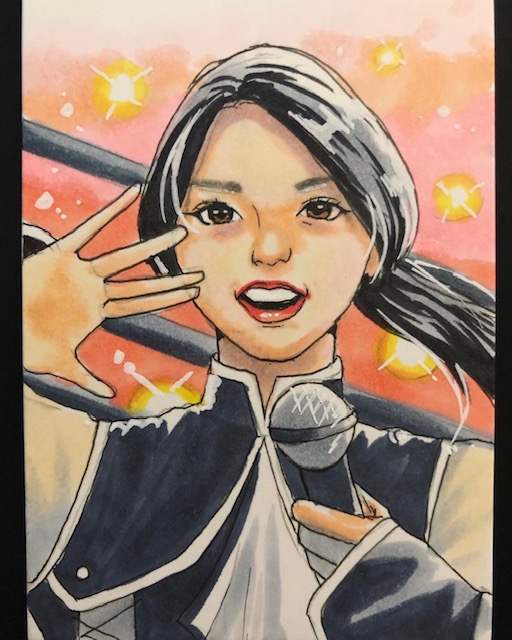
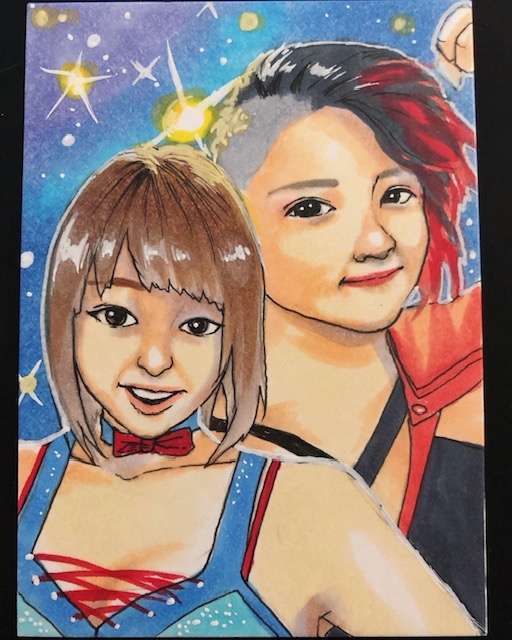
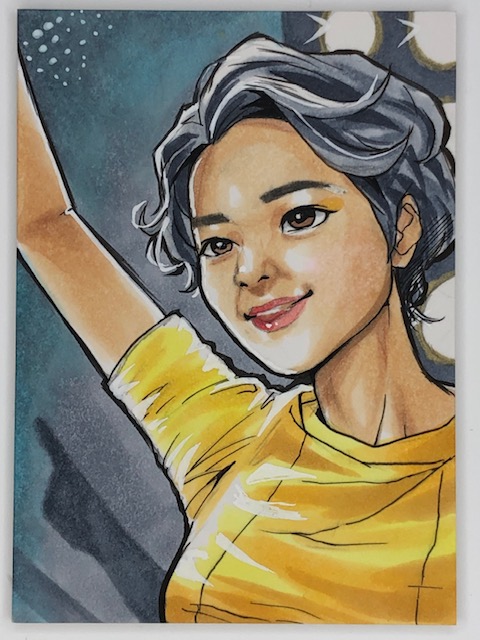
I am a huge fan of Japanese women’s professional wrestling, and have an extensive collection of personal sketch cards (PSCs) I’ve commissioned of many of my favorites, including quite a number from Juri H. Chinchilla (whose art I’ve discussed extensively in Beautiful DreamsBeautiful Dreams 2,Beautiful Dreams 3, and Beautiful Dreams 4).

I was thrilled that Miki was open to doing some of these for me, and my first requests were a combination of wrestlers I’d planned on having done for quite a while in Ice Ribbon’s Kyuri & Maika Ozaki, AEW’s Hikaru Shida, and Marvelous’ Mio Momono & Maria, a perennial favorite in WWE’s Asuka, and even a brilliant up and coming rookie in Gatoh Move’s Miya Yotsuba.

She did an outstanding job with the unfamiliar subjects, and this became just the first of several batches of joshi PSCs I would get from her over the course of 2023. The joshi cards really illustrate Miki’s ability to apply her personal style to her art while still really capturing the essence of the subject.

The next batch included Yappy & Banny from Ice Ribbon, Momo Watanabe from Stardom, Emi Sakura and Best Bros (Mei Suruga & Balliyan Akki) from Gatoh Move, and TJPW’s announcer Sayuri Namba. These are all excellent and the coloring and highlighting really stand out in this group. The backgrounds are masterfully vibrant in a complementary way that doesn’t overwhelm the wonderful depictions of the wrestlers.

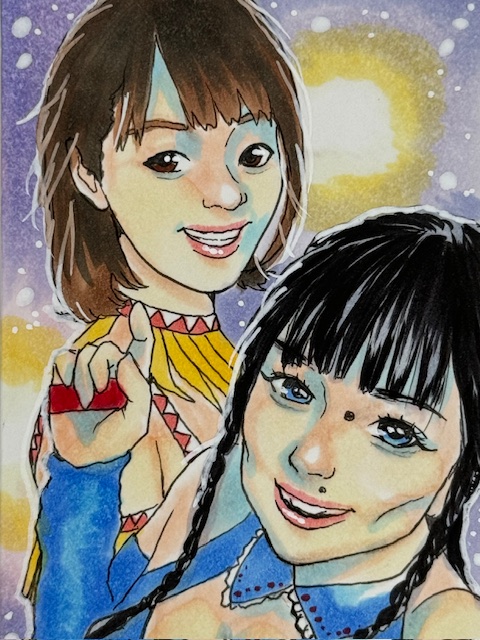
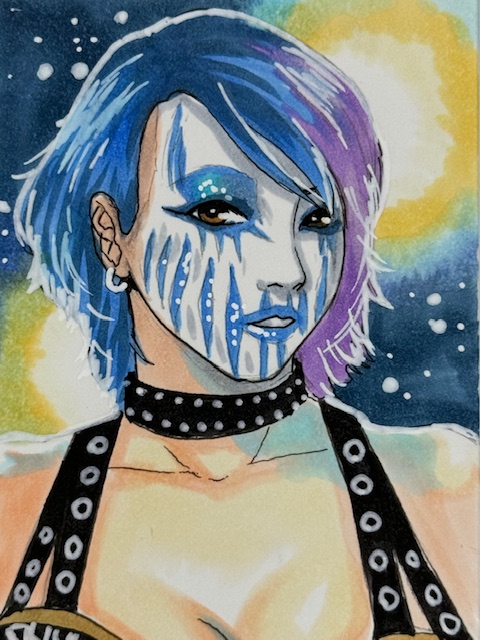
Finally around the end of the year I had cards done of TJPW’s Free Wi-Fi (Hikari Noa & Nao Kakuta), and Daisy Monkey (Suzume & Arisu Endo), another up and coming Gatoh Move rookie Nonoka Seto, WWE’s reigning Women’s Champion Iyo Sky (formerly Io Shirai), Stardom’s Yuna Mizumori (formerly of Gatoh Move), and freelancer Momoka Hanazono.
The detail on these is particularly fantastic, and it’s was really cool to see how Miki’s style evolved over such a short period. I know I’m repeating myself to the point of sounding like a broken record, but once again the coloring is impeccable and perfectly spotlights the subjects.
The Nonoka Seto card is particularly special from a few reasons, from the awesome way Miki captured her pointed finger pose in shadow even though the arm is out of frame to the fact that it’s a companion piece to the card Miki did for me of her sister, fellow Gatoh Move wrestler Miya Yotsuba.

I greatly appreciate all the art Miki has created for me and I hope to continue collecting her work in the future.

More information about Miki’s wonderful art can be found on her social media pages.

Categories
Japan Reviews Wrestling

Wonderland: The History of Joshi Pro-Wrestling Ice Ribbon 2016-2021 Review

Disclosure: The author of this book is a friend of mine and introduced me to Ice Ribbon years ago. This has had no influence on the opinions in this review, although obviously my status as a fan of the promotion does affect my appreciation of the subject matter.

This is Charles Short’s second book about Ice Ribbon. Please also check out my review of the first, Be Happy.

Ice Ribbon is a women’s professional wrestling company based in Tokyo, Japan that approaches wrestling in an accessible way to be fun for both the audience and performers.

Wonderland opens with a foreword from Ice Ribbon’s ace Tsukasa Fujimoto herself and a solid section of bios with pictures for all of the Ice Ribbon roster members during the covered time period, before heading into the results section that comprises the majority of the book.

The results section is an incredibly detailed chronicle of match outcomes that picks up immediately after last book and goes 5 years and change through Ice Ribbon’s 15th Anniversary show in early August 2021. It not only covers results for all Ice Ribbon events, but also every match members of their roster participated in for other companies.

The amount of specific information provided and the meticulous record keeping it entails is incredibly impressive. Extensive context is included from match times to attendance figures and even things like when originally scheduled matches were changed (due to injury/illness/etc).

The time period covered in Wonderland is particularly interesting to me as I was attending a lot of Ice Ribbon shows live during this period. It’s really cool to revisit a snapshot of this particular time in the company’s existence.

A number of major moments in Ice Ribbon’s history are covered, including Tsukushi’s re-debut and Giulia’s departure. Short approaches everything without sensationalism or rumor, covering things in detail but appropriately keeping to the factual happenings known to the public.

The book features a number of wrestlers who have gone on to wrestle for other companies, which may be of particular interest to those familiar with their later work and wanting to learn about those wrestlers’ history.

Ease of reference and reading is incredibly important when presenting the sheer amount of data contained a volume like this. Like with Be Happy, and perhaps to an even greater extent, the careful formatting, interesting ancillary information, and inclusion of a variety of pictures keep everything accessible and engaging.

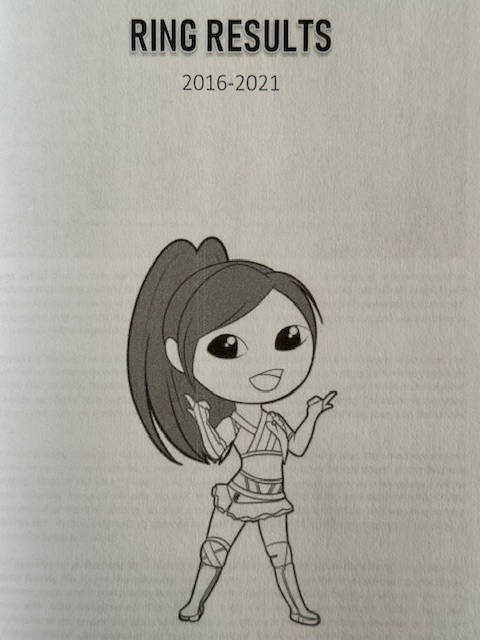
There are also several wonderful little touches that make the book special. One of the coolest is stylized section illustrations by Yappy, who is a talented artist in addition to being one of Ice Ribbon’s own wrestlers.

Tsukasa Fujimoto illustration by Yappy.

ThoughWonderland covers five years of the company compared to the first book’s ten, it ended up being longer (including over 150 more pages of content after the results section, compared to Be Happy’s 40). This is due to more context and detail added to returning information sections like title histories, as well as greatly expanded pictorial sections.

A huge variety of event posters, banners, wrestling gear, and merchandise is displayed with explanatory context notes as appropriate. As with Be Happy all of the pictures are in black and white, but that does not diminish the treasure trove of stuff to look through.

The book wraps up with a section featuring career summaries for wrestlers and staff that retired during the subject time period. Like the rest of the book, these are thorough, well presented, and quite informative.

At its heart Wonderland and its predecessor are reference books, and milage will vary with an individual’s interest in this unique little joshi wrestling company. But for anyone with even the smallest bit of curiosity about Ice Ribbon or the wrestlers who worked for it during this time the book is so well done and so overflowing with carefully assembled and interesting information it’s really a must have.

Categories
Japan Wrestling

Vanishing Ninja : Sayuri’s Retirement

In May of 2019 I was lucky enough to see a special showcase show of Emi Sakura’s casual training program DareJyo. It was a wonderfully fun display of training drills and exhibition matches. What no one knew at the time was five of the participants would go on to train as as full wrestlers and debut just a few months later as part of Gatoh Move’s Generation 4.

For many years in the early portion of Gatoh Move’s existence, Riho (now of AEW) was their ace and star. In Spring of 2019 it was announced that she would be leaving to go freelance in early July. The landscape of the promotion looked dramatically different after her departure and the subsequent debut of six rookies from DareJyo at Gatoh’s August show (the five previously mentioned that appeared on the 5/1/19 showcase show, plus Chie Koishikawa).

However as of the original announcement in July only four wrestlers would be debuting. The last trainee to decide to make the jump was the woman who eventually become Gatoh Move’s resident lovable ninja.

Sayuri’s DareJyo showcase exhibition match was against eventual fellow Gen 4 member Rin Rin (now the recently retired Yukari Hosokawa of Ganpro). Her debut match was against Mitsuru Konno.

Sayuri is the ultimate underdog and pitting her against the tough-as-nails, fierce Mitsuru in her first official match was perfect (the entire show was a masterclass in playing to their rookies’ strengths and presenting an incredibly entertaining slate of debuts). Even in this first match there were hints of the perseverance and personality that would draw fans to her.

Sayuri has incredibly unique charisma that continually emerged and evolved as she gained experience. Sakura once jokingly gave her an award for there being nothing remotely unique or interesting about her, but Gatoh’s founder couldn’t be more wrong in this case. There was an endearing goofiness to her mixed with a fiery determination that made it impossible not to cheer for her.

One of her most memorable series of moments revolved around her stubborn insistence to complete a bodyslam despite failure after failure to do so. She turned the cry of “Let’s bodyslam!” into a beloved rallying point for her fans (whom she named “Sayurists”). They were thrilled when she finally hit one on the 5/4/21 show.

Sayuri eventually fully embraced a ninja role, using tactics and antics such a shuriken style chops, awesome wall run headlock takedowns, and ninja vanishing techniques (hiding behind numerous environmental elements in Ichigaya Chocolate Square to later surprise her opponent). A perfect mix of skill and silliness, Sayuri’s matches were always captivating.

Sayuri and Sayaka PSC by Juri Chinchilla.

Gatoh’s 12/29/19 show turned out to be the last time I was able to attend a show Sayuri wrestled on. I missed a number of Gatoh Move shows during the remainder of that trip due to coming down with the flu, and once I recovered and could attend again Sayuri herself was out sick (along with many other wrestlers, it was a rough season).

However, there is something quite fitting that my final live memory of seeing her wrestle ended up being a singles match against her trainer, Emi Sakura. The legend spent the early match trying to run through and bully the overmatched ninja. But as usual Sayuri’s persistence created openings and allowed her to give her opponent much more fight than expected, even in defeat.

Sayuri’s career spanned just under 90 matches, and she never won a singles contest. But she never gave up and her Sayurists were certain her moment would come.

In 2021 Sayuri formed a regular tag team with 17 year veteran Choun Shiryu called Dragon Ninja. They had fantastic chemistry as a team, and Sayuri clearly evolved as a wrestler under Choun’s influence.

Dragon Ninja was a successful team with several wins, but always with Choun gaining the decision. They fought and won as a team, but the elusive pin or submission that evaded Sayuri in singles competition continued to do so in tag matches.

Until ChocoPro 264 on 10/23/22. In an incredible culmination of her wrestling journey she pinned Chie Koishikawa to give Dragon Ninja a huge win over Chie & Masa Takanashi. Her moment had arrived.

The victory seemed to herald big things ahead for Dragon Ninja and Sayuri, but unfortunately it wasn’t meant to be. She would wrestle two more matches after that before going on hiatus due to chronic health issues. In late 2023 it was announced she was not returning and would be retiring from wrestling.

Sayuri had remained involved in Gatoh Move and Chocopro in non-wrestling capacities in the meantime and ChocoPro 347 was her farewell show. She accompanied Choun against Otoki, and while not officially part of the match she had some involvement including traditional retirement spots. It was a great way to say farewell within the confines of her not being able to return for a full retirement match.

She gave a goodbye speech after the show and was sent off with smiles.

Sayuri had unique presence and style and was a breath of fresh air in wrestling throughout her short career. Wishing all the best to her in whatever’s next for our darling ninja.

Categories
Japan Wrestling

Eternal Sunrise

Heartbreaking news is not how I intended to return to blogging (and my previously planned posts will be coming soon). But tragedies are all too often completely unexpected, and I feel compelled to share some words of personal remembrance of a wrestler who meant a great deal to me as a fan.

Actwres girl’Z has shared that one of their performers, 21 year old Asahi, has unexpectedly passed away (no other details have been shared: please respect the privacy of her grieving family, friends, and colleagues).

Asahi debuted for a promotion named Ice Ribbon in August 2017. The then 14 year old faced wrestling legend Manami Toyota in her debut match. I was lucky enough to attend that show live, and was impressed with the sense of determination and resiliency Asahi showed.

The wrestler who would eventually be nicknamed The Sunrise of Hope became an absolute favorite of mine, and it was a joy to see her evolve and grow as her career progressed. She put her heart into her matches, was technically skilled, and most importantly was just flat out fun to watch.

One of my favorite memories of the emotion she put behind everything is a bit of an odd inclusion here, as it never really made tape. But it’s such a vivid memory to this day I’d like to share it.

At a show in early 2019 Asahi was part of a P’s Party themed team, alongside fellow rookies Tequila Saya and Giulia, going against then Ice Ribbon veterans Risa Sera, Maya Yukihi, and Akane Fujita. It was an elimination match with special stipulations, and by the end P’s Party had the unlikely advantage as it was down to Asahi and Giulia against Akane. Asahi had Akane on the verge of elimination and was slowly grounding her senior down, only to be shoved away at the last second by a partner who wanted the glory for herself. P’s Party won, but Asahi was betrayed all the same. What followed was intense, and only a tiny snippet made it to the video of the event.

From my recap of the event:

“Asahi stares a HOLE through her so called partner, and then goes CRAZY trying to claw and scrape her way to attack Giulia requiring three others to hold her back until finally Tsukka comes in to calm her down. Fantastic fire from Asahi here, and there was more story and character conveyed in these 30 seconds than I’ve seen in entire shows.”

No matter what type of moment, Asahi always vividly conveyed her emotions with captivating charisma.

Another special memory for me was getting to see her wrestle another of my favorites, Misaki Ohata, at a P’s Party show in a great match seeing Asahi throw everything she could at her vastly more experienced opponent.

I have not been able to return to Japan since before the pandemic, so the final times I was able to see Asahi wrestle live were Ribbonmania 2019 and one dojo show a couple weeks later. Her being victorious in the tag team gauntlet and then later part of Tequilia Saya’s retirement match in the main event are happy memories.

In Spring of 2023 Asahi left Ice Ribbon to go to Actwres girl’Z, a company with a more theatrical based approach to wrestling related entertainment. She was a good fit and I recommend checking out her work there as well.

It’s heart wrenching to try to process the loss of someone so young, with a seemingly bright future ahead of her. Farewell, our dear Sunrise. You will be remembered, and missed.