“It’s easier to live, when you don’t think or feel anything.”
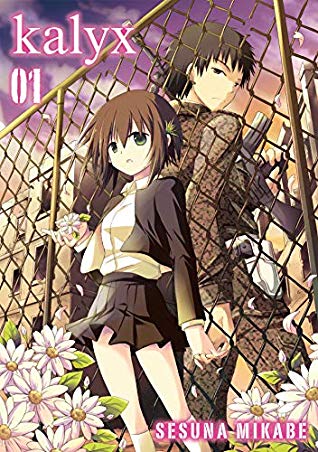
In 2050, amid the vast dessert that was once Japan, Soshi Sawamura became a soldier for one of the four nations that wars over food in order to stay fed himself. One day he meets one of the mysterious “Flower Girls” by chance, and the true nature of her condition might just change his life.
I’ve enjoyed manga in the past dealing with some of the more everyday aspects of life among war filled, post-apocalyptic settings, so the cover and a quick read of the premise intrigued me enough to check this out.
And a quick sense of the premise was certainly all I retained, as this one takes some odd turns I was totally unprepared for. The affliction plaguing the Flowers Girls and the way it manifests is WEIRD, and the consequences that arise naturally from the premise are quite grim. So far though it’s all well utilized and capitalized on, with appropriate emotional weight being given to the situation, no matter how absurd the initial idea.
The world building is interesting, and the dessert ravaged Japan our leads inhabit feels lived in and relatable despite it’s fantastical nature. The dessert world also heavily ties into the themes of the manga that relating to the flower aspect of Nadeko’s condition.
Several individual elements here have been done before, but this is a decent spin that pushes the tropes a bit in slightly new directions. Given the romantic themes of the manga and Soshi being an adult soldier I do wish Nadeko had been made a bit older (say at the very least late teens rather than early), but so far the execution has been fine and there are thematic reasons for her youth.
Soshi’s lack of ambition and drive is a perhaps obvious and cliched choice, but it works as a baseline since he can’t continue to be apathetic as Nadeko’s partner. There’s a real darkness simmering beneath the surface as the Flower Girls know exactly what awaits them in exchange for certain choices, and Nadeko and Soshi both having to face these realities in different ways seems a strong central plot anchor going forward.
All in all this is a decent start to a nicely character driven story in a well realized dystopian setting. I’m definitely curious enough to read more.
The Promised Neverland features an overarching story with a terrible, previously revealed underlying secret. Best to start reading with volume 1.
Volume 6 ended with the first major step towards the escapees larger goal of unraveling the mystery left by Minerva, which has now become the central focus of the manga, and here the realities of what they find in the shelter take center stage.
The story progresses nicely and continues to excel in character driven conflict while taking a little bit of a breath here to give fleeting glimpses of lighter things in middle of their struggle. The children’s reaction to being aggressively confronted with a conflicting viewpoint allows for needed affirmation / exploration their own as the harsh world wears on them.
This is a solid installment in The Promised Neverland’s larger story that serves mostly as setup for what’s to come, and by the end things are rapidly escalating again.
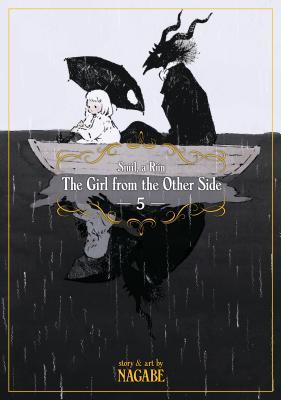
The mythology of The Girl from the Other Side’s world is gradually building, and it’s continuing to be a wonderful ride. There are more mysteries than answers, but in a constantly shifting manner and enough information is provided to keep the reader’s attention. It’s masterfully done. The more that’s revealed about the curse and its horrors the more questions about Teacher and Shiva arise. Of particular interest is the follow up to last volume’s cliffhanger and the contents of the long referred to revelation, which will have major ramifications going forward.
Parts of this manga are admittedly getting harder and harder to read. Desperation and terror leads to horrors in the name of survival, which is understandable and extremely important to the story and themes, but the repeated interactions of characters pleading uselessly against blind hatred or prejudice is emotionally exhausting.
Teacher (justifiably) worries constantly about his decisions and their effect on Shiva, and the consequences of those decisions is a big focus here. It’s well done and really resonates as an authentic feeling exchange between people with legitimate, different views on a situation leading to conflict. In a similar vein on those themes, Teacher being repeatedly forced into action is another great, intriguing aspect of the ongoing story.
Shiva’s choices seem to have had disastrous effects, and Teacher learns more about both the horrors of the curse and Shiva’s tragic past.
Back outside with Teacher, Shiva eases into a new status quo while being haunted by the events of last volume.
As the full effects of the curse start to be experienced and revealed, the reasons behind Inside’s rash actions become clearer. Nothing excuses them, but a deep and complex web of people’s very real fears emerges entangled with the seeming machinations of greater beings. There are a lot of heavy themes and happenings, and it’s all done so well. The pacing and balance exquisite, with the author knowing when to pause and let emotions sit for a minute and when to keep up the pressure and tension.
As I mentioned before the art does make it a little hard to follow certain things, but overall the gist is usually clear and the incredible atmosphere enhanced by the art style is worth the occasional bit of confusion in my opinion.
There’s definitely something lurking beneath the surface of this story, beyond the things the reader can see thus far. It gives a nice building sense of unease. Many things here could be as they seem… or not. As always I’m eager to find out.
The Promised Neverland features an overarching story with a terrible, previously revealed underlying secret. Best to start reading with volume 1.
I admittedly harp on this point, but as an avid mystery fan and reader of hundreds of stories with suspenseful twists, battle of wits, etc, it is SO IMPORTANT for characters to be smart and capable without being infallible, and The Promised Neverland does this SO WELL. It allows the reader to both marvel at the ingenious measures and dogged determination that allow characters to stay a step ahead while understanding things could wrong at any moment and feeling dread that they’re only a step ahead.
There are major revelations and a big shift in perception here, but it all feels logical and earned. The outside world Emma and friends find themselves in is filling in nicely, and the series continues to do an excellent job sprinkling in interesting characters with individual motivations and agendas among the general conflict and situation driving the children’s actions. Also, the author is particularly good at knowing when to revisit said motivations and goals amid ever changing situations and shifting circumstances.
This manga continues to be a gripping, wonderfully tense read.
The day Shiva’s been waiting for has come… but not without questions to be asked.
From the second volume’s subtly ominous ending The Girl from the Other Side continues full force and a complicated overarching narrative is forming with events moving rapidly out of Teacher’s control and Inside forces taking actions that will have significant effects.
As will no doubt become a running theme in my reviews for this manga, it does a particularly incredible job of balancing the multitude of contrasts aspects it contains.
It still retains its deliberate pacing and the “slice of life feel,” but main story elements are escalating and major developments starting to be sprinkled in. The way everyday life intersects with the more dire aspects is quite masterfully done, and the line of providing enough new information to keep readers engaged while continuing to have intriguing underlying mysteries is being walked perfectly.
This volume ends with another significant revelation, and it’s impressive how well the atmosphere and tension is being maintained without losing the relatable engaging nature of the characters amid this strange world. Both Shiva and Teacher will no doubt come away from the events of this volume significantly affected, and as usual I can’t wait to see what’s next.
Tapestry is the newest offering from Stonemaier Games, makers of several board games I adore including Viticulture, Euphoria, and Scythe.
I’m going to state up front that I enjoyed the game quite a bit overall, as there are some criticisms to explain and I don’t want the tone of the review to seem overly negative as I go through them. Bottom line is I’ve definitely had fun in the games of this I’ve played thus far (once 2-player and once 4-player).
Tapestry is advertised as a civilization game, which it is in theme only. The various trappings seem well researched and appropriate and it’s a fine theme, but nothing about playing feels like the mechanics really marry with the theme. There are no gameplay effects to changing ages, no real resonance between actions and consequences, etc. This is an engine building cube pusher, nothing more or less. WHICH IS PERFECTLY FINE, and it does it well. But it bears mentioning for those looking for a deeper thematic experience.
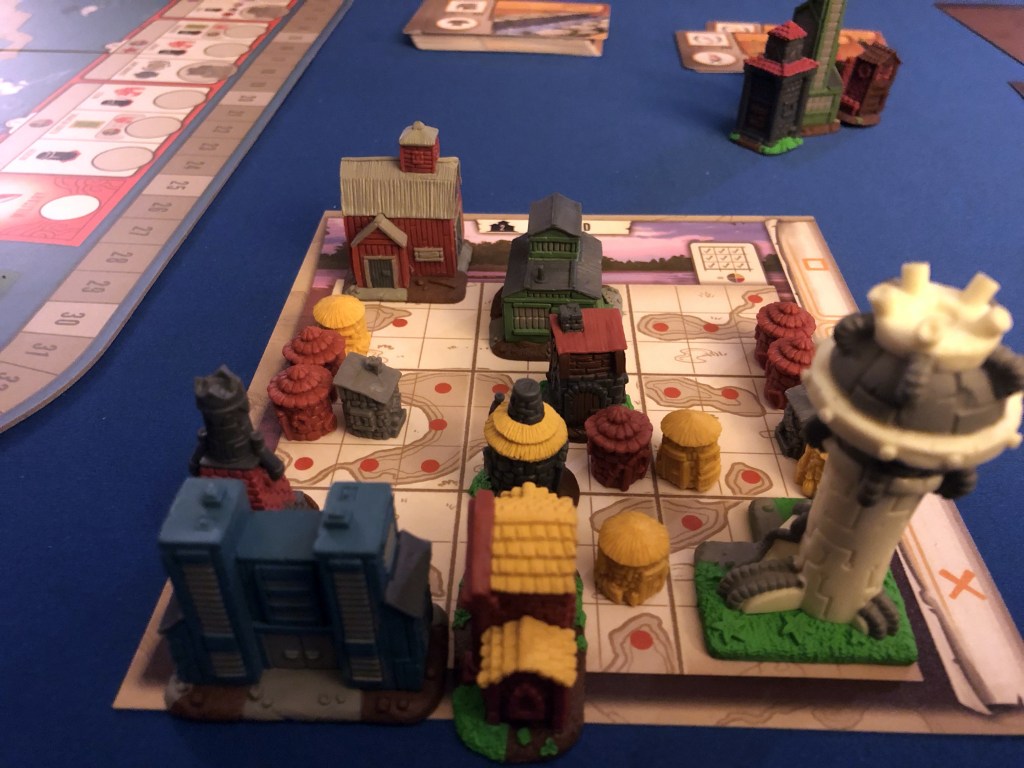
Also, Stonemaier’s usual high production quality admittedly and unfortunately feels like a case of style over substance here. The attractive, individually sculpted landmark tokens end up only having one function from a gameplay standpoint: to cover squares on a player’s capital city mat. And for that they are rather poorly designed.
The smallish bases with rounded corners make them cover a smaller area than they should, and in addition to not fully covering the intended areas they sometimes “fit” into spaces they shouldn’t (areas smaller than the number of squares they are supposed to cover). Yes, there are established, correct areas for them and it’s playable keeping this in mind and “centering” the tokens in the proper areas. But again, this is literally the ONLY thing these intricate tokens are for, so placing aesthetic preferences over functionality is a puzzling and disappointing production choice.
Lastly, some members of my gaming group’s initial impression is that Tapestry’s somewhat unbalanced and a bit too influenced by luck. The person who concentrated on the navigation track was disappointed in the space tiles compared to the rewards players received for completing other tracks, civilization bonuses have a potentially huge impact on the game, tapestry cards vary wildly in usefulness depending on when they are drawn with no real way to minimize the effect, etc.
They are all interested enough to try it again though, and I personally found the luck of the draw aspects fine. Also, luck of course tends to balance out over several plays. But the effect is large and for the type of gamer that prefers careful progress to adapting to circumstance changes this probably won’t be their cup of tea.
All that said, as indicated up top there is a lot to like about in Tapestry.
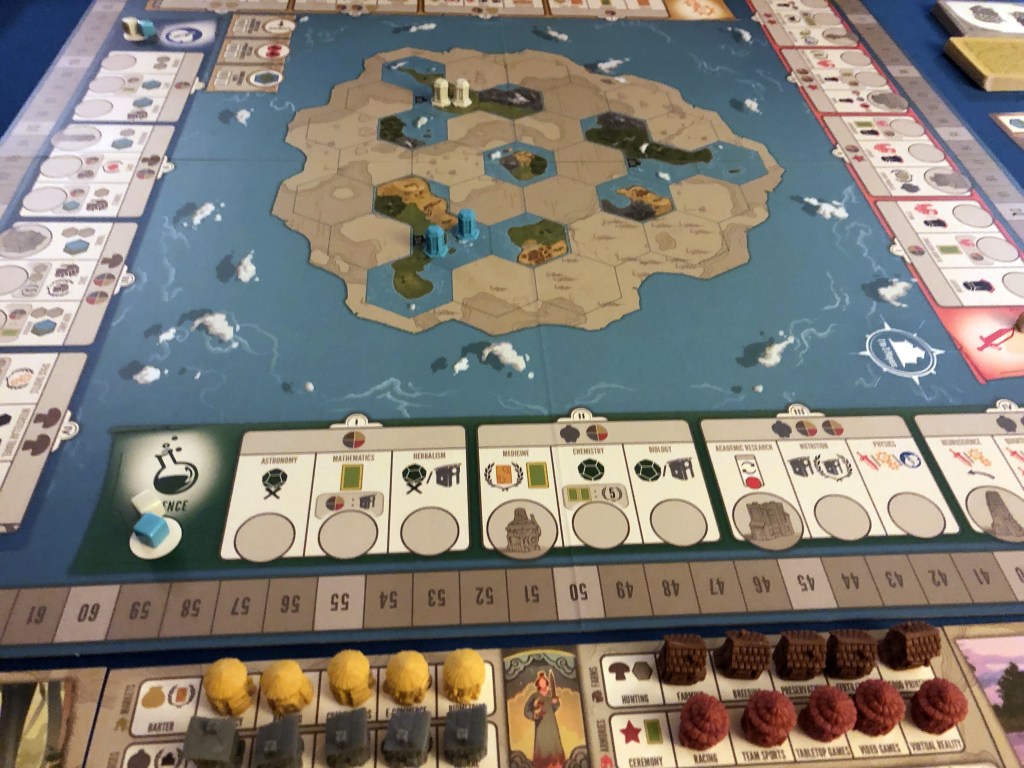
Each player continues taking turns to move their tokens along the various advancement tracks until they need to or want to take an income turn (during which points and resources are generated, among other things). The big innovation here is that the game lasts five income turns for each player, so since it’s their choice when those turns are taken the game can and likely will end at different times for different players. It’s a really cool and creative idea leading to interesting choices and is well implemented.
Moving along the four different advancement tracks is a strong central mechanic, particularly in how the tracks interact with each other and with the player boards. Removing buildings from the income mat increases resources and points collected as well as filling in the capital mat for bonuses as they’re then placed, discovering and advancing technology cards give other bonuses and special abilities, choosing which tracks to advance on and which resources to spend effects when income turns have to be taken, exploring and moving about the central map creates other opportunities for scoring, etc. I have minor quibbles with how a few aspects interact (and combat outcomes really should have more involved than pure luck of the draw), but overall the general frame is nicely done and it all gels well.
I’m curious to see how this feels after more plays with varying player counts, but so far despite perhaps not being quite as polished as Stonemaier’s previous offerings in some respects I found Tapestry a fun, creative game that I’m happy to have added to the collection.
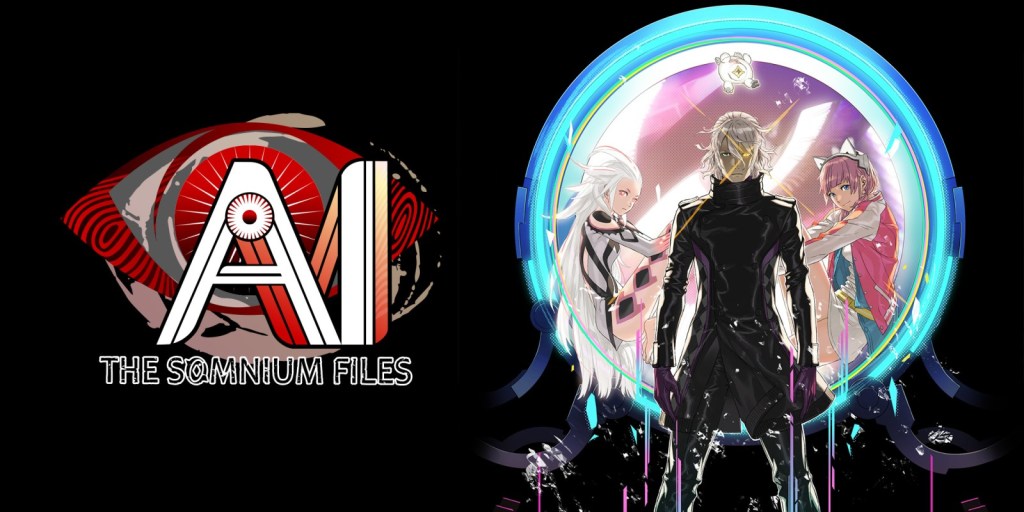
Kaname Date is a special agent of a futuristic police department, Advanced Brain Investigation Squad, specializing in exploring people’s subconscious in the course of their investigations. A murder case isn’t necessarily his normal assignment, but …
9 Hours, 9 Persons, 9 Doors remains one of my favorite games of all time. Virtue’s Last Reward and Zero Time Dilemma were solid follow ups to round out the Zero Escape trilogy and quite good in their own right (although they did start to collapse a bit under their own weight as the stories became more involved and grew in scope).
So a fresh start of a brand new mystery game by the same director was something I was extremely excited for. And AI is every bit as fantastic as I hoped.
The gameplay is divided between visual novel-like sections of gathering information and investigating crime scenes, and Somnium sections in which the player explores the subconscious of reluctant persons of interest in a dream-like setting.
It boasts a layered, subtly constructed story that unfolds in pieces across branching paths. Each branch feels solid and satisfying as a self-contained narrative, while giving carefully rationed hints about the big picture that only fully come together as all the branches are played. Using the Somnium sections as the branching points is a great choice, as there’s natural splitting opportunities narratively and gameplay-wise no need for the player to hunt around aimlessly to find the different story paths. The gameplay is top notch overall and brings some nice innovations to the genre.
The technology and sci-fi elements, which are extremely important to AI’s tale, are well used and explained in pieces as needed to avoid too much info dumping.
It’s really amazing how well balanced and executed everything is here. There’s just enough branching, and the way pieces of the puzzle are interspersed between the different tracks is excellently done. The complex story is explored just right, avoids straining to contain its own weight like VLR and ZTD. It strikes me as accessible either by playing down a single path until finished (or temporarily blocked by the need for information from other parts) or by jumping around a bit (which is how I chose to approach it). That’s really difficult to get just right, and an impressive achievement.
The characterizations, twists, general atmosphere and ever increasing feeling of tension all combined to create a tangible “can’t stop playing” feeling, gripping me unlike any other game in quite some time.
The valid possible solutions, suspects, and theories are great and make this an incredibly compelling experience. In fact the red herrings almost too good, as some false leads felt just a touch more interesting than the actual developments. Small criticism though, as the overall tapestry of AI’s tale is still excellent and incredibly well woven.
The limited turn mechanic in the Somnium sections can be a little frustrating mid-game when the difficulty ramps up. But if approached with the perspective of needing to gather information on the first couple of tries to “solve” it and enjoying the additional context exploring “wrong” choices gives this slight negative can be rapidly eliminated.
Certain aspects are also a bit overdone, and an argument can be made that scaling them back touch would enhance the tone and impact of the larger story. But overall it’s all within tolerable limits and the vast majority of the game is pitch perfect.
AI: The Somnium Files is a truly creative game boasting an imaginative story, solid and engrossing gameplay, and satisfying, captivating mysteries. This really covered all the bases for me and is easily my game of the year, something I honestly didn’t expect in competition with things like (the also great) Fire Emblem: Three Houses in the conversation. Simply fantastic.
The Promised Neverland features an overarching story with a terrible, previously revealed underlying secret. Best to start reading with volume 1.
Here we go. In several ways this volume is the payoff to everything that’s come thus far. The buildup has been excellent and the developments and twists feel earned and natural.
There’s been real, noticeable growth of a main character, with another slowly learning about limits and different points of view. The layering and way different story threads are interwoven is really masterfully done. Story progression continues to be surprising and clever while still arising logically.
This is another fantastic volume, and sets up significant new story threads going forward to boot. It’ll be interesting to see if it can keep up the level of quality and suspense with the shift in focus, but the signs are certainly good thus far.
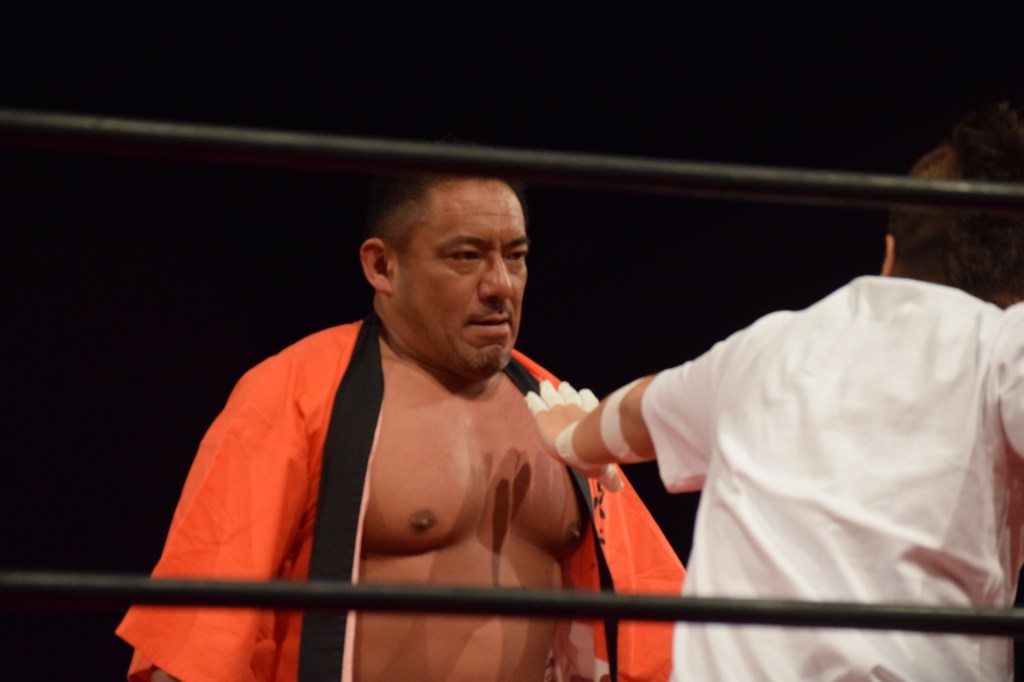
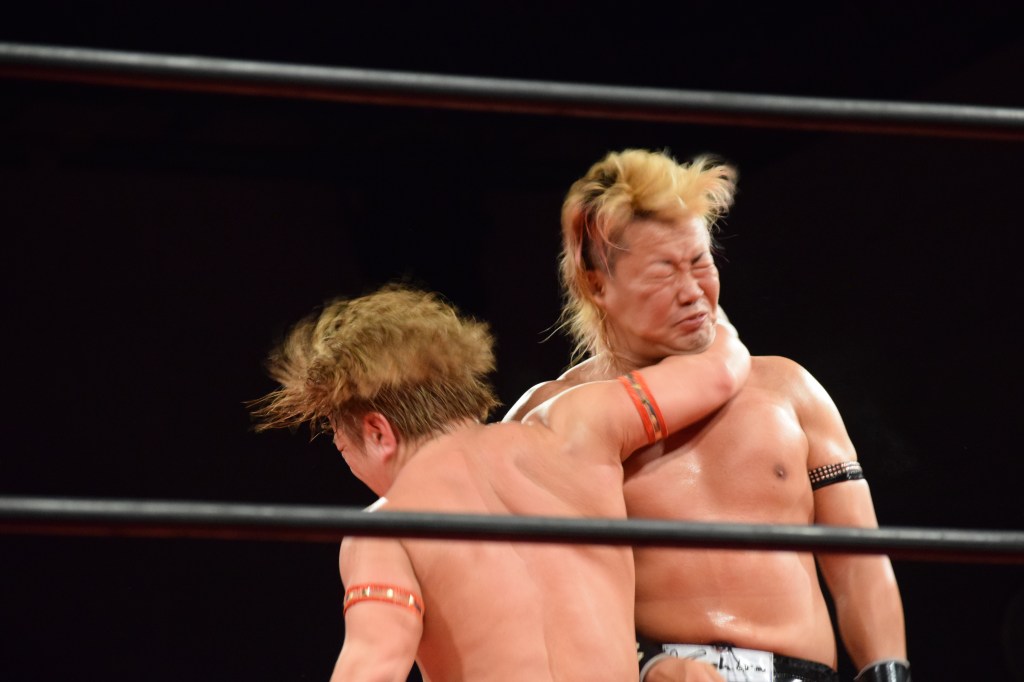
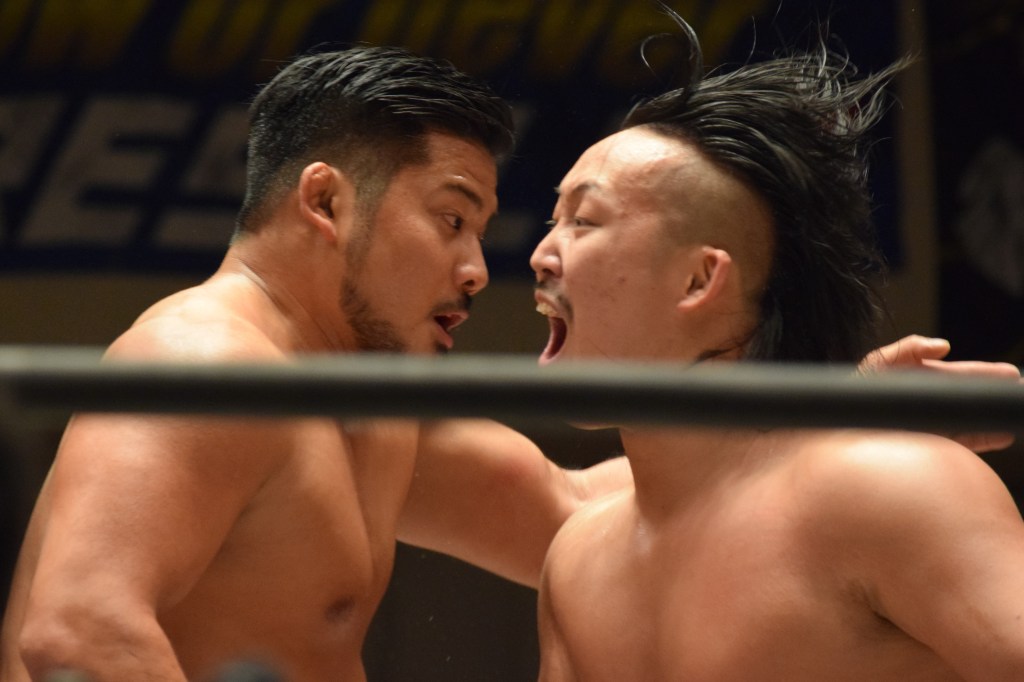
Interestingly, in following certain joshi promotions and athletes I ended up going to three different men’s promotions for the first time this past spring.
In each case it was a last second decision and I was unfamiliar with most of the company’s roster, so it was interesting to see how things would go as a fan of wrestling yet with no specific frame of reference for the companies and wrestlers.
As such (and to try out a new format) I’m not going to try to do full match by match for these shows. I’ll talk in some depth about the joshi match that lead me to the show, and give general impressions and highlights for the rest.
On to the wrestling:
Big Japan Pro-Wrestling (BJW) 5/11/19
1- Ryuichi Kawakami vs Yuichi Taniguchi 2- Desukamo & Edogawa Rizin vs Kazuki Hashimoto & Yuki Ishikawa 3- Akira Hyodo & Takuho Kato vs Kazumi Kikuta & Kosuke Sato 4- Riho & Mitsuru Konno vs Emi Sakura & Mei Suruga 5- Barbed Wire Board Death Six Man Tag: Drew Parker, Josh Crane & Ryuji Ito vs Masaya Takahashi, Takayuki Ueki & Toshiyuki Sakuda 6- Yasufumi Nakanoue, Yuko Miyamoto & Yuya Aoki vs Abdullah Kobayashi, Kankuro Hoshino & Yoshihisa Uto 7- Daisuke Sekimoto, Takuya Nomura & Yuji Okabayashi vs Daichi Kakimoto, Hideyoshi Kamitani & Ryota Hama
In addition to the Gatoh Move tag team match on this show I’ll discuss momentarily, I was draw to this event by the related pre-show DareJyo showcase, which was really unique and a treat to attend.
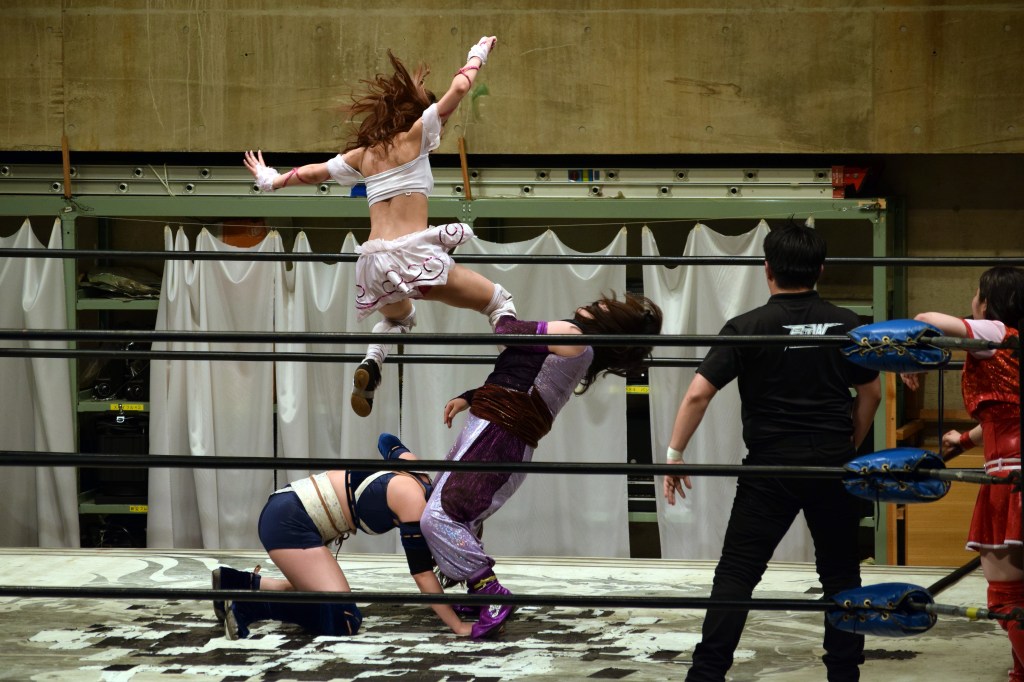
Gatoh Move and DareJyo’s founder/head Emi Sakura teamed with Mei Suruga to take on Riho and Mitsuru Konno in a fantastic tag team encounter. This was all kinds of fun, with a great pace. excellent build, and awesome double teams. They really made the most of the appearance, and the show’s already 100% worth coming to the show for this alone.
Otherwise the only wrestler I was previously familiar with was Hama, from his appearances in Ice Ribbon.
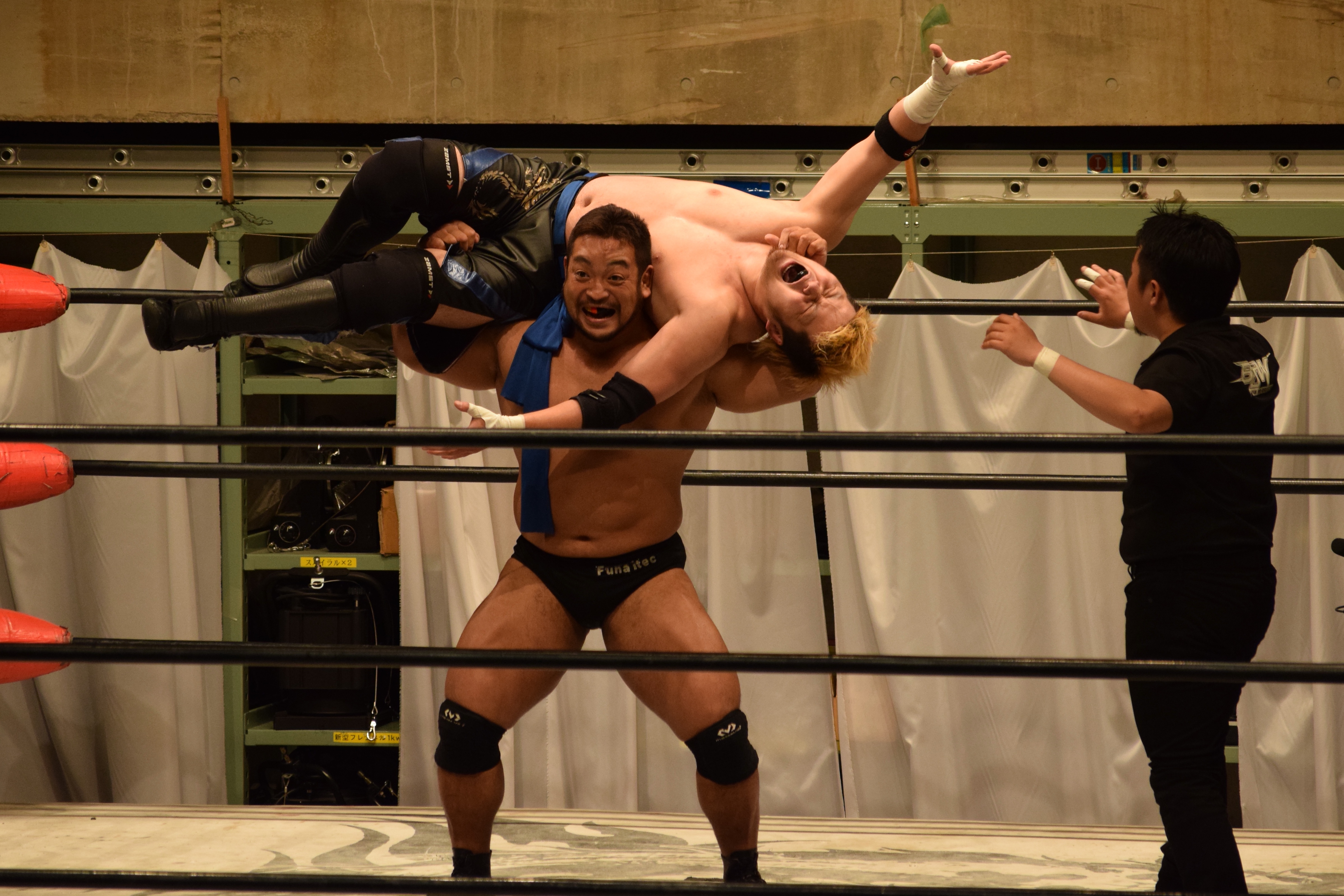
To be honest BJW had a high hurdle to clear as their style isn’t really my thing (although I can and do appreciate a well done deathmatch), and I can’t say they were entirely successful in that regard. The deathmatch, a 6 man tag in the middle of the show, didn’t have much structure and a pure spotfest wasn’t going to draw me in much as an introduction to new wrestlers. Even in the context of “being good for what it was” I found the pacing and execution off.
On the plus side, the effort was there throughout the night and nothing was actively bad. The highlight for me was the main event, where Daisuke Sekimoto specifically stood out in a great showing.
So outside of the joshi stuff this was fine but largely unmemorable. Fans of the style and promotion will have gotten much more out of it than I did, and I certainly don’t regret checking them out. But there’s a ton of great wrestling vying for my attention when I’m in Japan, and overall this didn’t strike me as a promotion I’d choose to attend over other options.
HEAT UP 5/19/19
1- Hiroshi Watanabe & KAMIKAZE vs Mega Star Man & Prince Kawasaki 2- Emi Sakura & Mei Suruga vs Mitsuru Konno & Yuna Mizumori 3- Akira Jo & Kenichiro Arai vs Baliyan Akki & Tetsuhiro Kuroda 4- Hiroshi Yamato, Mineo Fujita & Yusaku Ito vs Keizo Matsuda, Yu Iizuka & Yuji Kito 5- Fuminori Abe vs Hiroshi Watanabe 6- HEAT UP Universal Tag Team Championship: TAMURA & Tatsumi Fujinami (c) vs Daisuke Kanehira & Joji Otani
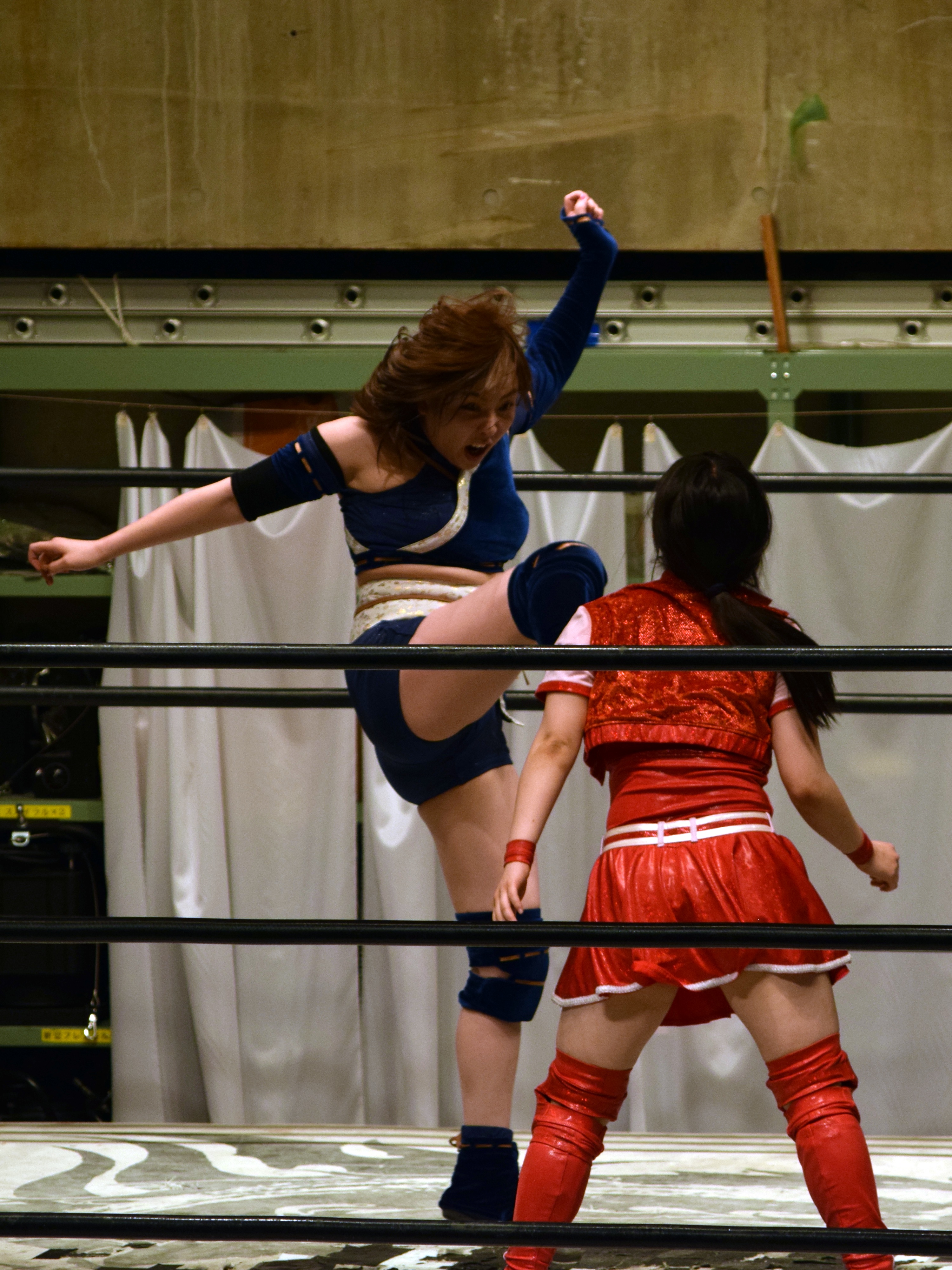
A week later Gatoh Move once again brought me to a new men’s company, with Emi Sakura again teaming with Mei Suruga to face Mitsuru & a partner, this time Yuna Mizumori. I love how different this felt from the previous while still retaining the core spirit of what Gatoh’s all about. Emi & Mei once again proved victorious in another energetic tag match.
I had more familiarity with the wrestlers this time, knowing Akki & Tamura from Gatoh Move, Arai from Wave, etc. This was a good show that I got into, with some big highlights. Seeing Tatsumi Fujinami live was incredible, and that main event was certainly a hard hitting affair.
The personalities involved in the 6-man were striking, and the match excellent. Of the new-to-me wrestlers I left with the strongest impression of them, particularly the trio of Yamato, Fujita & Ito, and wanting to see them all again.
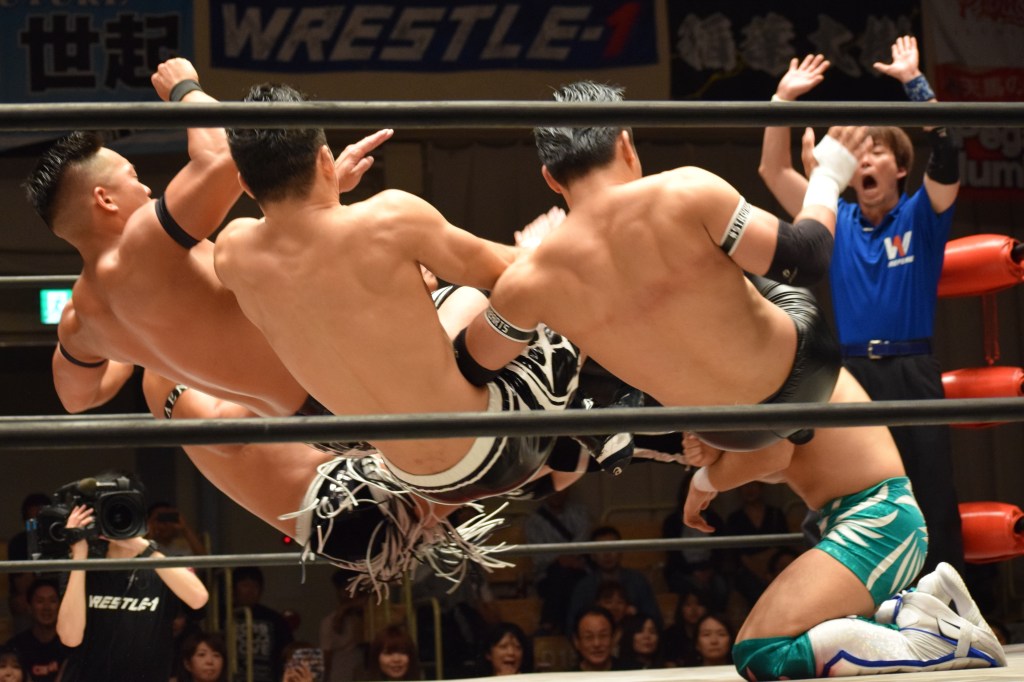
Wrestle-1 6/2/19
1- Ryuji Hijikata & Shota Nakagawa vs Ganseki Tanaka & Ryuki Honda 2- El Hijo del Pantera & MAZADA vs Kenichiro Arai & Yusuke Kodama 3- Reika Saiki vs Takako Inoue 4- WRESTLE-1 Grand Prix 2019 First Round: Kuma Arashi vs Pegaso Iluminar 5- WRESTLE-1 Grand Prix 2019 First Round: Daiki Inaba vs Masayuki Kono 6- Ten Man Tag: Alejandro, Andy Wu, Jun Tonsho, Kaz Hayashi & Shuji Kondo vs Strong Hearts (CIMA, El Lindaman, Seiki Yoshioka & T-Hawk) & Issei Onizuka 7- WRESTLE-1 Grand Prix 2019 First Round: Shotaro Ashino vs Seigo Tachibana 8- WRESTLE-1 Grand Prix 2019 First Round: Koji Doi vs Manabu Soya
W-1’s Reika Saiki (who is sadly out with a broken jaw for the time being) is a favorite of mine. During this trip she announced she’d be leaving Tokyo Joshi Pro, presumably to concentrate on her home promotion. W-1 brought in a series of legends for Reika to face, and I came to this show to see her wrestle Takako Inoue (in a rare, great opportunity to see her as well).
Solid match that went as expected, with some hard hitting back and forth and Reika taking it to Takako before coming up a bit short.
I was familiar with Cima and some of his Strong Hearts compatriots from DG-USA, and that was really it. It was cool to see Cima again, particularly doing such a different character, and their match was frantic and chaotic in a thoroughly enjoyable way.
The Wrestle-1 Grand Prix opening round matches had the advantage of having something specific on the line (which really does make a difference), but even beyond that I was surprised at how easy it was to get caught up in them without knowing the participants. That the matches throughout the show featured a nice variety of styles, pacing, etc also helped.
The semi-main was particularly incredible. I went from having no knowledge or investment in either man to DESPERATELY wanting Tachibana to win by the end. Just top notch work from both wrestlers to tell a compelling story in the ring with excellent action and psychology that transcended language and familiarity. One of the best matches I saw this trip, and a standout on a strong show.
For me this was the best of the men’s shows, and I definitely left it actively wanting to go back to W-1 in the future.