Categories
Board Games Reviews

Ars Alchimia Review (First Impressions)

Alchemy is a hallmark of a lot of video game sidequest activities, and I was both amused and intrigued by the thought of a board game based around it.


ars


The general setup is great and makes a lot of sense thematically: players gather materials, learn recipes (“orders”), and perform alchemy (all represented by different cards on the board). There are also cards representing assistants that can be hired to provide specific bonuses.

The key mechanics are worker placement and resource management. Collection and spending the proper resources to complete orders is the main way to collect victory points, which of course determine the winner at game end.

Taking actions is where the worker placement comes in. Players deploy workers to the board spaces associated with the card they want to claim/use. A significant amount of strategy revolves around this deployment. At least one more worker must be placed than those currently on the space (the previous workers are then moved to a general area for the rest of the round). So popular spaces become more and more “expensive” as the round goes on.

The second aspect to deciding how many workers to play involves bonus die rolls when taking certain actions. Playing extra workers increase the chances of collecting bonuses, but will also make that space require even more workers to use again in the future. It’s a really great aspect: players always get a set benefit for using the card regardless, but can mitigate the luck for bonuses if they choose.

There are other interesting elements that add depth, including players who go later in turn order getting more workers, elixirs which count as any resource when completing orders, etc. I found it all came together really well and provided interesting, meaningful choices during the game.


img_4881


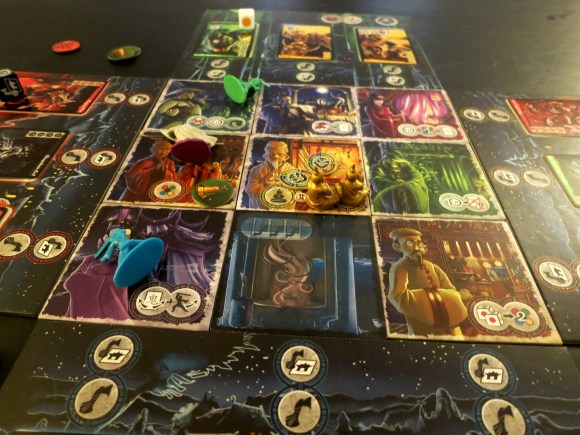
Ars Alchimedia has very nice looking components and attractive art, but admittedly it could have been “spruced up” a bit. It’s clearly reflective of Japanese design and original production in the economy of space everything has. There is an incredible amount of information and functionality compressed down into a general board and a bunch of different card types.

While impressive, this also makes things a bit overwhelming on the cards sometimes and leads to very small and occasionally hard to read type, particularly since TMG made the odd decision to leave the original Japanese text in addition to the translations. While the Japanese student in me likes this, from a gameplay perspective it’s unneeded and distracting. My opponent (who is not colorblind) also had some trouble telling the small colored boxed apart on the cards, which could have been easily addressed by using the symbols for each resources shown on the player’s tracking cards.

This is a hefty game cleverly packed into a small box, and as such while I generally really like the design and artistic style there are some minor resulting inconveniences.


img_4880


The overall balance seemed good, with harder to get materials and orders being involved in higher scoring. Although there is luck involved in the available options on the board at any given time and some are strictly better than others. However there is a mitigating mechanism for turn order, so I think it all fits nicely and fairly.

I really enjoyed my first experience with Ars Alchimia and am excited to play it again sometime, try it with more players, etc.

Categories
Board Games Reviews

Yakitori Board Game Review (First Impressions)

One of the most intriguing things about how gaming continues to expand and grow is the way designers take inspiration from all kinds of unexpected (and sometimes “mundane”) sources to create original and engaging games. One example of such is Yakitori, a laser cut wooden game based around trying to maximize profit while grilling and selling the titular street food.

img_4887

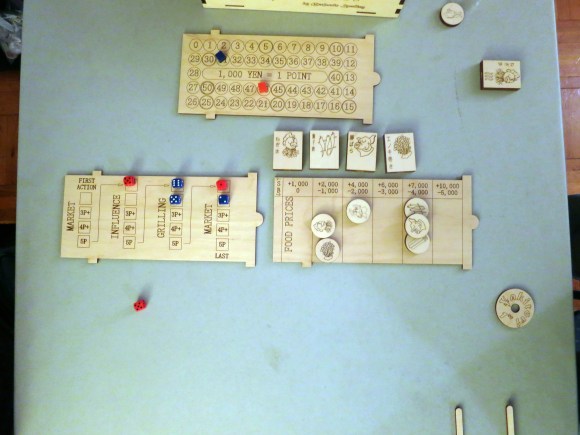
The gameplay is both a well simplified play on the chosen theme and a deep enough game in itself.  Each round players roll three dice and then use them to choose (in turn) which available actions they want to perform. The die values will determine action order within each action category.

  1. At Market players will buy raw ingredients or sell their cooked dishes. There are three different types of meat tiles and three different vegetable tiles available in the game.
  2. The Influence category allows manipulation of demand for ingredients, moving their individual buy and sell prices up or down.
  3. Finally Grilling allows players to cook the food on their skewers or accelerate/slow the speed with which it reaches doneness.

img_4882

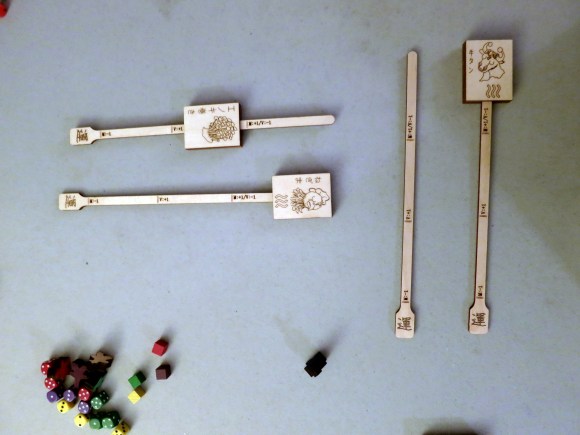
The skewers are both a fun thematic component and a clever mechanic. Raw food starts on the lowest section of the skewer, and moves upward as time passes. Which section it is in when a player sells it will determine whether they get a monetary bonus (for perfect doneness) or a penalty (for overcooking vegetables or undercooking meat).

At the end of the game players also receive bonuses for cooking the most of a particular type of food and for groups of diverse types sold (although each food item sold during the game may only be counted once for bonuses).

There are meaningful choices each round, although in the 2 player game certain limitations almost felt too restrictive. It adds strategy but can be a little frustrating and makes the learning curve for playing well steeper than first apparent.

img_4883

This is definitely a game enhanced by the production value and design choices. There’s a wonderful classic quality to a well made wooden game that fits nicely with the theme, and again the way the food tiles interact with the skewers is a unique hook to build gameplay around. The center slots on a couple of the tiles were a bit too tight to properly move along the skewers, but that should fix itself as we play more and seems better than having them too loose.

img_4884

While the game seemed quite accessible, as I mentioned earlier I feel like there’s aspects of the strategy I wasn’t quite getting. This isn’t necessarily bad early on, as it encourages more play to begin to understand certain subtleties beneath the  seemingly straightforward base mechanics. The 2 player game definitely felt a bit cutthroat, where one mistake might put the game out of reach. It seems like this will play much differently with more players, something I look forward to trying in the future.

There’s more to Yakitori that initially meets the eye, and all around it strikes me as a nice package. It’s a game with a unique (yet accessible) theme, good production quality, and interesting gameplay.

Categories
Board Games Reviews

Cooperative Gaming: Fun with a Common Goal

I’m an avid gamer and have played a large variety of board games of different complexities and styles over the years. A particular type that has become more common recently is the cooperative game, where instead of competing against each other players work together to defeat the game itself.

In addition to being a nice change of pace and a fun and exciting genre, co-op games can also be a nice way to introduce new gamers to the hobby, as working with veteran gamers instead of against them can be less intimidating. I’ll include notes on how new gamer friendly each is, but in most cases having at least one experienced gamer playing to learn / explain the rules will be very helpful.

Here’s a sampling of diverse cooperative games that include several of my favorites.


Beyond Baker Street

img_3048

Player count: 2-4

New gamer friendly?: Reasonably, but probably better to start with Hanabi.

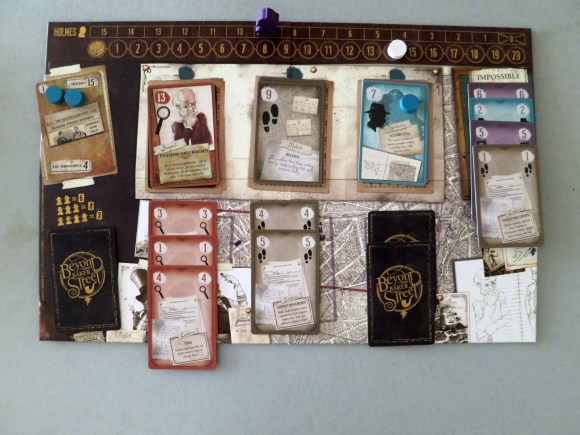
Like Hanabi, Beyond Baker Street is a fun team game in which players can not see their own cards but received limited information from other players about them in order to figure out what to play when. Beyond Baker Street goes a couple steps farther than ordering cards within a color type to having changing total goals as well as a “time limit” of sorts and a general track that has to be exactly maxed out during the coarse of the game.

I enjoy the additional complexities this adds and experienced gamers will be able to jump right in here, but with new gamers I’d again recommend starting with Hanabi. Further thoughts here.


Ghost Stories

img_1115

Player count: 1-4 (I recommend 2+, best with the full 4)

New gamer friendly?: Reasonably

Easily one of my favorite co-op games of all time. Fairly easy to teach but has a lot of variation and depth. Best on its own or with the Ghost Moon expansion  (Black Secret has fallen flat with my group so far). Notorious for its difficulty, but we’ve found it challenging rather than frustrating. The changing board, player powers and enemy cards make every game significantly different, which greatly aids its longevity. I’ve had good reception playing this with both new and experienced gamers.


Mysterium

IMG_4412

Player count: 2-7 (I recommend 4+)

New gamer friendly?: Yes

I love the way Mysterium takes the base concept of Dixit and expands it into not only a fuller game, but also cooperative one. One player is a ghost trying to point “psychics” (the other players) to possible culprits solely through handing out cards with abstract images on them. The multi-round elements where players can get further clues towards each of their personal cards to guess is fun, and taking the competitive aspect out of this type of interpretive exercise is nice.

Have tried this with a mix of veteran and new gamers, and everyone’s had a lot of fun with it (having an experienced gamer around to play the ghost is recommended though). Some aspects of gameplay are lost with less than 4 players, so while it’s playable with 2 or 3 bigger groups are better.

Further thoughts here.


Project Elite

img_3241

Player count: 1-4 (I recommend 2-4)

New gamer friendly?: Reasonably

Project Elite has an aspect that other games on this list do not have: real-time sections. In between periods of common planning and upkeep of the enemy alien pieces, players frantically roll dice during two minute real-time periods during which they attack the aliens and attempt to accomplish their goals. There’s a fairly large learning curve to initally start playing, but once someone’s played once I think it’d be pretty easy to teach. This is frantically fun and having upkeep outside of the real-time play is a wonderful design choice. It feels almost video game like in a great way.

Further thoughts here.


Ravens of Thri Sahshri

img_3049

Player count: 2

New gamer friendly?: No

Ravens of Thri Sahashri is an asymmetrical two player game whose core concept requires both players having firm grasp of rules before play starts. The players are trying to complete certain goals while having completely different personal gameplay mechanics and communicating only through play choices.

Ravens has elements of deduction, press-your-luck card drawing, and color/type matching. There are tons of little rules working in concert, but the game does a lot with them and comes together mechanically and thematically. It takes some time to wrap your brain around, but I adored it once initiated.

Further thoughts here.


Shadows Over Camelot

img_4878

Player count: 3-7

New gamer friendly?: Reasonably

For years this was my go-to cooperative game, and probably my most used to intro new gamers. The presence of different quests to do and a choice of activities is appealing, and the theme classic. It does have significant downtime between turns as the player count gets high, but is still a lot of fun. One barrier to entry here is the possible presence of a hidden traitor, secretly working to help the game defeat the players.  This can be difficult for new gamers as they can’t really ask for help with playing if they end up a traitor. Still, while newer games have replaced this a bit in our group this is  great co-op all around.


T.I.M.E Stories

timestories

Player count: 2-4 (best with 4)

New gamer friendly?: Somewhat

As much an experience as it is a game, T.I.M.E Stories provides a compelling and fun first mission as well as fantastic framework for future expansions/adventures. It’s hard to talk about in detail because of the exploration and story based nature of the game make any specific comments spoiler prone, but T.I.M.E Stories is a fun and immersive adventure that I highly recommend.

Because of that spoiler-ish nature, when starting with the base game mission everyone playing must be new to game. So unlike the other games on this list it’s not possible to have someone who’s previously played the game take part to teach and explain as things go. Experienced gamers don’t necessarily have an advantage here, but they might understand rules quicker

Full review here.


——-

Hope this feature has been useful in shining a light on some gems in the cooperative genre. While these are some of my personal favorites there are many other excellent games of this type to discover.

Categories
Reviews Video Games

Batman: The Telltale Series Episode 1 Review

I’m a lifelong fan of Batman and the mythos surrounding him in various incarnations. I also have enjoyed previous episodic adventure games from Telltale such as The Wolf Among Us and Life is Strange.  As such I’ve been quite excited to check out Telltale’s foray into Gotham City and their exploration of its iconic hero.


batmantelltaleep1


Adventure games of this type are primarily about the story, and Telltale had the proper insight to realize any strong Batman story is at least as much about Bruce Wayne as it is his alter ego. The core plot arises from the Wayne persona, while Batman provides the action. The balance is quite good so far. The themes and certain events are quite dark, but of course a serious take on Batman lends itself to such treatment.

This is set early on in Batman’s career, and the worldbuilding and introduction of their version of familiar characters is well handled. There are several nice cameos and Easter eggs, and the combination of characters used at this point is excellent. I really like one reimagining of classic villain in particular, and there’s a great twist involving another.

The actions sequences seemed a bit different from what I’m used to from Telltale, as the commands I missed didn’t seem to impact the scene at all. Batman still appeared to dodge in the indicated direction even if I missed the input. I could be wrong, or the inputs in this game might just determine a failure of scene if enough are failed. Can’t say at this point.

The conversation parts were the expected solid stuff from Telltale. The choices have small effects so far, but they are there and appreciated. The staying silent option continues to add nice layer to conversation choices. It’s simple but important.

A third part of this game involves investigation of a crime scene. These aspects are interesting and have a lot of potential.

Overall I found this to be a strong start to what will hopefully be a captivating ride. There’s a nice mystery at the center and this episode ended with a big hook for future episodes.

The environment is fantastic. It captures the feel of the locales perfectly, including a boarding school, associated dorms, a run down house, etc. I found myself stopping to look at all the posters and flyers as much out of curiosity as to find clues. There’s a significant amount of little things to poke around.

Some players will find it on the short side, but it had good progression and found a decent stopping point, and is after all just episode 1. I enjoyed this and will definitely be checking out further chapters.

Categories
Wrestling

The Future is Now 4

In addition to excellent matches and an incredible number of highly talented wrestlers, I love watching independent wrestling to see people develop and grow and get a glimpse of tomorrow’s stars today. I’ve previously featured Timothy Thatcher, Dalton Castle, and Nicole Savoy in my first The Future is Now blog, Su Yung, Leah Vaughn (then Leah von Dutch) and Takumi Iroha in my second, and Courtney Rush, Matt Riddle, Shayna Baszler, and Rhia O’Reilly in my third.

This time I’m going to narrow the focus a bit, doing a feature on some of the young Joshi stars that made huge impressions on me during my trip to Japan at the beginning of this year.

Professional wrestlers can start (much) younger in Japan than the US, leading to some interesting situations with standout young talent already being established and accomplished veterans while still in their teens, in addition to young rookie talent getting an early chance to develop into fully rounded performers. All of the wrestlers in this column are 20 years old or younger.

This column is long overdue and in some ways outdated, but I decided it’s still worth it to share my impressions as they were when I saw these athletes live. I’ve added some further context where needed, but for the most part the following information and opinions are rooted in the beginning of 2016.

Kyuri

IMG_7288

It’s easy to tell that the (seemingly) diminutive Kyuri already has an extensive understanding of her craft. She’s an amazingly smooth, masterful submission wrestler who always seems the equal to her often larger and more experienced opponents. Even in her frilly, bright green gear (that reminds my niece of Tinkerbell) Kyuri conveys a sense of being a competent threat to her opponents in a way beyond several wrestlers I’ve seen with far more time in the business.  If she continues to acclimate and excel as much as she has so far in her 3 years in wrestling, this 18 year old is easily going to be a huge star by her mid-twenties despite her size. An ICE Cross Infinity Championship reign for her sooner rather than later would be entirely justified.

Yuuka

IMG_5786_trim

Yuuka is another young star whose instincts far outshone her 2 years of experience and 17 years of age. She carried herself in a way that made an immediate impact, including a ring style that showcased hard strikes and fierce determination in a thoroughly compelling manner.

Unfortunately Yuuka has spent the latter half of this year on hiatus for undisclosed reasons. But is still listed as part of the Ice Ribbon roster on their webpage, so here’s hoping she will return at some point. Of the wrestlers I was previously unfamiliar with she left perhaps the greatest impression, and she certainly has the potential for a big career ahead of her if she continues.

Kotori

IMG_7040

Kotori is a 18 year old wrestler based in the Gatoh Move promotion who has an exuberance and enthusiasm to her wrestling that’s downright contagious. She’s a captivating performer and more than held her own in all the matches I saw, usually against opponents with a great deal more experience. Her unique charisma and already well honed skills and instincts will certainly only continue to develop and expand as her career goes on beyond its current 3 years.

Riho

img_4893

I’d like to finish this feature talking about two wrestlers who are on the other end of what I mentioned in the opening than those discussed so far. In contrast to showing poise and skill beyond their experience, these wrestlers already HAVE an incredible amount of experience at an extremely young age.

First is Riho, who like Kotori currently works for the Gatoh Move promotion. She began wrestling an the age of 9 and thus has an astonishing 10+ years in the business at only 19. A natural, likable underdog, Riho effortlessly rallies the crowd behind her with a bright personality and expert timing and execution in her wrestling. She is so masterful at her role I actually get the impression branching out a bit in terms of style and opponents would be good for her, as she comes across as someone who has all the tools to succeed at anything she wanted to.

Tsukushi

IMG_5950

Finally we have Tsukushi , another example of the unique situations in which a very young wrestler can already be a long established veteran. At 19 years old she’s already been wrestling for over 6 years, and it shows in her instincts, polish, and overall performance.

Tsukushi’s extremely smooth in the ring and knows how to make her offense look believable, even though she’s usually smaller than her opponents (often quite significantly). Her ring style is generally strike and high-flying based, so she approaches the size disadvantage in a distinctly different way than what I mentioned about Kyuri. She comes across as a threat even when at first glance it seems she should be horribly outmatched, which is both a result of and a testament to her experience and devotion to her craft.

She’s always a stone’s throw from Ice Ribbon’s main title and is an invaluable utility player that can help the less experienced wrestlers, elevate others into title contention, or challenge the reigning champion herself to establish their worthiness. Tsukasa Fujimoto is the ace of Ice Ribbon, but Tsukushi is just as important to the promotion at present. And given her age they could build the promotion around her (and others mentioned here) for a long time to come.

Honorable mentions: 

Narrowing this list was tough, as I saw numerous young talents with bright futures.

Maruko Nagasaki might have been the most surprisingly impressive wrestler I saw relative to her experience. She was clearly still “earning her stripes” so to speak, but was solid in the ring and held up her end of matches so well I was shocked to learn she had debuted only 3 months prior to my seeing her wrestle. Also, Kurumi was recovering from injury during my trip, so I haven’t seen her wrestle yet. From what I understand if I had she would have been a certain inclusion in this list.

There are some excellent young wrestlers outside of my favorite promotions that I didn’t get to see as much of as I would have liked, so hopefully my path will cross more with wrestlers such as Sareee, Meiko Tanaka, etc going forward.

——-

That all for now. Hope I’ve brought a new wrestler or two to attention, and everyone mentioned is well worth checking out.

Categories
Board Games Reviews

Deception: Murder in Hong Kong Board Game First Impressions

In the wake of a murder investigators are on the scene and their forensic scientist knows who did it and how. However the murderer is secretly among their ranks and will try to distort the evidence and distract the rest of the group away from the true explanation.


deception


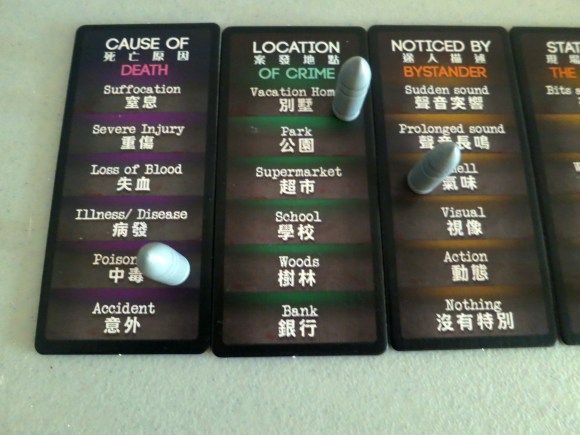
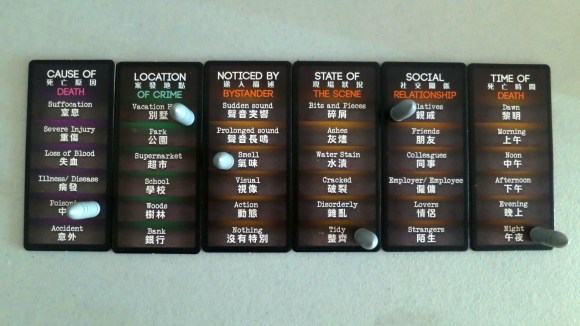
Deception is an asymmetric game where one player is a “forensic scientist” who knows the truth behind a committed crime and is trying to direct the rest of the players (investigators) to the proper means and a particular clue by conveying details about the crime scene. The twist is that one of the investigators is the murderer, and is trying to misdirect everyone else.


img_4863


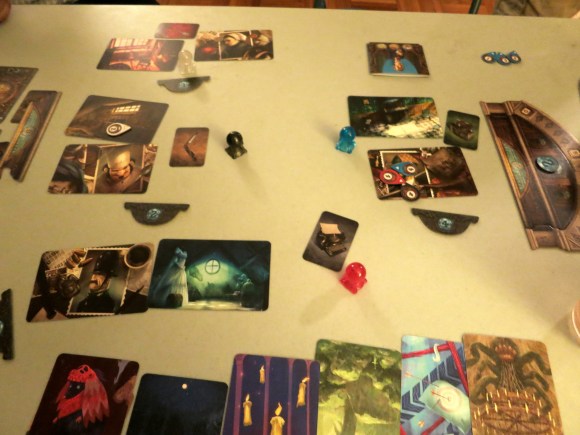
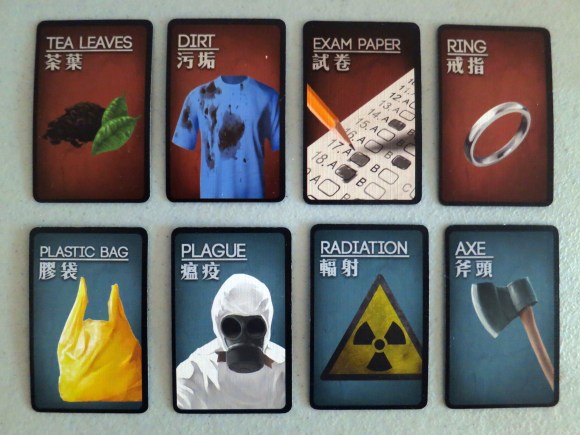
The general idea of the game is similar to Werewolf/Mafia, but getting actual concrete information from the gamemaster (Forensic Scientist) to discuss and interpret makes a huge difference and turns this into a more structured and cerebral game. Each player has four “clue” cards and four “means” cards in front of them. One of each in front of the murderer define the solution the players are trying to figure out. The Forensic Scientist knows the solution and provides information only through indicating which options on descriptive “scene tiles” best match their idea of the crime.

So there is still a social discussion and bluffing aspect, but having a starting point for discussions and a goal beyond just identifying the murderer elevates this greatly over it’s (admittedly fun) inspiration games. It also seems to play quicker overall than such games, which is another nice bonus.


img_4862


I’ve also seen some comparisons of this to Mysterium. There are some general similarities in base mechanics relating to having an asymmetric role of information distribution, but otherwise this really is a much different game. The biggest contrast (in addition to linguistic clues vs Mysterium’s Dixit style card matching) is Mysterium is purely cooperative while Deception is a hidden role game with an antagonist(s) among the players with a subversive goal. I understand the parallels, but the two games don’t feel that similar to me. I enjoyed both in different ways and see value in having both games on hand for different moods and groups.


img_4865


There’s good variety in the clue and means cards and the evidence tiles, which will provide excellent replayability. Since this was our first couple of games we played without the accomplice and witness roles, and without event tiles. They all seem like they’ll add even further depth to an already compelling game.

Overall this is an excellent entry into the social deduction genre and I’m excited about getting to play it more in the future.

Categories
Board Games Reviews

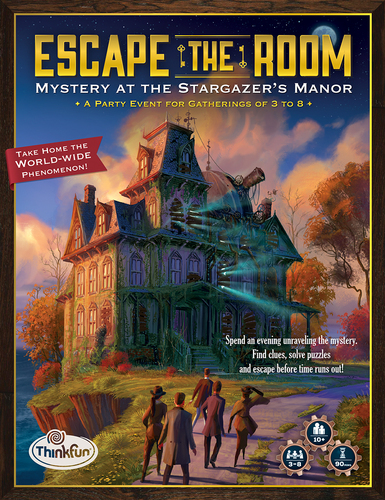
Escape the Room: Mystery at the Stargazer’s Manor Board Game Review

I adore the Escape Game phenomenon, and was excited to try out this board game attempt to capture the same type of feeling and fun. Here’s a SPOILER FREE look at ThinkFun’s home version.

stargazer

Basic Gameplay:

There is a brief instruction manual that introduces the concept of the game and sets the stage, but really everything the players need to know is explained on the various pieces that will be part of the game. At the beginning the players are presented with five sealed envelopes depicting various areas of the Manor and the first Scene Card. The card sets up the story context for the game and walks the players through how the solution wheel works in a nice little intro.  It then points players to the first envelope to begin the game proper.

The solution wheel is particularly well done. Solutions to each puzzle / envelope are indicated by paired colors and symbols, and if correctly entered into the wheel a symbol matching the current puzzle will be shown in two places on the wheel, indicating that envelope should then be opened.

General Thoughts:

Stargazer’s Manor is well designed and produced, and reasonably thematic. The puzzles make sense and are pretty well held together with the story framing. The quality of components is high, particularly at the price point. A good job was done overall evoking a location and providing some hands on puzzling without getting crazy in the cost department, but there is of course a visceral feeling to the exploration of an Escape Room that can’t be captured in a primarily 2d game.

The box says it accommodates 3-8 players, and given this type of game can only be played with a given group once we went with the maximum to get as many people involved as possible.

It may have been because all but one of us have previously played an actual Escape Room and were experienced puzzlers, but we didn’t need nearly that many people and it was tough keeping everyone involved since it’s mostly a “one puzzle at a time” experience. Four of us would have been plenty, and that’s the number my intuition recommends trying this with.

We found the puzzles on the easy side, but still had fun and again it might have been because of our experience level. The game tends to point you rather directly at the next thing to solve, which is a bit of unnecessary handholding given how few things there are to choose between.

Outside of possible tape damage to some paper pieces if you aren’t careful when opening things, none of the components are permanently marked while playing. Combined with instructions on the website on how to put everything back in the proper envelopes when finished, the game can be packed back up afterwards and given to a new group to try. Nice touch by ThinkFun.

Summary

So in conclusion while Escape the Room: Mystery at The Stargazer’s Manor is not quite equal to its inspirational namesake and tends to the easy side, it’s still a fun experience well worth trying out. ThinkFun has another out already (Secret of Dr. Gravely’s Retreat) which I’ll definitely try sometime.

Categories
Board Games Reviews

Quick Thoughts: Abraca…what? and Sushi Go!

It’s sometimes hard to find games that are younger player friendly and yet offer something for older / more experienced gamers. Here’s a brief look at two such games I tried recently that take one great concept each from more complex games and build introductory level experiences from there.


Abraca…what?

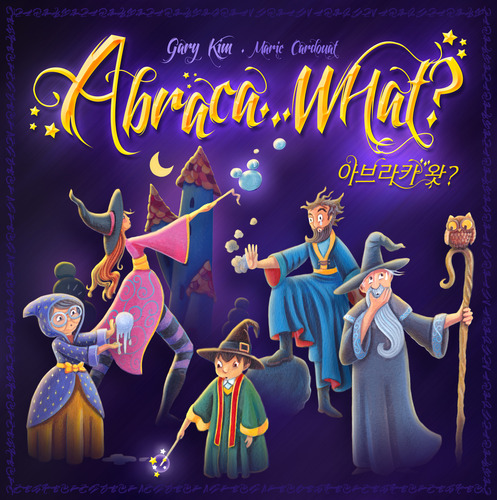
abra

The cartoonish characters and silly name had me expecting a much lighter game than Abraca…what? turned out to be. Players have a “hand” of five spellstones in front of them that they can’t see the values of, but that are visible to all other players. This recalls games like Hanabi or Beyond Baker Street, but here instead of a cooperative exchange of information towards a common goal players try to use what they see to “cast” (play) their own spells, often to the detriment of other players. Each spell has an associated value, and the value is the same as the number of that spell that exists among all the spellstones in the game (so for example, there are 5 total copies of spell #5). Having a few hidden spellstones each round adds an appropriate amount of luck, but there’s a solid deductive core in this game and it was fun to play with my niece and nephew and see them start to put it all together as the game went on.

Given the humorous player artwork and title I would have liked to see similarly silly spell names (and perhaps effects) instead of things like “fireball,” etc, but it’s a small criticism. Would be a reasonable light-gateway game to have on hand for new gamers of nearly any age.


Sushi Go!

sushigo

Next up is a game with perhaps even more universal appeal than Abraca-what? in Sushi-Go! Trimming away everything from games like 7 Wonders except the card drafting, Sushi Go! simply adds a well implemented set gathering goal to create a easy to learn, quick playing card game with nice balance and (light) strategic choices.

The artwork is cute and the sushi theme has just a bit of context that aligns with the desired pairings of different card types. There is enough variation to have the hands feel and play out differently from round to round, and the core mechanic of “take a card, pass your hand, then repeat” is wonderfully simple. Strikes me as a great game to have on hand for quick plays in between diving into heavier fare. Also, this is again a game that introduces a concept prominent in more complex games is an extremely straightforward manner.


——-

That’s all for now. Hope to be back with more soon. 🙂

Categories
Comics Film Reviews

Doctor Strange Review

“We never lose our demons, we only learn to live above them.

drstrange

Doctor Strange is perhaps the hardest Marvel Comics hero they’ve tried to adapt so far, yet the casting of Benedict Cumberbatch (and several excellent supporting actors) had expectations fairly high for the latest puzzle piece in the unfolding Marvel Cinematic Universe. I was extremely curious as to how the mythical elements and certain parts of the mythos would be handled, and for most part really liked what they came up with.

Being both a Marvel movie and the origin of a new hero to the MCU, there are formulaic and cliched elements to Stephen Strange’s introduction. Also, some of the supporting actors are considerably better than what they were given to work with.

That said, everything did come together extremely well due to nice touches of foreshadowing here and there and a couple of strong twists. Strange himself, the Ancient One, and Mordo were given nice complexities and reasonable depth, and were all superbly acted. The special effects were brilliant and really anchored the idea of magic in the MCU along with of course providing the expected spectacles and chaotic actions sequences. The climactic battle is stunning, clever, and totally in character, which is everything I could have asked of it.

There are little things in Doctor Strange that could have been done to elevate it even farther, but by the same token there are numerous little things that WERE done that add up to make the Sorcerer Supreme’s screen debut a thoroughly enjoyable endeavor.


Categories
Reviews Wrestling

NXT Takeover Toronto IPPV Live Thoughts

November 19, 2016 in Toronto, Canada

Lot of anticipation going into this one, with DIY’s last shot at the Rivial and the NXT Tag Team Championships, Mickie James’ return to WWE to face Asuka for the NXT Women’s Championship, and a huge rematch between Samoa Joe and Shinsuke Nakamura for the NXT Championship.

tyebobby

Bobby Roode continues to get amazing entrances (that aren’t exactly discouraging the crowd from cheering him, at least on the way to the ring) and a here a full choir sings along with his theme (and the crowd) live. Once the song ends about half the crowd remembers he’s a heel and is firmly behind “The Perfect 10” Tye Dillinger as he comes out for his grudge match with Roode.

Crowd’s certainly hot, as Tye and Bobby get an “this is awesome” chant for their opening staredown. Roode circles Dillinger as the latter just stares a hole through the Glorious one. Finally Roode approaches and Dillinger unloads on him, getting the better of an exchange of punches and taking things outside the ring. Tye showing an appropriate edge here given the story and totally controls the match in the early going.

Roode eventually takes advantage of Tye’s aggressiveness and catches him charging with a backdrop to the outside, and then just grinds at him for a while. Towards the end they go back and forth until Roode decides to mock his opponent too much (like a good heel) leading to a surge for Dillinger. Lots of teases of a Tye victory – ref catching Roode’s feet on the ropes during a pin, Tye with a superkick, finisher teases, a Sharpshooter spot, small package exchange, etc.

Solid win for Bobby after sending Tye into a ringpost and then hitting an implant DDT (nice change from pump handle slam – still no nonsense finisher & appropriate for heel, but has more oomph).

This went much longer than I expected, to good effect. It dragged only a little during Bobby’s initial heat segment, and overall was a great opener and elevated Tye to where he looked like he was on Bobby’s level even in defeat.


In the finals of the Dusty Rhodes Tag Team Classic Tournament, TM61 (Shane Thorne & Nick Miller)faced The Authors of Pain (Akam & Rezar). The old school stipulation of having AoP’s manager suspended in a cage above the ring is mixed with a strange supporting scaffolding in one corner of the ring (which has already been revealed as a new toy inspiration). The scaffolding seemed to be there primarily for someone to dive off of, and sure enough TM61 made use of it for that purpose.

Both teams tried and there were some nice moments, like TM61’s dual headscissors counter out of AoP’s double powerbomb, but these were two of the more bland teams in the tournament and the crowd was tepid for this outside of the big spots. I wonder if the ending was botched. The heels tried to cheat in the classic, expected fashion given the stip (with Elering dropping a chain to help them from the very cage meant to prevent his interference), but the chain went flying into crowd on the first attempted hit. It looked like it might have been planned, but if so it was an unnecessary and pointless swerve with the heels winning cleanly with their finish moments later.

The AoP victory was unsurprising, but did make me second guess my expectation of DIY losing and imploding during the tag title match.

diyrevival

Speaking of which, next we would find out if DIY (Johnny Gargano & Tomaso Ciampa) finally unseat The Revival (Dash Wilder and Scott Dawson) for the NXT Tag Team Championships in a 2 out of 3 falls match or if they’d come up short leading to Ciampa going nuts and turning on Gargano in emphatic fashion.

Nice showcase here for DIY in the early going, until Revival cheats for the advantage. Classic formulas are classic for a reason. Speaking of classic formulas, the heels get the first fall with their finisher (Shatter Machine in a beautiful reversal of Gargano’s slingshot spear) to put faces behind the 8-ball.

During the second fall Johnny and the Revival just played the crowd like a fiddle building up to a false tag that had the arena ready to riot.  Later a smooth back and forth sequence lead to a Heart Attack and a believable “Revival could sweep” moment.

After Ciampa finally got the hot tag he fought the Revival off by himself for an extended time, further teasing a possible DIY loss at the end with him blaming Gargano. Eventually DIY hit their double strike combo to even things up.

The third fall was just a non-stop parade of believable false finishes and callbacks to the two teams’ previous encounter. The excellent work from all four throughout the match combined with a few totally plausible reasons for the match going either way led to a dramatic finish with the crowd ERUPTING for DIY’s win. Two of the best teams in the business putting on an instant classic. Seek this one out right away.


asukamickie

Asuka’s a favorite of mine and after seeing Mickie James wrestle in Shimmer the previous weekend I was quite excited to see how her return against NXT’s wrecking ball for the NXT Women’s Title would turn out.

During the introductions Mickie did a good job of selling confidence mixed with caution in her expressions. The pace built nicely, with some mind games and Mickie actually putting Asuka on the defensive a bit in the early going. James’ matches at Shimmer certainly helped her eliminate any potential ring rust issues. There were some great exchanges of both holds and explosive strikes early on, a great choice to help re-engage the crowd after the roller coaster ride of the Tag Title match.

It felt more even than I expected to start, which I thought was a good way to portray James as a legitimate threat before Asuka destroyed her. The longer the match went however, it became more and more clear Mickie was being shown as Asuka’s equal and challenging her in ways the Empress of Tomorrow hadn’t been during her time in NXT.

Both wrestlers are extremely charismatic and the match was structured to play to Mickie’s strengths. They kept this reasonably brisk and exciting, and after Mickie having Asuka on the ropes a few times and having unexpected answers to a lot of the champ’s offense, Asuka persevered in fighting for the Asukalock and forcing Mickie to tap.

Asuka’s building delight in dominating opponents is a nice direction to allow her to take the character. She’s always at her best when allowing almost heelish, bullying mannerisms into her ringwork. The taunting refusal of Mickie’s handshake offer after the match not only continues in that vein nicely, but also gives Mickie a storyline reason of disrespect to stick around if that’s what she decides to do.

 

nakamurajoe


Several live violins for NXT Champion Shinsuke Nakamura’s entrance for his defense against Samoa Joe, which was awesome. This was built as a bitter grudge match, and both combatants sold it perfectly. Each brought great intensity during the staredown, and really conveyed the idea that they just wanted to get their hands on each other.

Joe was unexpectedly dominant early on, and I adored the psychology of him going after Nakamura’s knee. They really laid into each other as things built up throughout the match. Great match for Joe to pull out the tope, and on the other side of things seeing someone give Joe a German is always amazing. The STRAIGHTJACKET GERMAN made me pop big time, although I do question Joe starting to make regular use of it now considering Akira Tozawa’s in talks and it’s his centerpiece finisher.

Joe’s cheapshot low blow and subsequent Muscle Buster to retake the title just STUNNED the crowd. No one was really expecting the invasion of 50-50 booking here, but it does make a certain amount of sense in that Nakamura’s first loss is now out of the way, meaning they aren’t telling the same undefeated champion story with both him and Asuka, and it seems they’re setting up for a big win and retaking of the title for him in Japan.


Overall

Great show, with everything really being exceptional outside the tourney finals, and a tag title match that could be a match of the year contender.